moneysherpa

Author: Brendan Nordon

  • Should I make AVC Pension Contributions Ireland? How do returns compare?

    Should I make AVC Pension Contributions Ireland? How do returns compare?

    AVC Pension Contributions

    With lockdowns limiting options for spending last year, legions of ‘accidental savers’ were created across the country. This has opened up the opportunity for many to make AVC pension contributions in Ireland.

    Saving deposits nationally reached a record €126 Billion, up by €15 Billion. With 44% of people saving over €5,600 in that period.

    All this means while the pandemic brought financial hardship to some, others have found themselves with an unexpected savings nest egg. 

    1. Need for returns – AVC Pension Contributions Ireland
    2. We have lift off – AVC Pension Contributions Ireland
    3. Sound too good to be true? – AVC Pension Contributions Ireland
    4. Pensions unpacked – AVC Pension Contributions Ireland
    5. What does that mean for you? – AVC Pension Contributions Ireland
    6. What’s next? – AVC Pension Contributions Ireland

    So if you need the lowdown on how increasing your AVC pension contributions compares to other investment options you have come to the right place!

    Need for returns – AVC Pension Contributions Ireland

    With banks looking to start charging savers to keep their money in the bank and inflation on the horizon, many Irish savers are looking for ways to protect and grow that nest egg.

    Savers across Ireland have ploughed money into the old favourite residential property. This rush coupled with limited supply has pushed property rents and prices higher, up 3.7% this year. The new favourite seems to be crypto currencies, with Irish savers investing 92% more than savers in Britain, France and Spain.

    Putting all your eggs into one basket is never wise, but especially when your basket swings wildly back and forth. Both property and crypto currencies are famously volatile. Even these risky options might not yield the mega returns investors are seeking as the revenue will take between 33% and 41% of your returns in tax.

    The magic of investing is in the mathematical process of compounding. When applied to returns, 20% growth per year = doubling your money every 4 years.  

    Albert Einstein is reported to have said “The most powerful force in the universe is compound interest”.

    Business Insider

    Tax though acts like a handbrake on returns, slowing speed your savings take off. So what to do?

    We have lift off – AVC Pension Contributions Ireland

    What if I was to tell you that there is an investing vehicle that is fully regulated, 100% tax free and has delivered returns of 8.24% per year on average for the last 36 years.

    Turning a €10,000 of savings into €60,000 of savings in that time.  Even better, what if I was to tell you in many cases your employer will double your money turning your savings into €120,000.

    Sound too good to be true? – AVC Pension Contributions Ireland

    Well it’s not, because what I’ve just described is called a pension. Stay with me here, the humble pension is the most under appreciated investment opportunity ever. Getting a private pension or increasing your AVC pension contributions is the best way to maximise that opportunity.

    It’s secret sauce is that because it’s sheltered from tax it can unleash the full force of compound interest, growing your wealth exponentially. It’s also not as complex as some like to make out.

    Pensions unpacked – AVC Pension Contributions Ireland

    As long as you are ok to commit your savings and returns until a certain age, which can be as early as 50 in some cases, the tax man will let you have 100% of the returns. That’s all a pension is, a committed tax free savings pot [1].

    If you start up a private pension, you are creating your own private tax shelter, when you look at it like that why wouldn’t you maximise your AVC pension contributions?

    What you invest in that savings pot: cash, gold, shares, property, crypto etc.. is entirely up to you, as is the level of risk.

    What does that mean for you? – AVC Pension Contributions Ireland

    If you have any savings, seriously consider starting a private pension, or if you have a pension through work increase your AVC pension contributions. There is a real opportunity for some coming out of lockdown to secure their financial future.

    The good news is you don’t have to do all the financial planning yourself, initial financial advice from a financial advisor is usually free according to Brendan Nordon of DFP Pension & Investments.

    “Getting financially fit is really important and now is a great opportunity to put yourself on the right path. We can help advise on what option is the right one for you.”

    Brendan Nordon DFP Pensions & Investments


    If you are one of the 44% of Irish people to have put extra money by during lockdown, don’t waste it. Talk to a financial advisor and they will help get you started today.

    What’s next? – AVC Pension Contributions Ireland

    If you want to know more about our saving and financial planning you can read our guides here.

    If you want to talk to a financial advisor about your pensions check out our recommended financial advisors here.

    If you want to know about transferring your defined benefit pension to a defined contribution pension you can check out Brendan’s article on the subject here.


  • Expert private pension advice Ireland: Should I transfer my Defined Benefit pension to a Defined Contribution pension?

    Expert private pension advice Ireland: Should I transfer my Defined Benefit pension to a Defined Contribution pension?

    private pension advice

    If you have a Defined Benefit (DB) Pension then you might have been offered the option to transfer this into the more common type of pension (Defined Contribution). This is called a Defined Benefit transfer. This is a big decision and an irreversible one, so it’s important to understand exactly what this means, and what the pros and cons might be.

    As a qualified actuary and someone who has been providing Irish private pension advice to clients in Ireland for over a decade I can help steer you in the right direction.

    In this article we will explain some of the key details, explain why this transfer is more attractive than ever and also explain the downsides to consider. If after reading you have an interest in exploring a transfer further I’ll point you in the right direction.

    What is a Final Salary/Defined Benefit Scheme, Irish private pension advice?

    What are the Key Benefits of a DB pension, Irish private pension advice?

    What are the key Drawbacks of a Defined Benefit pension, Irish private pension advice?

    What is a Transfer Value?

    How are transfer values calculated, Irish private pension advice?

    Why are current Transfer Values at record highs, Irish private pension advice?

    How long will Transfer Values be at this rate, Irish private pension advice?

    What are the key things I need to consider before transferring my Defined Benefit pension?

    Transferring in a nutshell Irish private pension advice

    I may be interested, where can I get further Irish private pension advice?

    What is a Final Salary/Defined Benefit Irish private pension scheme? Advice

    A defined benefit or DB Pension (also known as final salary pension) is a type of workplace pension. Instead of building up a pension pot over time, it provides you with a guaranteed annual income for life, based on your final or average salary.

    DB pensions are most often provided by the public sector and government employers. Some private sector employers do still offer them yet many the private sector schemes have ceased accruing benefits for future service. A DB Pension is sometimes seen as the most attractive pension arrangement for employees. Read on for Irish private pension advice on the pro’s and con’s of transfers.

    What are the Key Benefits of a DB Irish private pension? Advice

    DB pensions are often seen as more generous, because it would take an above average defined contribution (DC) pot to be able to pay the same regular amount.

    What’s more, the payouts from a DB pension is guaranteed for the rest of your life. So long as the pension scheme remains funded, your pension income is paid no matter how long you live. There is also a spouses pension in the event of death.

    What are the key Drawbacks of a Defined Benefit Irish private pension? Advice

    Despite the attractions of a DB pension, in some ways it is not as flexible as a DC pension pot. You can’t vary the income you take from it, or draw out larger lump sums (with some exceptions).

    The DB pension can’t be inherited by your beneficiaries. If you die prematurely, there will be a widow’s/widower’s pension for your spouse, but most of the benefits will be lost, and nothing passes to your estate.

    Also, there is also a risk that your pension scheme may collapse at some future point, if it is no longer adequately funded (e.g. employer becomes insolvent).

    What is a Transfer Value for an Irish private pension? Advice

    You can ‘trade in’ a DB pension for a fixed-size pot of the kind found in defined contribution (DC) pension schemes. That ‘transfer value’ is calculated to estimate the monetary amount needed to provide the same guaranteed income, based on current market conditions.

    Taking a transfer value involves giving up the certainty of income for life to directly take control of the investment behind the defined benefit pension. You would then use the fund under a defined contribution arrangement to provide an income over the course of retirement.

    The transfer option offers greater flexibility on how you take your benefits at the expense of certainty.

    There are significant risks, in particular, investment risk with taking the transfer value and professional advice should be sought before making this decision. 

    The key risks in transferring to a DC pension are:

    · The value is subject to investment performance, so there is risk of capital loss

    · The investment performance is worse than anticipated the value might not be enough to meet your needs.

    · If you live longer than you provided for.

    How are transfer values calculated for an Irish private pension? Advice

    The transfer value’s being offered are based on the yield on long-term government bonds. These bond yields have fallen in recent times. This has resulted in a significant increase in the transfer value being offered to pension members. 

    That’s why members of existing defined benefit pensions now need to reassess whether transferring the DB pension, that was once seen as untouchable, is now a realistic option.

    Why are current Transfer Values at record highs for Irish private pensions?

    The defined benefit transfer value is calculated under guidance from Pensions Authority and Society of Actuaries in Ireland. A factor called the Market Value Adjustment (MVA) is used to reflect economic conditions at the time of calculation.

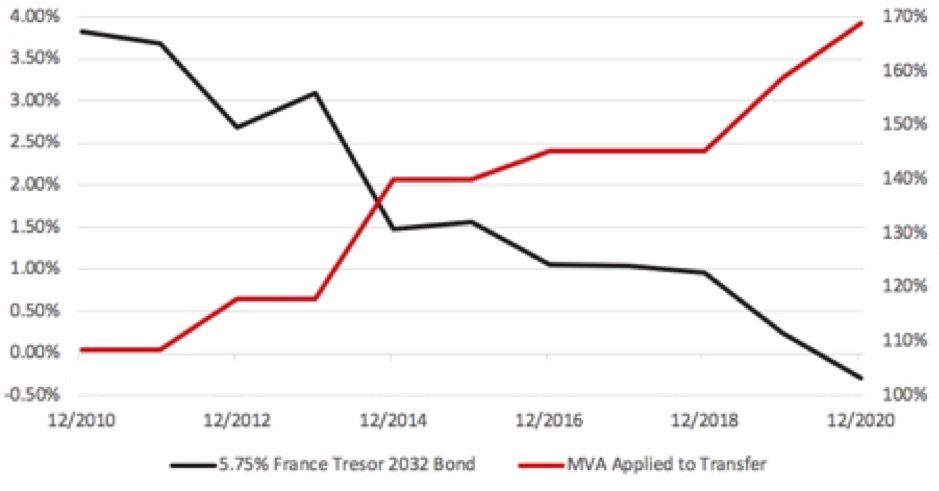
    The MVA is calculated based on an agreed measure of long -term government bond yields. The graphic below shows how this yield has changed over the past 10 years and how the MVA adjusts for it. 

    The table shows that as the yields fell from 3.83% in December 2010 to -0.29% in December 2020. This has resulted in an increase in the MVA over the same period from 109% to 169% (up 56%).

    pension transfer

    Source: Society of Actuaries – MVA Factor. Data from 31st October 2010 to 31st October 2020

    How long will Transfer Values be at this rate for Irish private pensions? Advice

    Negative yielding government debt now amounts to a record E17.2trn, the vast majority of which in the Eurozone bond markets. 

    This is driven by the ECB rate policy and Quantitative Easing (QE), which involves Central Banks increasing the money supply. The thinking behind these policies is to stimulate the european economy.  

    With QE measures in place and forward guidance implying no change in interest rates for the next 3 years, it is clear that bond yields will remain ‘captive’ to these extraordinarily low levels for some time to come.

    What are the key things I need to consider before transferring my Defined Benefit pension? Advice

    As well as the transfer value on offer, these are the other things you need to consider: 

    · Does the flexibility of the transfer value meet your requirements in retirement?

    · Do I want to manage my own wealth and the investment risk that this incurs?

    · Do you want to pass on your wealth to your kids?

    · How secure is your current Defined Benefit scheme?

    · How does the decision fit in with your other non pension assets and income?

    Transferring in a nutshell, Irish private pension advice

    Transfer values are at record highs due to market conditions, even if it didn’t make sense to transfer before it may do now.

    Defined benefit pensions have a number of major advantages, mainly that the benefits are in theory guaranteed, but that’s not always the case.

    Defined contribution pensions are generally more flexible in how you can take your benefits, but offer no guarantees on return.

    Now that transfer values are relatively high the decision around transferring centres on the priority of flexibility versus certainty for your individual circumstances. That’s why it makes sense to get Irish private pension advice if your are considering a transfer.

    I may be interested, where can I get further Irish private pension advice?

    You should take independent qualified financial advice before deciding to transfer. This advice is usually free. If after taking advice you decide to transfer Irish private pension advisors typically receive a commission from your new pension provider.  

    You can check out our recommended list of Irish private pension advisors in your area here. The list only includes fully qualified financial advisors regulated by the Central Bank of Ireland.