moneysherpa

Category: Investing

Want to make the most of your money? We will give you the inside track with our investing guides across all major asset classes. Shares, bonds, property and more.

  • Bank Crisis – What Does It Mean For You Ireland 2023

    Bank Crisis – What Does It Mean For You Ireland 2023

    As rising interest rates turn up the pressure on the whole financial system, a few things have started to go pop. The big question is whether this is just the system blowing off steam or whether the whole thing is about to go kaboom.

    The two things that went pop recently were Silicon Valley Bank in the US and Credit Suisse here in Europe. 

    Who are Silicon Valley Bank (SVB)? Ireland 2023

    SVB is considered a medium sized regional bank in the US, but that doesn’t mean it’s small. At €250Bn in assets SVB was over twice the size of the biggest bank in Ireland, Bank of Ireland.

    Compared to the major US banks though it’s only a toy, so it’s meant to be no great shakes if banks like this get into trouble.

    In fact that’s why the bank successfully lobbied the Trump administration to remove regulations intended to limit the fall out from a bank blow out. SVB management and a number of other regional US banks argued that banks under €250Bn weren’t ‘systemic risks’ to the banking system, so didn’t need the extra red tape.

    Yet, when things went off the rails for SVB the US Government decided it did in fact need to intervene, as the bank going under could put the wider financial system at risk. 

    What happened with Silicon Valley Bank (SVB)? Ireland 2023

    SVB had grown rapidly over the last decade or so, by attracting the great and the good of the tech sector to bank with them. As the companies in Silicon Valley grew so did SVB.

    The wheels started to come off though precisely, because SVB was so successful in tech. As interest rates started to escalate tech companies found themselves struggling to get new funding. As a result they started to eat into the cash they all had stashed in SVB.

    SVB had invested that cash in long term bonds, which is a good bet if you hold them to maturity as they have a guaranteed return. However, with bank deposits dwindling the banks treasury now needed to sell the bonds to raise enough cash to pay back their depositors.

    The problem though was that rising interest rates also mean rock bottom bond prices, so when SVB sold their recorded asset value plummeted overnight.

    The big write down of assets spooked the cash strapped depositors who all of a sudden realised their hard won funding might be about to go up in smoke, causing them to pull all their money from the bank. Cue mass panic.

    What’s the story with Credit Suisse? Ireland 2023

    Credit suisse is the same, but different. They are even bigger than SVB weighing in at over €1 Trillion in assets, but the bank had been rocked by a series of scandals over the last twenty years or so.

    As the markets got increasingly edgy over events in the US it emerged that the Swiss authorities had identified ‘accounting irregularities’ in the banks books. This coupled with the Saudi National Bank, the banks biggest sugar daddy, indicating that it wouldn’t be increasing it’s stake was enough to trigger a collapse in the banks share price and get it snapped up by it’s rival UBS for only €3 Billion.

    What does the bank crisis all mean? Ireland 2023

    Bank runs aren’t new, they are even movie staples, from It’s a Wonderful Life to Mary Poppins. Banks go belly up all the time.

    Banks never have enough deposits to cover loans, that’s just how banking works. As a result they are fragile and completely dependent on the confidence of depositors.

    The issue stalking the world of finance right now is fear and fear is contagious.

    SVB and Credit Suisse were the canaries in the coal mine, indicating that rising interest rates might push the whole financial system over the edge. 

    What everyone is worried about now is that that fear will cause people to pull money and set off a financial death spiral. 

    There is another read on this however, SVB had a uniquely concentrated depositor base in a market that was uniquely deregulated by the Trump administration. Many believe if the Obama era regulation hadn’t been repealed the whole SVB debacle would have been avoided.

    In this reading, Credit Suisse was famous, in fact infamous for its mis management. It was a zombie bank and only took a stiff breeze to blow it over.

    In fact the swift action of governments and regulators, the US government guaranteeing all deposits and the Swiss forcing through the UBS takeover can be seen as evidence that they are in fact ready to do whatever it takes to prop up the banking system. 

    What does the bank crisis mean for me? Ireland 2023

    Although the jury is still out, one thing seems certain. Inflation is going to stick around for a little while longer.

    Inflation is the bogey man that haunts the Central Bankers. If inflation becomes ingrained then investors stop investing and the whole economy grinds to a halt.

    This means Central Bank’s have a tricky path to tread on future interest rate rises, between financial catastrophe on one side and economic collapse on the other. 

    This backdrop is likely to result in a change of prescription for the sick economy, from a short sharp dose of interest rates to a gradual grind of sustained higher rates. Those hoping for a swift return to low interest rates, may have longer to wait than they bargained for.


  • Market Insider – Investing Ireland August 2021

    Market Insider – Investing Ireland August 2021

    Investing in Ireland 2021

    Fiat 50 motors on! – Investing Ireland August 2021

    Last month marked the 50th anniversary of the “Nixon Shock” of August, 1971, whereby the US dollar’s unpegging from its Gold Standard straitjacket served to liberate the fiat currency printing presses of the global financial system in a manner that has fuelled a debt-financed asset-inflation odyssey for three generations of investors.

    Equity markets duly celebrated this landmark anniversary with their 7th consecutive month of gains, that Worry Wall of Delta variant, peak growth (for economies and earnings), inflation risk, Fed taper talk and now Afghanistan still being climbed in resolute fashion by a TINA investment community amply lubricated by the excess liquidity drip-feed of current central bank policy settings.

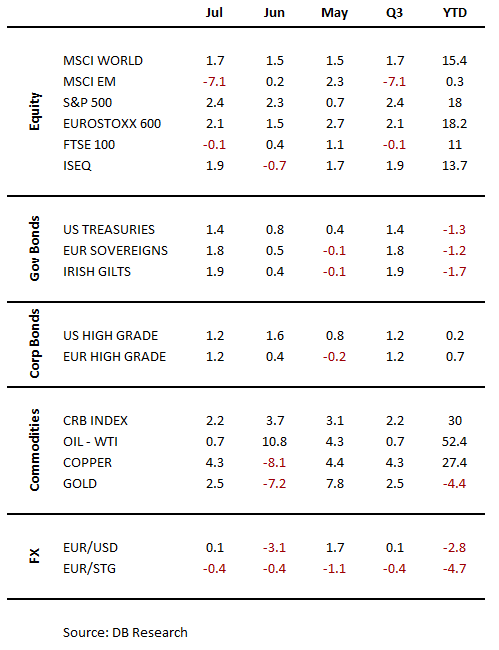
    The MSCI World advanced by a further 2.5% in August, its recovery from the March, 2020 lows now exceeding 100% (dividends included).

    Value indices once again lagged Growth on both sides of the Atlantic, although the gap narrowed from previous months, with financials extending their recovery back towards cycle peaks.

    The S&P500 secured it’s 54th record close ytd above 4,500 by month’s-end, whilst the STOXX 600 enjoyed 10 straight gains, its longest run of consecutive daily advances since 2006. Equity markets were not without their mid-month swoon, however, this a recurring (and perhaps options-expiry related) feature of the past several months.

    Some acute intra-month volatility across bond and commodity complexes also; US real yields rebounded sharply from fresh record lows (-1.22% in 10yr TIPS) as taper talk resurfaced, Gold endured a $115 flash crash to sub-$1700 early-August before recovering above its $1800 pivot point, and Brent crude tested both ends of a $65-75 range-trade as COVID uncertainties abounded.

    By contrast, currency markets were an oasis of calm, with Eur/USD still engaged in a sideways meander above its perceived 1.1600 floor.

    Equities – Investing Ireland August 2021

    Another month of gains for global stock markets, their 7th straight advance, both S&P500 and STOXX 600 indices now reporting total returns of 20%+ on a ytd basis.

    A stellar Q2 corporate earnings season remained the primary impulse, although the Delta variant did impact on sectoral performance, the more defensive Nasdaq (+4.1%) once again showing the way on Wall Street.

    Emerging markets (+2.6%) enjoyed their best performance since January, courtesy of renewed liquidity support from the People’s Bank of China, while the US Senate’s passage of a $550bn bipartisan infrastructure package was a timely reminder that overall policy support for economies and markets is not yet sated, the Fed’s taper talk notwithstanding. 

    Bonds Investing Ireland August 2021

    On the surface, bond markets were becalmed in August, with US Treasuries reporting their smallest move (-0.2%) in either direction for more than a year. However, yields did gyrate materially intra-month, with investors torn between the impact of a globally spreading Delta variant and that potential policy pivot by the major central banks.

    The key 10yr Treasury yield touched a low of 1.13% early in the month, before an avalanche of Fed taper talk forced an abrupt about-turn to a 1.37% high late in the period.

    The sell-off in Treasuries was compounded by renewed weakness in European government bonds, where the region’s highest headline inflation rate (+3.0%) since November, 2011 raised the spectre of a PEPP (asset purchase) dial-back by the ECB. 

    Currencies Investing Ireland August 2021

    A late-Summer lull descended over the foreign exchange markets last month, with relatively modest changes on the major crosses, although the US Dollar Index did manage to eke out a further 0.5% gain, while Sterling lost some ground on both USD and Euro fronts.

    The dominant Eur/USD cross had an interesting month, recovering steadily from 1.1660 lows mid-August to a 1.1810 close. This exchange rate is now tracking relative short-term interest rate movements quite closely, and it has been the firming up of Euribor quotes in the midst of strengthening Euroland data-flow and some quasi-hawkish soundings from certain ECB Governors that is now supporting a revival of investor interest in the single currency.

    Commodities Investing Ireland August 2021

    Although the CRB index flatlined in August following its recent steady gains, the energy components suffered their first decline since March, with both WTI (-7.4%) and Brent crude (-4.4%) selling off on concerns over slowing demand in China and the Delta variant more generally.

    Industrial metals prices were also softer for the same reasons, whilst Gold prices endured a rollercoaster month, rebounding from a $115 flash crash in early-August to close broadly unchanged, that $1800 valuation level still exhibiting a magnetic attraction, be it  from above and below.

    Asset Market Outlook Investing Ireland August 2021

    • Equity markets now entering their seasonally most vulnerable period, with the build-up of more defensive investor positioning signalling correction concerns
    • A mild pullback is certainly overdue although, remarkably, stocks are already cheapening on standard valuation metrics (both absolute and relative to bonds), whilst the degree of overall policy support (monetary and fiscal) remains acute
    • Tentative indications of slowly declining Delta spread following two months of gains harbinger of a “Reopening Trade” revival to favour rotation back to cyclical stocks 
    • Corrective rally in global bond markets has seemingly now run its course, the prospective dial-back of Fed and ECB asset purchases ensuring more adverse supply/demand conditions and a return to higher yields
    • USD rally finally running out of steam on fading relative interest-rate support, with Eur/USD eyeing a key 1.1950 retest, and scope for speculative longs to rebuild after a 3-mth flush-out
    • Gold prices still not straying too far away from their $1800 pivot, with ETF holdings now stabilised and Asian jewellery demand in recovery mode; needs to vault $1830 for breakout

    Asset Allocation Investing Ireland August 2021 Outlook

                                      Equities      Bonds       Credit      Forex/Euro

    US                                         +1              -2              -1                 -1

    Euroland                              +2              -2              -1                 N/A

    UK                                         +2              -2              -1                  0

    Asia                                       +1              -1              -1                 -1

    Code +3/-3 very attractive/ very unattractive

    Financial Market Performance Data Investing Ireland August 2021 Outlook [1]

    AugJulJunQ3YTD
    Equity
    MSCI WORLD2.51.81.54.418.3
    MSCI EM2.6-6.70.2-4.32.9
    S&P 5003.12.42.35.521.6
    EUROSTOXX 6002.22.11.54.320.8
    FTSE 1002.10.10.42.213.2
    ISEQ5.61.9-0.77.620.1
    Gov Bonds
    US TREASURIES-0.21.40.81.2-1.5
    EUR SOVEREIGNS-0.51.80.51.3-1.7
    IRISH GILTS-0.61.90.41.3-2.4
    Corp Bonds
    US HIGH GRADE-0.21.21.61.10.1
    EUR HIGH GRADE0.61.20.4-0.80.3
    Commodities
    CRB INDEX0.12.23.72.330.1
    OIL – WTI-7.40.710.8-6.841.2
    COPPER-2.74.3-8.11.523.9
    GOLD0.12.5-7.22.6-4.5
    FX
    EUR/USD-0.50.1-3.1-0.4-3.3
    EUR/STG0.6-0.4-0.40.2-4.1
    Source: DB Research

    Next steps

    You can read our more investing in Ireland analysis here.

    You can check out our other guides on Investing in Ireland here.

    You can find out where to get individual investing in Ireland and financial advice in your area here.

  • Investments Ireland 2021 – Bonds Update

    Investments Ireland 2021 – Bonds Update

    If you are thinking about Investments Ireland 2021, you may be wondering how suitable bonds are as an asset class right now. Here’s the rundown on the latest trends in the bond market.

    investments ireland 2021

    Traditionally, bonds have always accounted for a significant portion of a well-constructed investment portfolio. This fixed-income asset class provides additional diversification for the more turbulent market conditions when stocks falter.

    Although bonds still warrant a place in a well balanced portfolio, ultra-low interest rates and general investment market conditions require investors to review their bond allocations, and assess whether they should be reduced.

    Read on to find out why.

    Latest bond trends – Investments Ireland 2021

    Inflation and the Yield curve – Investments Ireland 2021

    Effect of bond yields on stock markets – Investments Ireland 2021

    Jackson Hole – Late August FED Meeting – Investments Ireland 2021

    Where to invest right now? – Investments Ireland 2021

    Investment Outlook for bonds? – Investments Ireland 2021

    Latest bond trends – Investments Ireland 2021

    German 10-year government bonds are currently yielding -0.49%, which means they will lose 4.9% of their value in a 10-year time period, and that is before any inflation considerations. The current ultra-low interest rate environment creates a challenging dynamic for bond investors. 

    Typically, bonds weaken in response to higher inflation, as inflation eats into the value of the regular fixed interest payments associated with bonds. 

    On the other side of the Atlantic, 10yr US Treasury notes have rallied since the beginning of April and this has been the source of much confusion for investors, as the pace of US inflation (CPI) continues to worry. These elevated inflation levels have challenged the FED’s view that high inflation during the US recovery will be temporary. 

    The consumer price index increased 0.5% in July, after climbing 0.9% in June. In the 12 months through July, the CPI advanced 5.4%, the fastest pace since August 2008. Although the CPI data for July decelerated, inflation still remains at significantly elevated levels.

    US 10yr Treasury yields have continued to fall during this period, closing out July at 1.22%. Yields move inversely to the price of bonds.

    Inflation and the Yield curve – Investments Ireland 2021

    The June CPI inflation data initiated a counterintuitive trend within the US government bond market.

    The rise of the COVID-19 delta variant and a surprise hawkish tilt from the FED in response to the inflation readings (prospect of “tapering”/reducing the bond buying program), surprisingly led to an increased demand for 10-year Treasury notes, even as the inflation readings were at levels last seen over a decade ago.

    The surprise hawkish FED tilt also resulted in a spike in short-dated Treasury yields, resulting in a flatter US Treasury yield curve.

    The shape of the yield curve portrays the state of the overall economy. A normal upward sloping yield curve implies stable economic conditions, as yields increase for bonds with higher maturity.

    Investors want to get compensated for holding bonds with a longer duration in a normal economic landscape. The recent flattening of a yield curve suggests a more uncertain economic environment and easing inflation concerns, in the anticipation of tighter monetary policy. 

    Investors have been betting that an adjustment to short-term rates will have the ability to quash inflation concerns in the longer term, leading to the variation in movement between the front and back end of the curve.

    Reduced summer trading volume coupled with weaker supply in recent Treasury auctions have also supported the downward trend of 10yr US Treasury yields.

    Effect of bond yields on stock markets – Investments Ireland 2021

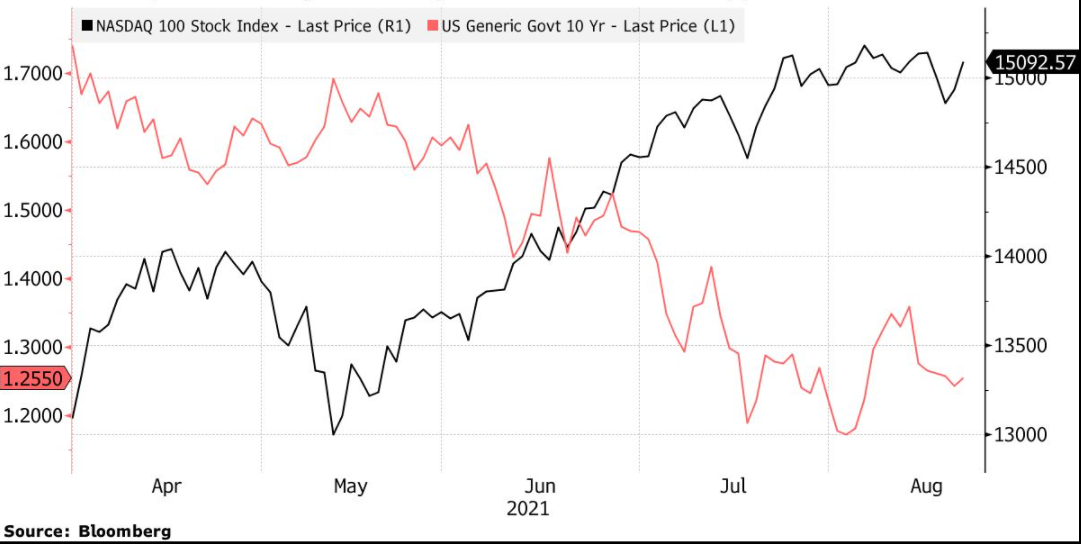
    The negative relationship between US 10yr yields and the Nasdaq 100 (Tech) is evident in the chart below [1]:

    The recent advance in tech stocks (defensive COVID strategy) came at a time when the price of Treasury bills has risen. The yield on the 10-year Treasury has since fallen nearly a half a percent since the end of March, while the Nasdaq 100 has gained 17% over that period, outperforming the S&P 500 Index by more than 4%.

    Jackson Hole – Late August FED Meeting – Investments Ireland 2021

    As FED policy makers prepare for another virtual Jackson Hole conference at the end of August, the meeting seems to hold more significance for the global investor community than usual. Any indication that the FED is going to taper the bond buying program is likely to steepen government bond curves, as longer maturity bonds are likely to sell off. 

    Longer-term interest rates have dominated equity markets over the past year. Investors that expect the 10-year yield to climb in in the latter part of 2021 and into 2022, should be reducing exposure to tech stocks – due to the risk of higher interest rates.

    When the 10-year Treasury yield rose to 1.74% during the first quarter of 2021 (rise of 80 basis points), that period also coincided with a significant Growth to Value style rotation within equity markets. The MSCI World Value index rose by nearly 9% during that period, while the MSCI World Growth index barely moved.

    This resulted in cheaper (undervalued) equity markets, such as Europe and the UK, outperforming the US. This trend has reversed over the past few months, as the 10-year US Treasury yield plunged to 1.17% by early August, as the fear over the Delta variant gripped global investment markets.

    Delta concerns have supported renewed investment in the “stay at home” growth stocks, as they started to outperform again.

    Where to invest right now? – Investments Ireland 2021

    Investors should be focussing on sectors that are positioned to do well in an increasing yield curve environment, which is one that depicts economic reopening and recovery. The latest viral challenge should be viewed as yet another hurdle along the road to economic recovery, as opposed to a barrier, although the variant may cause a more uneven globally recovery.

    Investment Outlook for bonds? – Investments Ireland 2021

    According to a recent regulatory filing, Michael Burry, played by Chirstian Bale in the Big Short, has a large short position on long-term (20+ years) US Treasury bills. The options contracts will make money if the value of long-term Treasury bonds depreciate (yields go up). Burry, who was made famous by his very profitable bet against the US housing market, shares the same bearish outlook as many of Wall Street’s elite.

    With the Federal Reserve inching ever closer to a “tapering” of its QE bond purchase program, all eyes are once again on the bond market.

    Next steps

    You can read our more investing in Ireland analysis here.

    You can check out our other guides on Investing in Ireland here.

    You can find out where to get individual investing in Ireland and financial advice in your area here.

  • Investing in Ireland 2021 – July Recap

    Investing in Ireland 2021 – July Recap

    Investing in Ireland 2021

    Olympian Efforts – Investing in Ireland 2021

    The struggle against COVID-19 is proving to be a global endeavour of Olympian proportions, but now the marathon efforts of the past 18 months have turned into something of a sprint, being a straight run-off between Vaccination and (delta) Variant in the desperate pursuit of economic reopening and societal normalisation.

    Although latest investor sentiment surveys portray the virus as a fading “tail risk” for economies and markets, it is also the case that crowded positioning in the “Reopening Trade” for undervalued cyclical stocks has suffered meaningful profit-taking pressures over the past 10 weeks.

    In consequence, the MSCI World Value index, which outperformed its Growth equivalent by as much as 12 pps from the start of this year to mid-May, has now surrendered this outperformance amidst re-rotation out of cyclical names (energy, banks, industrials) into more defensive plays (tech, healthcare).

    For all that, equity markets continue to find ways to move higher, extending 2021’s clear pattern of rolling corrections under the bonnet (to SPACS, Meme stocks, Crypto and now Cyclicals), whilst overall indices grind higher to successive all-time peaks.

    The MSCI World rose by a further 1.7% in July, its 6th straight monthly gain, a feat shared by the S&P500 and Europe’s STOXX600 which, in the latter case, is the longest winning streak since Draghi’s “whatever it takes” rally of 2012/13.

    Clearly, equity markets are beneficiaries of sustained policy and liquidity support, factors which are also sustaining bond market performance in the face of accelerating inflation rates globally.

    Benchmark 10yr yields declined by 25bps on both sides of the Atlantic last month, their biggest one-month drop since the height of the Pandemic panic in March, 2020.

    This decline in yields prompted a recovery in Gold prices above $1800, amidst renewed (if tentative) ETF inflows after more than 6 months of sales.

    Equities – Investing in Ireland 2021

    A sharp contrast in equity market returns last month between the developed and emerging economies, that 1.7% gain in the MSCI World compared with a 7.1% decline in the MSCI EM.

    As China’s abrupt regulatory clampdown on its internet and technology companies weighed very heavily on both the Shanghai Composite (-5.4%) and Hang Seng (-9.9%) indices, leaving the EM index now barely in positive territory on a ytd basis.

    Lack of contagion towards the US and European markets is perhaps best explained by the insulation provided by a robust corporate earnings season now in full flow. However, the FTSE100 did snap a 5-mth winning streak with a marginal (-0.1%) decline.

    Bonds Investing in Ireland 2021

    The growing conundrum of declining bond yields in the midst of strengthening inflation rates globally continued to fixate last month, with 10yr benchmark Treasury yields falling by more than 25bps to a 1.22% close, low since mid-February.

    Intriguingly, this decline in US yields was wholly attributable to the real yield component, whereas “breakeven” inflation was slightly higher on the month.

    Sliding US bond yields were broadly matched in Europe, where 10yr benchmark Bund yields declined by 25bps to -0.46%, their biggest monthly drop since August, 2019.

    Currencies Investing in Ireland 2021

    A traditional mid-Summer lull in trading conditions was most apparent in foreign exchange markets last month, with the major currency pairs confined to generally sideways moves within their well-defined ranges.

    The USD trade-weighted index slipped marginally in July, the previous rebalancing of predominantly short USD positioning having now substantially run its course.

    Eur/USD found solid support close to ytd lows at 1.1750, ending the month with a topside probe towards the 1.1900 area, whilst Sterling responded to a more hopeful COVID-19 trajectory in a fully-reopened UK economy, the Eur/Stg cross retesting its ytd low circa 85c. 

    Commodities Investing in Ireland 2021

    Commodity markets enjoyed further broad-based gains last month, the CRB Index rising by 2.2% for its 4th straight gain (and 8 of the last 9), this index now scaling 6-year peaks.

    Whilst oil prices have been leading the charge for much of 2021, last month proved a more volatile affair, with Brent crude completing a $76-67-76 round-trip amidst swirling uncertainty over the latest OPEC+ production accord.

    Industrial metals rebounded from recent corrective pressures, as indeed did precious metals, with Gold prices clawing their way back to the key $1830 resistance area in response to the renewed slippage of both real yields and the USD.

    Asset Market Outlook Investing in Ireland 2021

    • Equity markets still climbing a wall of worry (Delta variant, inflation, policy risks), testament to the potency of current macroeconomic, earnings and liquidity supports.
    • Stellar corporate earnings recovery mitigating equity overvaluation concerns, whilst renewed decline in bond yields reinforcing the relative valuation argument.
    • Significant investor positioning flush-out of “reflation trade” favourites (financials, energy, industrials) harbinger of renewed engagement as global growth jitters fade.
    • Conundrum of lower bond yields in the face of rising inflation risks perhaps best explained by the “financial repression” realities of central bank policymaking via zero interest rates and open-ended asset purchase programmes (QE).
    • Renewed decline in 10yr Treasury real yields to fresh record lows portending catch-up weakness for the US Dollar following last month’s disconnect; Eur/USD now targeting a 1.1950 vault for bullish continuation.
    • Gold ETF liquidations now seemingly having run their course, allowing prices to base-build above recent $1680 and $1760 lows; $1830 the next barrier to overcome ahead of a re-run to the $1900 area.

    Asset Allocation Investing in Ireland 2021 Outlook

                                       Equities          Bonds       Credit       Forex/Euro

    US                                           +1                  -2               -1                 -1

    Euroland                               +2                   -2               -1                N/A

    UK                                           +2                   -2               -1                  0

    Asia                                         0                    -1               -1                 -1

    Code +3/-3 very attractive/ very unattractive

    Financial Market Performance Data Investing in Ireland 2021 Outlook [1]

    Next steps

    You can read our more investing in Ireland analysis here.

    You can check out our other guides on Investing in Ireland here.

    You can find out where to get individual investing in Ireland and financial advice in your area here.

  • Best Investments Ireland July 2021

    Best Investments Ireland July 2021

    So what are the best investments Ireland July 2021?

    best investments ireland july 2021

    It was a case of high fives all round for global stock markets last month, the major indices rounding off their half-term report with a fifth consecutive advance on both monthly and quarterly bases, and the broadest barometer of US stocks (Wilshire 5000) now doubled in value from its 2020 Pandemic trough [1].

    Nonetheless, whilst equity markets ended June atop fresh record peaks, declining trading volumes and narrowing breadth flagged a more hesitant investor base, prompted by an abrupt sentiment shift from inflation concerns to growth jitters on the wall of worry front.

    In consequence, the ubiquitous global reflation trade succumbed to profit-taking reflows from cyclical to secular growth plays, spurred both by the rise of the COVID-19 delta variant and a hawkish surprise from the Federal Reserve, its Dot Plot of prospective policy changes flagging possible “lift-off” for higher rates in 2022. 

    The MSCI World rose a further 1.5% in June, cementing ytd gains of 13.3%, and with both US and European indices posting their best H1 gains since 1998. US stocks outperformed last month, and the Nasdaq especially so (+5.5%), whilst the excess return of Russell 1000 Growth over its Value equivalent (+7.4%) almost matched the March, 2020 dysfunction.

    Bond markets were mixed, a sell-off in shorter-dated maturities contrasting with longer-dated gains in a violent curve-flattening reposition.

    In response, the US Dollar enjoyed its best month since November, 2016 (+2.9% per TWI), whilst Gold suffered its sharpest decline (-7.2%) since the same period.

    Further weakness also for that Digital Gold disruptor Bitcoin (-5.7%), whereas Black Gold extended its stellar recovery amidst an ever-tightening physical market, with WTI crude revisiting 2018 peaks circa $75 for ytd gains of 51.4%.

    1. Equities – Best Investments Ireland July 2021
    2. Bonds – Best Investments Ireland July 2021
    3. Currencies – Best Investments Ireland July 2021
    4. Commodities – Best Investments Ireland July 2021
    5. Asset Market Outlook – Best Investments Ireland July 2021

    Equities – Best Investments Ireland July 2021

    Equity markets added to their 2021 gains last month, but performances varied amongst and between the major blocs, with profit-taking impulses unfolding in the “Global Reopening” trade following seven months of gains.

    Although both the S&P500 and STOXX 600 scaled fresh record peaks in June, directional leadership now reverted to some of the more defensive plays (healthcare, technology), whilst COVID-sensitive stocks (travel and leisure, banks) lagged materially. In consequence, the Nasdaq enjoyed its best performance of 2021 to date (absolute and relative terms), whereas the more cyclically-attuned DJIA suffered its first monthly loss in five.

    Bonds – Best Investments Ireland July 2021

    A lively month in fixed income space, whereby a perceived hawkish pivot by the Federal Reserve regarding its ultra-accommodative policy stance prompted a spike in short-dated Treasury yields in tandem with declining yields for longer-dated bonds.

    Investors have long positioned for steeper yield curves on the presumption of Fed tolerance for some inflation overshoot in a recovering US (and global) economy, but concern that policymakers may now be having some second thoughts on that score (given recent elevated inflation readings) triggered a sharp position unwind last month.

    In consequence, 2yr Treasury yields surged by 13bps to 15-mth highs at 0.27%, alongside a commensurate decline in 10yr yields to 1.47%. European bond markets were more becalmed by comparison, given no change in the ECB’s dovish disposition.

    Currencies – Best Investments Ireland July 2021

    The US Dollar enjoyed its best monthly performance of the year to date, its trade-weighted index rising by 2.9%, with across-the-board gains against major and minor currencies alike.

    Key to last month’s rebound was the spectre of an earlier than anticipated tightening of US monetary policy, with interest rate differentials now moving in support of the currency and eliciting a short squeeze of bearish USD positions in forex futures markets.

    Eur/USD recoiled from 1.2255 peaks early-June to a 1.1845 end-month low, whilst Stg/USD also about-turned sharply from its 3-year highs above 1.4200, sentiment here also buffeted by the risks posed by a surging COVID-19 delta variant on UK economic reopening plans.

    Commodities – Best Investments Ireland July 2021

    The CRB index rose by a further 3.7% in June, but it proved a mixed bag, with strength in energy and soft commodities contrasting with weakness across the metals complex (both industrial and precious).

    Shrinking inventories continue to support the rebound in oil prices, with spot WTI (+10.8%) securing ytd gains in excess of 50% at $75 a barrel. However, high-flying Copper prices endured their sharpest monthly decline since March, 2020 (-8.1%), duly trimming ytd gains to 22.1%, whilst Gold (-7.2%) reversed all of the previous month’s rise in response to that more hawkish tilt to Fed policy guidance. 

    Asset Market Outlook – Best Investments Ireland July 2021

    • Equity indices continue to probe fresh record peaks, and volatility has declined to post-Pandemic lows, but narrowing market breadth and fading volumes betray a certain bullish hesitancy at current fully-invested levels
    • COVID delta variant may prove a short-lived distraction, but a more durable concern is whether financial markets are now passing their peaks of policy support, liquidity, economic growth and earnings momentum
    • Post-peak environment (macro, policy) apt to remain highly supportive of further equity market gains, not least as EPS outpaces share-price growth and mitigates valuation constraints 
    • Ostensible bond market pivot from inflation risk (bearish) to growth risk (bullish) looks decidedly premature; recent curve flattening is more corrective than trend-reversing, and a Fed late-Summer “taper” threat can reignite the steepening trend
    • Currency markets locked in historically tight ranges, the USD thusfar resistant to either bearish or bullish breakouts; Eur/USD revisiting lower echelons of a 1.17-1.23 meander, awaiting EU’s vaccination vs variant outturn before renewed topside test
    • Gold’s failed test of $1920 resistance and ensuing sell-off to $1760 lows jars with renewed weakness in real yields; recovery requires early foothold above $1830 area

    Asset Allocation

                                              Equities                Bonds             Credit           Forex/Euro

    US                                             +1                       -2                      -1                       -1

    Euroland                                  +2                       -2                      -1                      N/A

    UK                                             +2                       -2                      -1                        0

    Asia                                           +1                       -1                      -1                       -1

    Code +3/-3 very attractive/ very unattractive

    Next steps

    You can read our more investing in Ireland analysis here.

    You can check out our other guides on Investing in Ireland here.

    You can find out where to get individual investing in Ireland and financial advice in your area here.

  • How to buy shares in Ireland and maximise your returns – Ireland 2023

    How to buy shares in Ireland and maximise your returns – Ireland 2023

    how to buy shares ireland

    In our ultimate guide to how to buy shares in Ireland and what shares to buy, we will take you through the basics of what a share is, how to choose which shares are good value and how to buy them. Buying shares in Ireland is almost certainly easier than you think, you can use an Irish financial advisor/broker or through an international online broker.

    A share is simply a slice of ownership in a company. Read on to see what this means for share prices.

    The right shares to buy are obviously those that will grow in value. Based on fundamentals these should be shares that are cheaper than they should be right now when you forecast out their future profits.

    In my view investors should always try to focus on company fundamentals when looking to invest in shares. Ignoring a company’s fundamentals is taking a shot in the dark and leaving everything up to chance, not an advisable strategy for your money.

    Read on to see how you work out which shares to buy in Ireland right now.

    What is a share anyway? How to buy shares in Ireland

    How do I choose which shares to invest in? How to buy shares in Ireland

    Which is based Fundamental or Momentum based investing? How to buy shares in Ireland

    In a nutshell. How to buy shares in Ireland

    Next steps. How to buy shares in Ireland

    What is a share anyway? How to buy shares in Ireland

    The ownership of a publicly traded company is thinly sliced into equal shares on the stock exchange to make them easier for investors to buy and sell, hence the name for this split in ownership – shares.

    Traditionally, companies are priced by each individual share, which leads to the question of what the price of a single share tells investors about the value of a company? Absolutely nothing…

    A single share does not tell you anything about the value of a company. Instead, it is the number of shares in the company multiplied by the price per share that gives you the total market value of the company, or the market capitalisation.

    A company can be thinly or thickly sliced, but investors should only be concerned by the overall value of a company.

    A rookie mistake is to compare one company share price to another, as both companies are likely to each have a different number of shares outstanding. Looking for cheap stocks is similar to comparing the size of two loafs of bread, simply by comparing a slice from each loaf, which would be a strange method for picking out which loaf or indeed company that you would like to own a “share” of.

    So if you can’t use the price of a share alone to work out if it is good value what can you use?

    Read on to find the key tactics that investors use, to zero in on shares that offer the highest potential for returns.

    private pension

    How do I choose which shares to invest in? How to buy shares in Ireland

    There are two text book tactics that investors use to determine the underlying value of a share, Relative Valuation and Discounted Cash Flow. Here’s how they work and the pro’s and pitfalls of each.

    Relative Valuation

    Relative Valuation methods are quick and easy. They represent a straight forward way to compare a stock to its own historical price, other companies or to the price of the overall market.

    Relative valuations indicate whether a company is over or undervalued, but they do not give a fair market value for the stock. There are two ways to do this relative comparison, Dividend Yield and the Price-to-Earnings Ratios.

    Dividend Yield is the amount of money a company pays shareholders as a dividend, as a percentage of its current stock price. The lower the dividend yield, the more expensive the stock.

    Yields also depend on the industry the firms in or how mature the company is. Growth companies often decide not to pay any dividends, as the money is instead reinvested into the company to fuel growth. Indeed five of the seven largest S&P 500 members currently do not pay any dividends at all.

    Price-to-Earnings (P/E) ratio is the other main relative valuation metric, which depicts a company’s value in terms of its earnings, allowing investors to compare companies of all different types and sizes. Simply put, the higher the P/E ratio, the more expensive the stock.

    Determining a fair P/E ratio hinges on how fast you think a company’s earnings will grow. A fast-growing company will warrant a higher P/E ratio, as opposed to a company in decline.

    An extreme recent example would be the high premium that investors are currently willing to pay for Tesla, which currently has with a P/E ratio of 998, compared to General Motors modest P/E ratio of 13.

    Although you may hear Dividend Yield and P/E ratio bandied about by some on the internet and in social media. These relative valuation tactics are very blunt instruments.

    Those looking for something more tethered to the underlying value of the shares often reach for some something known as the discounted cash flow model.

    Discounted Cash Flow

    The discounted cash flow model involves estimating the future earnings of the firm and then calculating how much the future earnings are worth today. The estimates of the company’s future earnings are discounted because of the uncertainty of the future.

    Simply put, investors are willing to trade the promise of a larger sum tomorrow, for the certainty of a smaller sum today. The total value of the firm is equal to the discounted value of the company’s future earnings under this model.

    The amount you discount the earnings is the combination of what an investor would be guaranteed by putting their money in a risk free investment (usually the current yield on a US 10-year government bond) plus a risk premium that is based on how probable the future returns are.

    The future earnings plus the discount equals the total value of the firm (enterprise value). You then take away the balance if what the company owes in it’s accounts to get the company’s total value.

    (Value = Enterprise value – Debt + Cash)

    Dividing the total value of the company by the number of shares produces a value for one share. Using this logic, if you can buy the share cheaper than the calculated value it’s a good investment.

    This approach provides a direct relationship between the value of a company’s share and its fundamental measure of success, its future earnings.

    Momentum plays Fundamentals. How to buy shares in Ireland

    Both absolute and relative valuation models rely heavily on the company’s earnings. Indeed how much should a company be worth if it does not have solid earnings? This approach is often called value or fundamental based investing, most famously used by Warren Buffet, the billionaire ‘sage of Omaha’.

    In my view investors should always try to focus on company fundamentals when looking to invest in shares. Ignoring a company’s fundamentals is comparable to taking a shot in the dark that leaves everything up to chance, which is clearly not an advisable strategy when looking to invest.

    In a nutshell. How to buy shares in Ireland

    There are many ways for investors to buy shares in Ireland. It is possible to buy shares directly through one of the online brokerages operating in Ireland, such as DEGIRO or eToro. “Robo advisors” have also increased in popularity, as the digital advice provided requires with little human input.

    Speaking to a dependable financial advisor still remains the most advisable approach to investing in stocks. Reviewing your finances with a financial advisor will allow you to see how investing in stocks can help you to achieve your financial goals.

    Next steps

    You can read our more investing in Ireland analysis here.

    You can check out our other guides on Investing in Ireland here.

    You can find out where to get individual investing in Ireland and financial advice in your area here.

  • Investing in Ireland, shares v other Investments. Jan 2021 expert view

    Investing in Ireland, shares v other Investments. Jan 2021 expert view

    I offer investment advice to Irish financial advisors, and my role is to help my clients make the right choices, at the right time, when looking to invest in Ireland. This article cuts through all the noise to give you the information you need to make better investment choices. If you’re Investing in Ireland here’s what you need to know in 2021.

    Share valuations are at record highs versus company earnings and markets are jumpy with COVID-19 still at large. Yet given the potential risks, equity stocks must still be viewed as a sound investment in the current climate, as we look forward to multiple vaccine roll-outs, upgraded growth forecasts and continued central bank and government support.

    A recent investor survey highlights a shift in investor sentiment, as investors look to move away from over owned US markets, driving an increased capital flow to value opportunities across Europe and other regional markets

    In particular, UK stocks may offer the best value opportunity of all, as the market with a notable lack of technology stocks starts to play out a post-Brexit catch-up. Although the Brexit drama has resulted in a notable “skinny trade deal”, UK equities have a lot of ground to make up on Global markets performance since the referendum in mid-2016.

    After a bit of a battering in recent months, gold has bounced back and is a good way to balance out your investment in shares. The need for diversification will drive continued demand for gold, amongst the unprecedented money printing by central banks at present.

    Read on to get more Investing in Ireland insights including

    Party like it’s 1921  – vaccine a shot in the arm for shares in 2021

    Don’t fight the fed – why government policy will continue to prop up long term share valuations

    Sanity Clause – Brexit done, British shares to bounce back in 2021?

    In a nutshell – the vaccine, stimulus & brexit triple booster

    What next? – Further investing in Ireland insights

    Party like it’s 1921  – vaccine a shot in the arm for shares in 2021

    The western world faces into the new year armed with 3 effective vaccines to control the COVID-19 pandemic.

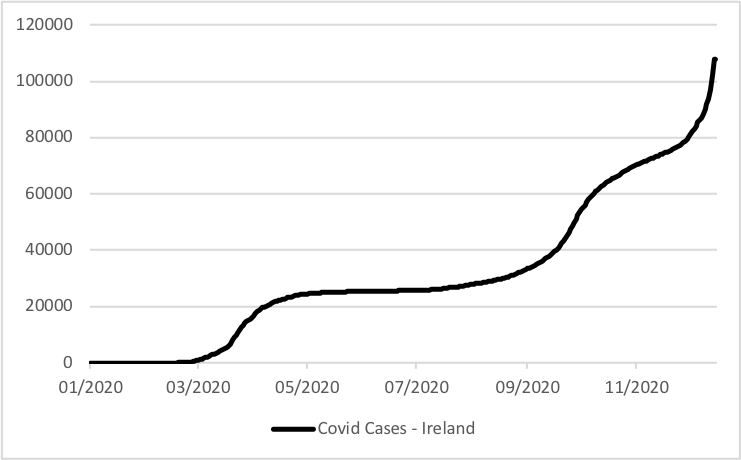
    Inoculation programmes cannot come at a moment too soon. COVID-19 is currently surfing its third major wave since the pandemic erupted. In Ireland, caseloads have exploded, with the fastest-growing infection rate across the EU. Straining the capacity of the healthcare system and prompting severe lockdown restrictions.

    FIGURE 1:    IRISH COVID-19 CASES

    Ireland’s pattern of renewed societal restrictions is a broadening theme across the global economy. Lending even sharper focus to rapid vaccine deployment.

    So far, 13m doses have been administered in 33 countries worldwide, of which 4.7m have occurred in the United States, 1.4% of the population. Remarkably, the Israeli government has already managed to administer double-doses to 14% of its people. China is also broadening distribution of it’s vaccine, with 4.5m doses already administered, 3m of which in the past 3 weeks alone.

    Elsewhere, vaccine programmes will ramp-up over the next few months. All of the major economic blocs have pre-ordered sufficient doses to put herd immunity within reach by late-Summer, if not sooner, with all things going to plan.

    This represents a massive shot in the arm for the global economy, whose historic 4.4% contraction in 2020 may now see a 6%+ springback. Demand for economic goods and services did not die last year, rather it was suspended. It is pent-up demand that informs more bullish outlook for the global economy in 2021/22.

    Some more excitable commentary heralds the dawning of this century’s Roaring Twenties which followed WW1 and the Spanish Flu. Whilst this is simplistic, Irish investors could see roaring returns from the right investment selections.

    Don’t fight the fed – why central bank policy will continue to prop up long term share valuations

    Traditionally, working out whether a company’s shares were a good investment focussed heavily on dividing a company’s share price by the associated earnings of the firm. The higher this ratio, the less of a bargain you are getting, all else being equal. This guideline ratio is at a documented all-time high in the S&P500 (a composite index of the top 500 companies in the US), and this has been a source of caution for investors right now, and understandably so.

    Yet, the current central bank policies that are stimulating the economy have altered this equation. The size of the stimulus is difficult to grasp, COVID-19 and its associated lockdowns triggered a vast $13trn fiscal stabilisation effort last year. Roughly 15% of global GDP.

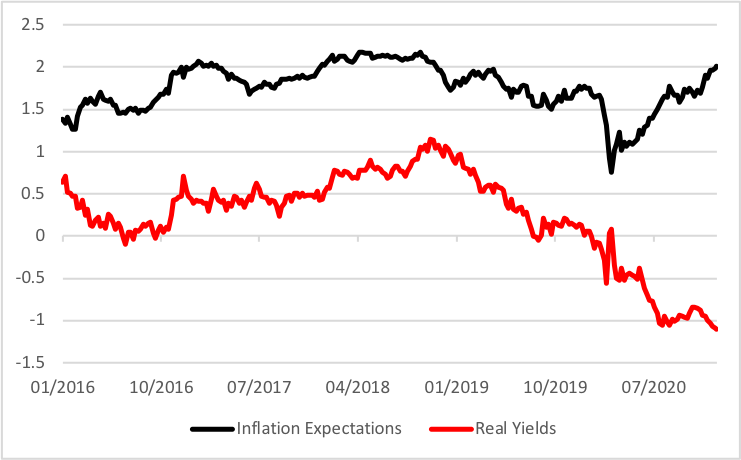
    FIGURE 2:   US 10yr REAL YIELDS & “BREAKEVENS”

    The lack of other viable investment options will continue to drive more investors into buying shares, driving up values above ratios that would have been considered as historically high. The reduction to US yields has however rendered any historical comparison to the time proven P/E ratio as obsolete. More specifically, the standard equity risk premium against current US Treasury yields allows for a higher P/E ratio.

    Significantly, US Federal bank chair Jerome Powell saw fit to comment on this last month. “if you look at P/Es (price to earning ratio’s), they’re historically high, but in a world where the risk-free rate is going to be low for a sustained period, the equity premium, which is really the reward for taking equity risk, is what you’d look at”. 

    These conditions and the resulting premium is set to continue with Powell pledging that “we’re going to keep policy highly accommodative until the expansion is well down the tracks”.

    Market commentators now appear to be singing off the same hymn sheet. Expecting stronger equity and commodity markets, flatlining bond yields and a weaker US dollar. This all points to share valuations holding up well compared to the assets that are traditionally perceived as lower risk such as bonds.

    Sanity Clause – Brexit done, British shares to bounce back?

    You couldn’t have your cake and eat it, we were told; maybe it would be unduly provocative to say that this is a cake-ist treaty, but it is certainly from the patisserie department” (Boris Johnson, December, 2020)

    The sealing of a 1246-page free trade agreement (FTA) between UK and EU negotiators at 14.44 CET on Christmas Eve, brought to an end 9 months of fractious and repetitive talks.

    For all the obvious shortcomings of the deal, improvements across UK financial assets brought a difficult 2020 to a more optimistic close.

    Sterling ended the year at its highest level versus the weakening USD since April, 2018.  The FTSE100 outperformed its major stock market peers for the second consecutive month.

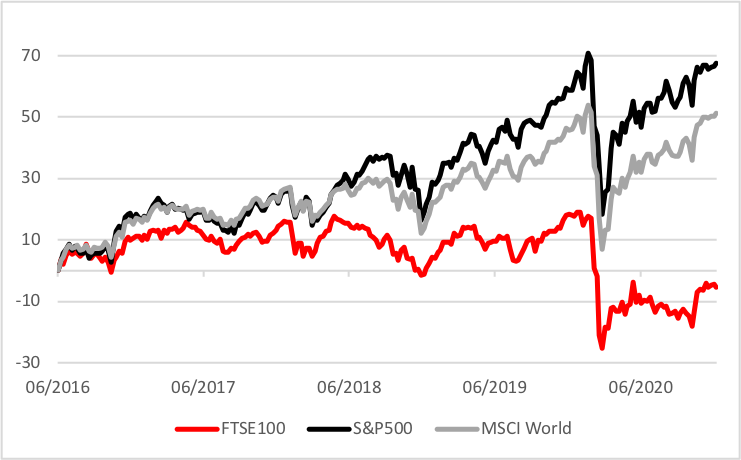
    Brexit uncertainties have weighed heavily on the UK economy since mid-2016. Investors, both domestic and overseas, have abandoned UK stocks in the pursuit of richer pickings elsewhere. This condemned the UK market to wallow at record low valuations relative to US and global peers.

    The FTSE100 has barely risen in the post Brexit referendum period. For those investing in Ireland and trading in Euro’s it has actually returned a cumulative 5.5% loss. This compares to a 67.5% gains for the US market S&P 500 and 51.2% for World market MSCI World.

    FIGURE 3: POST-BREXIT REFERENDUM RETURNS (Eur)

    Now, with the weight of Brexit uncertainty lifted, investors are likely to seek value in the UK stock market driving gains. Respondents to December’s BAML Global Fund Manager Survey were already turning less bearish (less downbeat) towards UK equities.

    In a world where shares are still the value play, UK shares look like the best value of all.

    In a nutshell – the vaccine, stimulus & Brexit triple booster

    The year ended in festive financial mood.

    Thanks to the initial vaccination roll-out for COVID-19 and a further $900bn stimulus deal on Capitol Hill. The MSCI World led a host of major equity indices to fresh record peaks by year-end. Up 14.3% across the full-year, with a 68.3% rebound from late-March lows. The S&P500 saw a 16.3% rise compared with average 11.8% gains over the previous ten years.

    Other assets performed poorly. Bond markets remained close to historic lows. The Dollar remained weak closing at the lowest levels since April 2018. As a result, Gold rebounded to complete its biggest annual advance since 2010.

    This points to shares in general still being a sound investment in 2021, whilst gold continues to provide a source of diversification amidst the unprecedented money printing by central banks at present. The commodity is a good way to provide balance to an increased equity exposure across a portfolio, particularly at time in which bonds yields are returning next to nothing.

    UK stocks may indeed represent the best equity value opportunity at the moment, as they are playing catch-up with the other markets post-Brexit.

    What next? – Further investing in Ireland insights

    You can read our more investing in Ireland analysis here.

    You can check out our other guides on Investing in Ireland here.

    You can find out where to get individual investing in Ireland and financial advice in your area here.