Our mortgage switching guides include everything you need to know about switching your mortgage and remortgaging. Who should switch mortgage, how you switch mortgage and how to calculate your mortgage switching savings.
148,000 mortgage holders with either variable or short term fixed mortgage rates could face rates as high as 6% next year.
While tracker customers have borne the brunt of recent ECB rate increases, variable and fixed rate customers have seen little or no increases to their mortgage repayments to date.
Now though these customers risk sleepwalking into rates as high as 6% as banks look to pass on increased funding costs.
According to recent mortgage statistics released by the Central Bank of Ireland over 50,000 mortgage holders with less than a year to run on their fixed rates and 100,000 already on variable rates are now exposed to mortgage rate hikes.
A fixed rate customer paying the average fixed rate of 2.85% will see their mortgage repayment rise by €224 a month if they roll off onto a rate of 6%. While the average variable rate customer on 4.02% will also see their repayments climb by just over €140 a month.
Why are Variable Rates Likely to Rise?
Irish banks have come under increasing pressure to increase the deposit rates they offer to savers.
International competitors are offering the best savings account returns right now, with Dutch fintech Bunq offering 1.56% interest for on demand savers for example. In an attempt to head this off we have already seen Irish bank overnight deposit rates creeping up.
Correct as of 25/03/25. AER = Annual Equivalent Rate
This good news for savers is likely to mean bad news for borrowers as the banks look to preserve their profits on the difference they charge between both. We have already seen variable mortgage rates rise by 0.54% so far this year and further increases now look inevitable.
If variable rates do start to rise as predicted, they will impact a whole new set of mortgage holders who have been isolated from repayment increases to date. As with the tracker customer repayments there is a real risk that by the time they wake up to the increases it will be too late to do anything about it.
Central Bank retail Interest Rate data updated 20/10/2023
With the ECB rate likely to stay above 4% for the foreseeable and rising deposit rates, banks may now look to put through ‘catch up’ increases to offset their increased funding costs . This has already happened to over 30,000 variable mortgage rate holders with vulture funds where variable rates are now as high as 9% in some cases.
If variable rate increases track those seen across Europe where the Eurozone average mortgage rate has moved from 1.31% to 3.89% in the last 18 months, we would expect to see an increase of 2.58%, which would take Irish variable rates to an average of 6.06%.
What Can I Do To Avoid the Hikes?
If you’re on a variable rate or a fixed rate with less than a year to run you may still be able to avoid these hikes by switching your mortgage and fixing your rates long term on the best mortgage rate.
As rates have been rising it’s unlikely that you will incur a breakage fee if you choose to break your current fixed mortgage deal to avoid higher rates. This is because EU rules limit when banks can charge breakage fees.
It may even be worth breaking your current short term fixed rate now and paying more to secure a long term fixed rate as the current low long term fixed rates deals available now are unlikely to be around this time next year.
Fixed rates of up to 30 years are available at 3.95% from some lenders, such as Avant Money. At 3.95% the €223 a month the average hike in repayments would be cut to just €75 a month, as well as giving you absolute certainty on your future repayments.
Be aware though if interest rates fall you do risk missing out on any potential upside though.
The high street lenders have some of the highest fixed rates on the market for existing customers, so don’t sleepwalk into higher rates, talk to a mortgage broker and get market based advice before choosing your lender.
moneysherpa believe that the Government and Central Bank are failing customers who have been sold off to ‘vulture funds’.
Although the name ‘Vulture Fund’ is commonly used, these funds, also known as non bank entity funds and closed funds, are usually backed by pension funds who are looking for low risk investments with a steady return and are common in financial markets around the world.
The important difference between mortgages with Vulture Funds and those with other lenders is that they are not open for new retail business. That’s why they are also known as closed funds.
The 85,000 Mortgage holders in Ireland with closed funds (‘vulture funds’) are more vulnerable than customers of ‘open’ funds (funds offering new mortgages) because.
Closed fund customers may be tied to their lender due to not being able to meet open lender affordability tests, making them ‘mortgage prisoners’ leaving them open to predatory pricing.
Closed funds are not actively competing for new business so are not constrained in their approach to their customers as Open funds.
It’s this lack of options that we believe is the key concern, where there is in effect a monopoly. When there is market failure as in this case, bad things can often happen to consumers.
If you have been out of arrears for more than 2 years and paying full capital and interest for more than a year a moneysherpa advisor will be happy to advise you for free here. If you are over sixty then even if you aren’t out of arrears equity release may be an option, if want to find out more check out our Equity Release Ultimate Guide.
We think that the current proposals to address these issues fall short of what is needed, being either unrealistic or even counter productive. The right approach to help vulture fund customers in our view is to focus on addressing the clear market failures.
For this reason moneysherpa believes, the regulator and government have a duty to protect consumers by lowering barriers to accessing the open market.
Within the 85,000 closed fund customers our analysis shows that there are three broad customer groups to consider
Customers who can access the open market now – circa 26,000
Customers who can’t access the market due to affordability tests- circa 38,625
Customer customer who can’t access the market due to arrears – circa 20,375
Our estimates are based on the Central Bank non bank lender data reduced by the projected non bank lender share of open bank lenders and converted to actual mortgage holders using the 1.2 ratio of mortgages per mortgage holder als in Central Bank data as below.
Number of mortgages affected by vulture funds Ireland 2023
Closed Fund Status
Mortgage Holders
Total Closed Fund Mortgages
90,104
Performing Tracker
25,625
Performing & Fixed
7,500
Performing Variable
12,500
Restructured
13,638
In Arrears
20,496
moneysherpa estimates 20/10/2023 based on Central Bank Arrears Data
Within the 85,000 mortgage holders with closed funds we estimate there are around 59,000 ‘mortgage prisoners’ who are unable to move to the open market.
Current interest rates for these groups is estimated below based on Central Bank Jan 2023 data and assuming that the 1% ECB rate increase post Jan has been passed through to mortgage holders.
Closed Fund Type
Mix
Mortgage Accounts
Mortgage Holders
Est Rates March ’23
Closed Fund Type
Mix
Mortgage accounts
Mortgage holders
Estimated Rates March ‘23
Trackers
37%
37,517
31,000
4.14%
Variable
45%
45,475
38,000
5.57%
Fixed
18%
18,000
15,000
2.57% (5.57% after fixed ends)
Total
100,992
85,000
Rates based on Central Bank January 2023 Retail Interest Report + ECB 1% March ’23 – 20/03/2023
Based on these projections the majority of closed fund customers are paying or will be paying significantly above current market rates, which are typically around 3.5% APRC.
It should be recognised that a sizable group of these customers, over 30,000, are simply with closed funds due to the exit of HBOS and Danske bank from the Irish market.
Read on for further analysis of the vulture funds customers and what should be done.
Customers with non restructured mortgages – vulture funds Ireland
53% of closed fund customers (46,294) are not in arrears and are paying the full outstanding capital on their mortgage. They are therefore in theory able to switch to open market lenders subject to meeting lender criteria.
Affordability checks
CCR requirements 2-5 outside of arrears
It’s unclear how many of these customers can switch in practice.
The most significant obstacle in practice is the lender affordability checks which include a mandatory 2% stress test on the prevailing rate required under the Central Bank Consumer Protection Code.
Closed Fund Switching Examples
March ‘23 APRC
New rate APRC
Remaining Loan
Remaining Term
Current Repayment
New Average Repayment
Monthly Saving
Total Saving
Variable customer
5.57%
3.19%
€138,000
15
€1,133
€966
€167
€30,068
Tracker customer
4.14%
3.19%
€173,000
15
€1,292
€1,211
€81
€14,626
Fixed customer
5.57%
3.19%
€206,000
15
€1,691
€1,441
€249
€44,884
Data from Central Bank Retail Interest Rate report Jan 23
Therefore a typical performing closed fund variable rate customer @ 5.57%, €138,000 and 15 years outstanding, paying €1,133 a month may not be able to switch to an open market repayment of €167 less due to a combination of lender and Central Bank affordability rules.
Customers with Restructured Mortgages – vulture funds Ireland
22.5% of closed funds,19,000 in total, are classified as restructured of which 16,000 are meeting the terms of the restructure. This includes mortgage splits, capitalisation, reduced interest and term extension.
The 16,000 restructured mortgages meeting the terms of their restructuring may also be able to switch to the open market, although only to a limited set of products and lenders. The example shown below uses Finance Ireland Progress Plus rates, which are available to restructured customers, not in arrears for 2 years when paying the full capital and interest.
Closed Fund Switching Examples
March ‘23 APRC
New rate APRC
Remaining Loan
Remaining Term
Current Repayment
New Average Repayment
Monthly Saving
Total Saving
Variable customer
5.57%
5.69%
€138,000
15
€1,133
€1,142
-€9
-€1,589
Tracker customer
4.14%
5.69%
€173,000
15
€1,292
€1,431
-€139
-€25,061
Fixed customer
5.57%
5.60%
€206,000
15
€1,691
€1,694
-€3
-€592
Data from Central Bank Retail Interest Rate report Jan 23
For both Variable and Fixed mortgage holders, if ECB rates rise above 3.5% returning to the open market could potentially reduce monthly repayments.
Customers in Arrears – vulture funds Ireland
Almost 24%, a total of 25,469 customers are in arrears of more than 90 days currently.
Number of mortgage in arrears Ireland 2023
Arrears Status
Accounts
Mortgage Holders
Total > 90 days arrears +
17,723
14,178 (19%)
Of which > 5 years arrears +
11,623
9,298
Data from Central Bank Arrears Report adjusted for closed funds using moneysherpa estimates 20/10/2023
These customers may have fallen into arrears due to changes in personal circumstances or other reasons. There are very limited solutions for them in the open market, however equity release may still be an option as explained below.
Options for customers by group – vulture funds Ireland
Depending on individual circumstances there are different options open to these customers. We have broken it down into three main groups.
1 – Customers who can access the open market now – vulture funds Ireland
We estimate that 26,000 of the 85,000 mortgage holders with vultures are able to switch, based on taking the average salary and outgoings 45,625 performing non restructured loans, with the average salary and outgoings applied to current lender calculators.
These customers may not have chosen to move to the open market, by switching their mortgage lender, as they think there may be little benefit or may be unaware that they can.
We believe that there are in fact substantial benefits for the majority of customers of moving to the open market, by being able to fix for example or to be able to exercise market power and that these benefits may not be fully understood by consumers.
We believe that inaccurate or misleading media coverage around Vulture funds and lack of communication by active lenders and brokers may have led to a false perception that these customers are ‘mortgage prisoners’ when they are in fact free to move.
2 – Customers who can’t access the market due to affordability tests – vulture funds Ireland
We estimate that there are 38,625 customers who can’t access the market due to affordability. These customers are either paying the whole value of the loan, but can’t pass affordability checks due to changed credit rules or circumstances, or are only currently paying off part of their loan.
These customers are not in arrears, but are currently ‘mortgage prisoners’ as they can not pass the open market lender affordability tests.
Some of these customers are being stopped moving by the Central Bank CPC stress test requirement of 2%.
Some of these customers would still fall below affordability thresholds if this test was to be removed.
3 – Customers who can’t access the market due to arrears – vulture funds Ireland
These customers 20,375 are in arrears and are currently ‘mortgage prisoners’ as it is unlikely another lender would take them on due to their credit history.
There are some exceptions to this, in particular equity release for those over 60 is not dependent on credit history and is a way to pay off the closed fund in return for giving away a slice of your property when you leave the home.
However for most people, it is unlikely they have any open market options currently and are therefore the group most in need of protection from predatory pricing.
moneysherpa are advocating for a number of changes from both government and the funds themselves to help those customers who are currently trapped or believe themselves to be trapped with closed funds.
1- Customers who can access the open market
The Government and/or the Closed Funds themselves should fund free independent financial advice to all closed fund customers currently able to access the open market.
This advice would include a full comms plan administered by the funds, website and advice services provided by the government and government agencies such as Citizens Information and/or MABS.
2- Customers who can’t access the market due to affordability
The Central Bank to work with lenders to develop more flexible affordability test for customers who are reducing their repayments by returning to the open market and to remove the CPC stress test for any customer moving to a lower average repayment over the mortgage term
The Government should also fund an equity grant scheme modeled on First Home scheme to bridge the affordability gap by reducing the required open market mortgage to a level that can be afforded by the customers and return closed customer to open market.
In the UK the London School of Economics has recently published a set of proposals including free advice and an equity release scheme to address the issue of Mortgage Prisoners there.
Next Steps- vulture funds Ireland
We are keen to understand the circumstances around mortgage prisoners as well as we can, so that we can lobby and develop ways to help.
If you have been out of arrears for more than 2 years a moneysherpa advisor will be happy to advise you for free here. If you are over sixty and want to find out more about equity release as an option, check out our Equity Release Ultimate Guide.
We are keen to understand the circumstances around mortgage prisoners as well as we can, so that we can lobby and develop ways to help. We have also opened a thread on this topic on askaboutmoney.com here.
Congratulations you have your loan offer, but what happens next? Don’t worry we are going to guide you through the mortgage drawdown process with our Mortgage Drawdown Ultimate Guide Ireland 2022
For most people this is a once or twice in a lifetime transaction. It can be stressful but ultimately it will be worthwhile. Your solicitor needs to make sure that they cover all legal and planning issues before mortgage drawdown so that there won’t be any problems when and if you decide to sell in future.
The following guide will give you a better understanding of the mortgage drawdown process and how you draw down your mortgage.
How Long Will The Process Of A Mortgage Drawdown Take? Mortgage Drawdown Ultimate Guide Ireland 2022
First your own solicitor will need a copy of your loan offer, this should be sent directly to your solicitor by your lender, in what’s known as the loan pack.
Your solicitor will need the loan pack for the house you are purchasing before they can proceed, if it’s a switch they still need the loan offer pack. On average the loan offer takes 4/6 weeks to be issued by the lender.
Most solicitors will not look at any other documents until they have received the loan offer as they don’t want to spend time on a purchase that might not go through.
If you want to speed the mortgage drawdown process up though, you can either undertake to pay the costs in the event of the loan not being received or find a solicitor who will waive their fee if the transaction doesn’t go through.
This can speed up the process considerably, as you can be working on sale contracts whilst still waiting for your loan offer.
What Can Delay Mortgage Drawdown ? Mortgage Drawdown Ultimate Guide Ireland 2022
The issuing of contracts can be delayed if the Vendor’s Solicitor is getting deeds from a Bank (this takes between 10 and 14 days normally, but can take over a month) or if they are missing documents such as Certificates of Compliance.
Your solicitor will request these as they need to make sure that the house complies with all Planning and Title matters.
The house deeds are always needed so requesting these as early as possible is essential in getting your mortgage draw down complete as soon as possible.
It’s worth pushing your solicitor to act fast and move things along in parallel.
Most solicitors don’t specialise in property conveyancing so are only part time on your house purchase. You might want to look for a solicitor who is 100% dedicated to conveyancing and allows you to track your completion process on line.
moneysherpa recommend Jacob Law who specialise in conveyancing and have an online tool so you can upload your docs and track progress. If your switching they offer an all in price of €1350 including outlays and VAT.
Solicitors are also a particularly cautious breed and while this can be a good quality in their role, encouraging them to act faster rather than hang on for all the t’s to be crossed and i’s dotted usually pays off.
If your don’t move quickly vendors can pull out, lenders rates can change and your own circumstances may also shift, so it’s your job to push the solicitor as hard as you can to speed up the closing.
What Happens When You Get The Contracts- Mortgage Drawdown Ultimate Guide Ireland 2022
Once your solicitor has contracts and your loan pack, they read them and advise you about the property. They will also raise queries with the Vendor’s solicitor regarding the title.
They should send you a copy of any correspondence with the vendors solicitor.
What Happens After You Get The Advice Letter- Mortgage Drawdown Ultimate Guide Ireland 2022
Once you get the advice letter from your solicitor you should make sure that you are happy with the advice given and your solicitor will chase for replies to the queries/questions they have sent to the vendor’s Solicitor.
Once they reply and if the replies are ok, your solicitor will call you to arrange an appointment to go through the contracts and sign them if appropriate.
On average it takes two weeks to get replies and arrange to get contracts signed.
What Do You Need When You Sign- Mortgage Drawdown Ultimate Guide Ireland 2022
You need to pay the balance of the deposit on signing contracts and the cheque is payable to the Vendor’s solicitor. If you have not given your solicitor a copy of your driving licence or utility bills, as proof of identity and address, you will need to provide these at this point.
Your solicitor will then go through the contracts and loan offer and if you are happy then you sign the contracts. At this point you should get a definite idea as to the closing date from your solicitor.
Are You Committed When You Sign? – Mortgage Drawdown Ultimate Guide Ireland 2022
Once you sign the contracts, they are sent to the Vendor’s solicitor for signing by the vendor. The contract is not binding until they sign and return one copy.
This normally takes a week or two but it may be longer if the Vendor is buying another property or if there is a chain of transactions.
When Do You Close And When Do You Pay? – Mortgage Drawdown Ultimate Guide Ireland 2022
Once your solicitors have a copy of the contract back and know the closing date, your solicitor will email you details of what balance is required to close.
You also need to make sure that all the documents necessary for drawdown of your loan are with your mortgage provider.
Once your solicitor has all the monies they will arrange the mortgage draw down.
The Vendor’s solicitor then sends your solicitor all the Title documents on trust and the purchaser’s solicitor will transfer monies on trust then carry out searches to make sure there are no judgements against the property or the vendors.
If everything is ok and you confirm that the house is vacant and cleared out, your solicitor will authorise the release of the monies and you can collect keys from the Auctioneer.
What Happens After Closing – Mortgage Drawdown Ultimate Guide Ireland 2022
Your solicitor will arrange to stamp the deed and register the property. If you have an existing mortgage, they send your deeds to the Bank after the registration completes. If you do not have a mortgage, they will write to you to collect your deeds when they are registered.
Summary – Mortgage Drawdown 2022, Ultimate Guide
Mortgage draw down is a complex process so to summarise the steps that you need
Review your loan offer conditions with your solicitor
Request the house deeds from your current lender (if you are also selling or switching)
Review the property contracts with your solicitor and sign
Pay the outstanding deposit balance (if a new house purchase)
Supply lender with any outstanding documents (mortgage protection etc..)
Drawdown Mortgage
The key tip is chase, chase, chase. Don’t let your solicitor drive the process, make sure you are pushing and getting all your docs in on time.
The longer things take, the more that can go wrong.
That’s why getting partners that know the process inside out makes a lot of sense. moneysherpa advisors work with the best completions and solicitors in the country to make sure you get the best and fastest route to mortgage drawdown.
Next Steps – Mortgage Drawdown Ultimate Guide Ireland 2022
The process of applying for a mortgage can often be very daunting and filled with uncertainty, but not if you get the right mortgage adviser. Find out what to look for with our mortgage adviser ultimate guide Ireland 2022.
In this article, we aim to outline what a mortgage adviser is, why you should consider going to one, and how to find the best one for you.
What is a Mortgage Adviser? Ultimate Guide Ireland 2022
A mortgage advisor is a qualified professional who aims to find the best mortgage deal for you given your personal circumstances.
With over 250 mortgage products offered by 9 different lenders in Ireland, it’s no wonder so many struggle to find the best mortgage for them, and end up going with a mortgage that could lose them thousands in the long run.
A mortgage adviser will help you work out how much you can afford to borrow and use their knowledge of the market to find the best deal available.
When looking for the best deal out there, a good mortgage adviser will;
Talk with you to figure out what you can afford to borrow given your financial situation
Search the market for the best deals available
Compare deals offered by lenders
Tell you about different deals to help you find one that best suits you
Why should I go to a Mortgage Adviser? Ultimate Guide Ireland 2022
There are many benefits to seeing a mortgage adviser, as a good mortgage adviser will;
Look at your financial circumstances to find a deal that best suits you
Use their knowledge of lenders to find ones that are right for you
Access exclusive deals not available directly
Help you with the paperwork that comes with applying for a mortgage
Help you find a deal that you are likely to get
A mortgage advisor can help lift the burden that comes with applying for a mortgage.
By using their connections and knowledge of the market, mortgage advisers can help find a deal that is affordable and right for you.
Finding a deal yourself can be a long and difficult process. Mortgage advisers are there to save you time and effort, and may even be able to find you a deal you can’t on your own.
How do I find the right Mortgage Adviser for me? Ultimate Guide Ireland 2022
There are many factors you should take into consideration when looking for a mortgage adviser, such as;
Type of mortgage adviser
Mortgage advisers can either act independent or work on behalf of a lender. It’s important to know if you’re mortgage advisers is working for a financial institution, as this can impact their advice.
It’s also important to see how many lenders your mortgage adviser works with, as mortgage advisers who only work with a certain amount of lenders can only offer you a limited amount of deals.
An independent mortgage adviser will show you deals from many different lenders as they are not tied to only one, meaning you can choose from a wider range of lenders and deals.
Fees
Some mortgage advisers will not charge their clients, as they’re paid a commission based on the value of their clients mortgage once it has gone through.
Yet some mortgage advisers may charge their clients a flat fee of €100-€150. Other advisers may charge their clients a commission based on a percentage of their mortgage. This can be a problem if you are looking to take out a large mortgage.
Always ask mortgage advisers about their fees before deciding who to go with.
Qualifications
It’s important to find out what qualifications your potential mortgage adviser has. Before going with a certain advisor, check that they;
Are a Qualified Financial Adviser (QFA)
Are an Accredited Product Adviser (APA)
Are registered with the Central Bank of Ireland
It’s vital that the advisor you go to has the right qualifications to give you accurate financial advice when it comes to your mortgage.
Find out more on how the Central Bank regulates mortgage advisers here.
In short, mortgage advisors are professional financial advisers who are there to act in your best interests and find the best mortgage for you.
Mortgage advisers help ease the stress of applying for a mortgage by figuring out what you can afford to lend, getting and comparing deals from lenders and finding the best one for you.
Next Steps – Mortgage Adviser Ireland 2022, Ultimate Guide
We at moneysherpa have qualified financial advisors on hand to help you find the best mortgage deal for you. If choose moneysherpa as your mortgage adviser, you will;
Get our expert opinion free of charge
Have a wide range of options from a wide range of lenders, as we act independent from financial institutions
Have your paperwork dealt with digitally in one of our free online calls
Get comprehensive advice on all your options to find the best deal to suit your personal circumstances
Get our lifetime best rate guarantee, meaning our sherpas will always check the market to switch if we find a better deal for you
Have all your questions or queries answered by our team of professional mortgage advisers
The European Central Bank (ECB) base rate drives lender mortgage interest rates, when it goes up or down then ultimately so do the mortgage rates in Ireland.
The latest ECB survey of professional forecasters expect the ECB interest rate to stay at 4.5% in the first half of 2024 and then fall back to just over 4% by the end of 2024.
That means the average ECB interest rate across the year in 2024 will actually be 0.5% higher than the rate was in 2023. In worse news they expect rates to stay above 3.5% in 2025 as underlying inflation is proving hard to tackle.
So does this mean mortgage interest rates in Ireland will go up and what does it mean for you?
In a nutshell, mortgage rates Ireland will stay higher for longer and the impact on your monthly repayments is likely to be significant. If you are on a tracker, variable or are one of the 70,000 households on a fixed rate of less than one year you could be looking at rates staying around 5%-6% into 2025.
Don’t panic though, by switching to the best fixed rate you can probably still reduce your monthly repayments as there are still fixed rates available below 4%. If you need advice on your options talk to a mortgage broker who has access to all the rates on the market, you can book a free advice call with a broker now using the button below or read on to get our in depth analysis of the market for each mortgage type.
Check out moneysherpa’s analysis for RTE news below or read on to understand what the mortgage rate increases mean for you (including our new simple tool for calculating the impact of rate changes for you) and to get the inside track on what to do about it.
ECB Interest Rate Increases – Mortgage Interest Rates Go Up Ireland 2024
The latest ECB Survey of Professional Forecasters came out this Autumn.
The survey uses forecasting data from finance experts across Europe to predict the likely direction of interest rates.
The average prediction is that ECB interest rates will stay at 4.5% until the second half of 2024 and drop slightly to 4.25%, before falling back to 3.25% in 2025. This sounds pretty realistic with UK interest rates are already over 6% with US rates over 5%.
Some of the European experts surveyed though see interest rates climbing toward 5% as the ECB struggles to tamp down inflation.
It’s worth remembering that back in the nineties interest rates hit over 10%, so although many believe rates will come down from the current peak, no one really knows how high they might get this time around or how long rates will stay high.
If you are one of the 300,000 tracker mortgage holders in Ireland, these mortgage rate increases will be passed directly onto you. A tracker mortgage ‘tracks’ the ECB interest rate and range between 0.5% above the base rate to 2.25%, with the average tracker in Ireland having a rate of 1.15%.
If ECB interest rates stay at 4.5% then,
1.15% tracker = 1.15% + 4.5% = 5.65%
Every 0.25% increase adds around €18 a month on average and mounts up because mortgages are usually taken out over a long period. Each 0.25% is actually an increase of €2,000 across the average mortgage term remaining of 11 years.
Variable Mortgage Rate Holders
The 175,000 variable rate mortgage holders have gotten a temporary stay of execution as the main Irish lenders have held off passing on ECB interest rate increases to customers. It is still possible though that these rates will be passed on over the next six months as the banks seek to catch up.
In a recent report the Irish Central bank assumed that 60% of the ECB interest rate increases will ultimately be passed on to variable rate customers. At a 4.5% ECB interest rate that would make the rate passed on around 2.7%.
0.7% of the ECB increase has already been passed through by lenders making the average mortgage variable rate in Ireland 4.0% according to the latest data available from the Central Bank of Ireland [1].
At an ECB interest rate of 4.5%,
4.0% variable mortgage rate = 4.0% + 2% = 6.0%
Average Monthly Increase = c€120
Fixed Rate Mortgage Holders
The remaining 235,000 mortgage holders are on fixed mortgage interest rates, this means that lenders can’t pass on the ECB rate increases to these customers. Yet these customers can’t rest easy either.
The average duration of fixed mortgage rate interest deals in Ireland is less than 3 years. This means that many of these customers will emerge out of their fixed rate periods onto the highest rates in a decade.
The average fixed mortgage interest rate is currently around 2.5%,
2.5% Fixed will go to 6% variable
Average Monthly Increase = €400+
Many of these customers believe that they will be able to re-fix at around 2.5% when they come off their current fixed mortgage interest rate deals, but average available fixed rates are already at 4.0% and set to rise further.
The good news is though that all 710,000 mortgage holders are able to act now to protect themselves from these increases. Read on to use our calculator and get the inside track on how to dodge the impending lender mortgage interest rates hike.
All of the above mortgage repayment calculations are based on an average outstanding mortgage of €200,000, but what does the hike in mortgage interest rates mean for your own mortgage?
Your actual increase will vary slightly from the calculator depending on your current mortgage interest rates.
What Can You Do To Dodge The Mortgage Rate Hikes? – Mortgage Interest Rates Ireland 2024
Without taking action over 710,000 mortgage holders face an average monthly increase ranging from around €180 to over €300 depending on where ECB rates actually land.
If you take action now by fixing your mortgage rate for 5 years or more, you can avoid the hikes completely.
There are two options open to you.
Fix with your current lender
Switch to a new lender and fix
If you are still in your fixed period, you may think that you will have to pay a ‘break fee’ for breaking out of your existing deal. Actually, due to recent EU legislation that’s unlikely to be the case, so call you bank to double check straight away.
Almost everyone, can fix or switch without penalty.
The best rates are with the ‘non bank lenders’ Avant Money and Haven, who are over 1% cheaper than Bank of Ireland or Permanent TSB, so if you want to get the lowest repayments possible that’s the way to go.
That means switching your lender for the vast majority of people.
See the comparison of the average mortgage interest rates across the term below.
[mortgage_rates]
you can add text here…
In fact the Avant Money 5 year fixed rate above, is €17,387 cheaper over the full mortgage term than Bank of Ireland’s 5 year rate for the average mortgage.
It should take you about 8-10 weeks to complete a switch to Avant.
Bear in mind though that if you are switching lender, you will need to invest about €1,500 to cover your valuer and solicitor costs, unless you switch to Haven who will give you €2,000 to cover these.
In A Nutshell – Mortgage Interest Rates Ireland 2024
So if you have a mortgage and you don’t act now, you may be looking at a €180-€300 hole in your monthly finances this time next year.
That said, you still have options to dodge these mortgage interest rate hikes completely.
You should look to fix in the next few months.
Call your current lender and confirm there are no break fees, then get in touch with a broker and see if you should switch to a new lender or fix with your current one.
Make sure the broker has all the lenders on board though, so you get the best deal.
With runaway inflation across the continent the European Central Bank looks set to hike interest rates with the cost of Irish mortgages set to continue to rise as a result.
So the question your probably asking is should i fix my mortgage in Ireland 2023?
ECB rates have risen by a staggering 4.0% in the last year and are due to rise again when the ECB rate gurus next meet.
The financial markets are expecting rates to have risen by at least 0.5% in the next 12 months, which would add a further €100 a month to the average Irish mortgage.
The good news is that by fixing your mortgage rate now you can dodge the coming rate hike and probably cut your current repayments at the same time.
The Irish mortgage market is almost unique in having fixed mortgage rates priced well below variable rates and over 140,000 variable, 240,000 tracker and around 200,000 fixed rate mortgage holders could save big by switching now and fixing on a lower rate, read on or check out our video explainer to see how much you could save and how.
How much you could save by fixing? – Should I Fix My Mortgage Ireland 2023
According to the latest Irish Central Bank figures available, the average variable rate in Ireland is around 3.8%, this is probably what you are on if you are with Bank of Ireland, AIB, Ulster, KBC and PTSB and not on a tracker which now average at 4.65%.
If you are with any of these banks then you should look into switching to a fixed rate. If you’re not sure about what rate you’re on dig out your annual mortgage statement, or take a gander at the table below.
[mortgage_rates_var_followon_ltv_compare]
So let’s run the numbers on an average outstanding loan of €200,000 and average outstanding term of 15 years. This is the case for Joe Average based on data from the Irish banking and payments federation.
Total monthly at variable rate of 3.8% = €1,459
Total monthly at a fixed rate of 2.96% = €1,372
That’s a saving of €87 a month or €15,660 over the full term and that’s not even an extreme case, that’s just Mr Joe Average.
However, that’s not even the biggest reason for you to switch.
The no 1 reason to switch is that you will cap your repayments, protecting yourself from further rises.
The Pro’s and Con’s of Fixed v Variable – Should I Fix My Mortgage Ireland 2023
The bizarre thing is that fixed rates are usually a better choice for mortgage holders, even before you compare fixed versus variable rates savings, because they are less risk.
For most people the certainty of knowing the payment at the end of the month won’t rise for 5, 10 or even 20 years far outweighs the risk that they might end up paying more than the going rate at some point.
In fact that’s why fixed rates in other countries are usually more expensive than variable, they are effectively ‘insurance’ that your repayments can’t rise.
Let’s take Mr Joe Average again who is on a variable rate of 3.8% paying €1,459 a month.
Remember that expected ECB rate increase of 2%? The banks will pass that straight through to Joe increasing his variable rate to 5.8%.
Total monthly at variable rate of 3.8% = €1,459
Total monthly at variable rate of 5.8% = €1,666 Total monthly at a fixed rate of 2.96% = €1,372
If the ECB hike rates by 2% as expected, Joe’s monthly repayments on his variable rate will go up by €207 a month. Making his monthly repayments €294 more a month than if he had fixed for 15 years with Avant Money.
There are still a couple of things to watch out for though with fixed rates. As well as the chance you could end up paying more if rates fall, you can also be penalised if you want to payback early.
That said on rates falling, most experts expect interest rates to stay high for years to come and never to fall back to the super low rates seen between 2008-2022.
Plus you might not have to pay a ‘breakout’ fee to get our of your fixed period. Under EU legislation the banks can only charge you the difference between the rate when you originally fixed and the rate when you look to repay.
Who Should I Fix With? – Should I Fix My Mortgage Ireland 2023
For most people we advise switching to the non bank lenders. As new entrants these lenders offer attractive long term rates, but also the best variable rates once you come off your fixed rate period.
This gives these mortgages a much lower average rate across the whole mortgage term, known as the APRC [1].
We would also encourage you to fix for as long as you’re comfortable with. Although this may cost you more in the short term, the benefit of capping your repayments will out weight the extra cost for most people.
The best fixed deals in the market across all 7 lenders and 290 mortgage products are shown below.
How to fix your mortgage rate – Should I Fix My Mortgage Ireland 2023
The simplest way to fix is to get in touch with your existing lender and get them to move you to their fixed rate.
This option, although hassle free, is unlikely to deliver big savings as many of the fixed rates are reserved for new customers only and the best fixed rates in the market are with the non bank lenders like Avant Money.
So the best way to fix your mortgage and save big is to switch your mortgage to one of these ‘non bank’ lenders. With regulation and new online platforms emerging in the last few years switching is now quite straightforward, most brokers will handle it for free as they are paid a commission by the lenders.
In a Nutshell – Should I Fix My Mortgage Ireland 2023
So should I fix my mortgage?
Probably.
With such uncertainty about interest rates right now almost everyone should look into fixing. Being able to cap your repayments against future potential interest rate rises, makes sense for almost anyone with a mortgage.
Even those with trackers or on shorter term fixed rates need to think about if they can afford not to.
If your on a variable though it really is a no brainer, you will save thousands and remove the worry around rising repayments.
Next Steps – Should I Fix My Mortgage Ireland 2023
The process of applying for a mortgage can often be very daunting and filled with uncertainty, but not if you get the right mortgage advisor. Find out what to look for with our mortgage advisor ultimate guide Ireland 2022.
In this article, we aim to outline what a mortgage advisor is, why you should consider going to one, and how to find the best one for you.
What is a Mortgage Advisor? Ultimate Guide Ireland 2022
A mortgage advisor is a qualified professional who aims to find the best mortgage deal for you given your personal circumstances.
With over 250 mortgage products offered by 9 different lenders in Ireland, it’s no wonder so many struggle to find the best mortgage for them, and end up going with a mortgage that could lose them thousands in the long run.
A mortgage advisor will help you work out how much you can afford to borrow and use their knowledge of the market to find the best deal available.
When looking for the best deal out there, a good mortgage advisor will;
Talk with you to figure out what you can afford to borrow given your financial situation
Search the market for the best deals available
Compare deals offered by lenders
Tell you about different deals to help you find one that best suits you
Why should I go to a Mortgage Advisor? Ultimate Guide Ireland 2022
There are many benefits to seeing a mortgage advisor, as a good mortgage advisor will;
Look at your financial circumstances to find a deal that best suits you
Use their knowledge of lenders to find ones that are right for you
Access exclusive deals not available directly
Help you with the paperwork that comes with applying for a mortgage
Help you find a deal that you are likely to get
A mortgage advisor can help lift the burden that comes with applying for a mortgage.
By using their connections and knowledge of the market, mortgage advisors can help find a deal that is affordable and right for you.
Finding a deal yourself can be a long and difficult process. Mortgage advisors are there to save you time and effort, and may even be able to find you a deal you can’t on your own.
How do I find the right Mortgage Advisor for me? Ultimate Guide Ireland 2022
There are many factors you should take into consideration when looking for a mortgage advisor, such as;
Type of mortgage advisor
Mortgage advisors can either act independent or work on behalf of a lender. It’s important to know if you’re mortgage advisors is working for a financial institution, as this can impact their advice.
It’s also important to see how many lenders your mortgage advisor works with, as mortgage advisors who only work with a certain amount of lenders can only offer you a limited amount of deals.
An independent mortgage advisor will show you deals from many different lenders as they are not tied to only one, meaning you can choose from a wider range of lenders and deals.
Fees
Some mortgage advisors will not charge their clients, as they’re paid a commission based on the value of their clients mortgage once it has gone through.
Yet some mortgage advisors may charge their clients a flat fee of €100-€150. Other advisors may charge their clients a commission based on a percentage of their mortgage. This can be a problem if you are looking to take out a large mortgage.
Always ask mortgage advisors about their fees before deciding who to go with.
Qualifications
It’s important to find out what qualifications your potential mortgage advisor has. Before going with a certain advisor, check that they;
Are a Qualified Financial Advisor (QFA)
Are an Accredited Product Adviser (APA)
Are registered with the Central Bank of Ireland
It’s vital that the advisor you go to has the right qualifications to give you accurate financial advice when it comes to your mortgage.
Find out more on how the Central Bank regulates mortgage advisors here.
In short, mortgage advisors are professional financial advisors who are there to act in your best interests and find the best mortgage for you.
Mortgage advisors help ease the stress of applying for a mortgage by figuring out what you can afford to lend, getting and comparing deals from lenders and finding the best one for you.
Next Steps – Mortgage Advisor Ultimate Guide Ireland 2022
We at moneysherpa have qualified financial advisors on hand to help you find the best mortgage deal for you. If choose moneysherpa as your mortgage advisor, you will;
Get our expert opinion free of charge
Have a wide range of options from a wide range of lenders, as we act independent from financial institutions
Have your paperwork dealt with digitally in one of our free online calls
Get comprehensive advice on all your options to find the best deal to suit your personal circumstances
Get our lifetime best rate guarantee, meaning our sherpas will always check the market to switch if we find a better deal for you
Have all your questions or queries answered by our team of professional mortgage advisors
With interest rates peaking, you’re probably wondering should I fix my tracker mortgage? The answer used to be a flat out no, but now the answer depends on two things.
What type of tracker mortgage are you on?
How much can you afford your repayments to rise by?
Check out our Tracker Mortgage Ultimate Guide Ireland 2024 to find out more.
Tracker mortgages come in different flavours based on how much extra interest they charge over the European Central Banks (ECB) base interest rate.
The average tracker in Ireland charges 1.15% above the ECB base rate based on the latest data from the Irish Central Bank. If you are on a tracker mortgage that charges over 1% above the ECB rate you should think about fixing your tracker as you are already paying more than you could on a fixed rate.
If you are on a tracker mortgage that charges less than 1% above the ECB rate, it still might make sense for you to fix your tracker mortgage.
Why? With experts predicting ECB rates will stay around 4.5% well into 2024 and rates to only come down slowly, most trackers could remain more expensive than current fixed rates.
Based on the average outstanding tracker value of €81,322 and a term of 15 years we have calculated the average savings by fixing at the best rate on the market against the forecast ECB rate for 2025 of 3%-3.5%.
Tracker to Fixed Rate Example Savings Average
Current APRC
Current Repayment
Monthly Saving
Total Saving
ECB 3.0% +1.15% Tracker (Best Case)
4.15%
€608
€39
€7,091
ECB 3.5% +1.15% Tracker (Mid case)
4.65%
€628
€60
€10,817
Savings for Average €81,322 15 year tracker switching to 3.17% APRC
The numbers above assumes the ECB rate does not come down below these rates for the remaining term. The latest ECB survey of expert forecasters indicated that most experts expect ECB rates to stay high until 2024 and then level off between 3-4% from 2025. It is very unlikely that rates will ever return to the levels seen after the 2008 financial crisis.
Unfortunately waiting to see which way things pan out isn’t really an option as lenders are likely to withdraw the ultra low fixed rate deals currently available at any moment.
So, should you fix your tracker mortgage?
Fixing your tracker is a big decision, once you fix there is no going back to your tracker rate. If you don’t fix however you are at risk of significant increases in your monthly repayments. Every case is different, so getting advice from a qualified mortgage advisor before making the final decision is crucial.
Check out us sharing our advice for tracker mortgage holders on Ireland AM or read on to find out more.
A tracker mortgage is a mortgage that follows or ‘tracks’ the ECB base rate. These mortgages were introduced by banks in the Celtic Tiger years in an attempt to cash in on the Irish housing boom.
Depending on the lender and when you signed up, rates ranged from 2.5% above the ECB base rate down to as low as 0.5% above the rate. The average tracker rate is 1.15% over the ECB base rate.
After the financial crash of 2008 ECB interest rates plummeted to 0%, this made tracker mortgages very attractive for consumers and loss making for the banks.
As a result Irish banks withdrew all tracker mortgages from the market and attempt to move a number of customers off tracker mortgages to try to reduce their losses. This is known as the ‘tracker mortgage scandal’ [1] resulting in customers losing homes and millions of euros in both costs and fines levied on the Irish banks.
How Does Fixing Compare to Sticking with My Tracker Mortgage?
In 2022 the European Central Bank raised the ECB base rate that tracker mortgage rates follow from 0% to 0.5% in July, added a further 0.75% in September and 0.75% in November, then 0.5% in December.
Most recently in February this year the ECB added a further 0.5% and announced it will hike rates by 0.5% again in March and 0.25% in June. All this takes the ECB rate to a record 3.75%.
That means the average tracker rate has gone from 1.15% to 4.95% in just 8 months, adding over €24,000 in total to the cost of the average tracker mortgage of a 15 year term. Depending on which tracker rate you are on then, tracker mortgage rates will rise to around 4.0%-6.0%.
They are doing this to try to reduce inflation by making credit more expensive to consumers.
But, markets indicate the ECB may put through even more increases before the summer’s out.
Most now expect to see a further 0.25% hike before July.
The average outstanding tracker mortgage in Ireland is €81,322 and the average term people have left is 15 years. By fixing onto the best rate on the market the average tracker customer will save €10,817 at an ECB rate of 3.5%.
You can calculate your own potential savings with our handy tracker calculator here.
[formidable id=”78″]
The average savings based on switching to the best rate in the market are below.
Tracker to Fixed Rate Example Savings Average
Current APRC
Current Repayment
Monthly Saving
Total Saving
ECB 3.0% +1.15% Tracker (Best)
4.15%
€608
€39
€7,091
ECB 3.5% +1.15% Tracker (Medium)
4.65%
€628
€60
€10,817
Savings for Average €81,322 15 year tracker switching to 3.17% APRC
Here’s the savings range from the highest tracker to the lowest as well, just in case you need it.
Tracker to Fixed Rate Example Savings High & Low
Current APRC
Current Repayment
Monthly Saving
Total Saving
ECB 3.0% +2.25% Tracker (Best)
5.25%
€654
€85
€15,383
ECB 3.5% +2.25% Tracker (Medium)
5.75%
€675
€107
€19,267
ECB 3.0% +0.75% Tracker (Best)
3.75%
€591
€23
€4,162
ECB 3.5% +0.75% Tracker (Medium)
4.25%
€612
€44
€7,830
Savings for Average €81,322 15 year tracker switching to 3.17% APRC
You can check out our explainer video here or read on to use our handy tracker calculator and get the full lowdown on the pro’s and con’s of fixing.
But, there is no reason that rates won’t go higher.
In the early 2000’s for example Central Bank interest rates were around 4.5%, that’s 1% higher than now, so would add €100 to the average monthly repayment.
If increases of that order may potentially cause issues with making your mortgage repayments, then you should think about fixing.
Should I Fix My Tracker Mortgage Ireland 2024?
So should I fix my tracker mortgage? A tracker mortgage is a variable rate mortgage so is exposed to interest rate hikes. The average tracker rate is now 4.65%, increasing the average repayment by 28% or €24,000 over a 15 year term.
With inflation across Europe still on the rise it’s not clear how high rates might go or when they might come back down again.
In fact, the near zero interest rates we have had since 2008 have been historically unprecedented and may believe that rates may never return to the levels we have seen for the last decade. Most analysts now predict that if ECB rates fall in future a level of around 2.5%-3.0% would be the most likely scenario.
Most experts agree that ECB rates are unlikely to return to previous rates for many years if at all.
The good news is that fixed rates are still available from as low as 3.5%, for most tracker mortgage customers this would keep their mortgage repayments at similar levels to today while capping any potential rises in future.
[mortgage_rates]
you can add text here…
The catch is that these low fixed rates are only available for 5 years or less and so when you come off them you still could be vulnerable to higher ECB base rates.
If you really want certainty then you can fix for up to 30 years right now with some lenders.
[mortgage_rates_longterm]
This would cap your repayments for the rest of your mortgage.
If you go to a broker 15-30 year fixed mortgages are still available for around 4.2%.
Obviously if tracker mortgage rates go down below the rate you fix at you will miss out on any savings, but you have to trade this off against the certainty you will get by fixing.
For most people we think these long term fixed rates offer great value as you are paying a low premium for the certainty they provide by capping future repayments.
How Do I Fix My Tracker Mortgage? Tracker Mortgage Ireland 2024
There are two ways to fix
Fix with your current lender
Switch and fix with a new lender
The best fixed rates are those with the newest lenders in the market Avant Money and Haven. So the chances are if you fix with your current bank you will end up paying more than you should. The table below shows how the different lenders stack up.
[mortgage_rates]
you can add text here…
Every 0.1% = €1,800 on the cost of the average mortgage over the full term, so not fixing onto the best rate could end up costing you tens of thousands in the long term.
So fixing with Bank of Ireland would cost you almost €25,000 more than if you were to fix with Avant Money.
That’s why we strongly advise that you talk to a broker to see what options you have.
Make sure the broker has access to all the lenders, will switch you for free and has experience of switching tracker mortgages. You can book a call with a broker now below.
We wouldn’t hang around having that first conversation with your broker for two reasons.
It’s not certain how long these low long term fixed rates will be available.
There is a rush to fix nationwide which is causing backlogs right now.
The good news is that you may be able to fix with your current lender while you are in the process of switching to a better fixed rate without being charged any breakage fees. This is because under EU law lenders can’t charge breakage fees when rates are on the rise.
This means you can ensure your rates don’t rise while you are waiting to complete your switch to a new lower cost lender.
In A Nutshell – Tracker Mortgage Ireland 2024
Although tracker mortgages have been fantastic value since 2008 as a variable mortgage they are exposed to rate rises. With ECB rate rises the average tracker rate is now 4.95%, much higher than current fixed rates.
These rates may go even higher and most analysts believe that tracker rates are unlikely to ever return to the rates seen since the 2008 crash.
That’s why fixing your rate to cap your repayments is the right option for most people and they should talk to a broker as soon as possible to get the best fixed rate, before fixed rates rise.
A tracker ‘tracks’ the European Central Bank (ECB) base rate, this means that if the ECB rate goes up your mortgage repayments will also rise. You should fix your tracker if you want to be certain what your monthly repayment will be.
Is now a good time to fix your mortgage in Ireland?
As rates are currently on the rise, fixing makes a lot of sense right now. The ECB base rate will be 3.5% by March 2023, this is 3.5% higher than it was in June 2022. Increasing the average cost of a tracker mortgage by €24,000 over a 15 year term, that’s 28% more. Fixing will cap the impact of these rises on your mortgage repayments.
What are the disadvantages of fixed rate mortgages?
Obviously if rates fall in the future, you may be locked into your fixed rate and be payment more. However, the certainty of capping repayments outweighs this disadvantage for most mortgage holders. Break fees may also apply if you want to move house, switch or pay your mortgage off early. Some lenders are more flexible than others, so you should talk to a mortgage broker about which lender will suit you best.
Is it better to go with a fixed or variable mortgage?
For most people a fixed mortgage is a much better option as it will cap your repayments. With a variable mortgage may be at risk if you are unable to make repayments due to rising interest rates. Fixed rates are also generally lower than variable rates in Ireland due to the amount of competition for new business making them doubly attractive. Fixed rates may not be the best option however, if you are looking to change your mortgage within the fixed term.
Will interest rates go up in 2023 Ireland?
ECB Interest rates have already increased by 0.5% so far this year, with tracker mortgages rising by the same amount. The ECB has already announced a further 0.5% in March with another increase possible before the summer. This would bring the ECB lending rate to 4% and the average tracker to 5.15%. New fixed rate deals have also been on the rise and variable rate mortgages are likely to rise, by the end of the year also. Further ECB rate increases, which drive all other rates in the market, are expected. However, fixed rates are currently available at 3.19% APRC almost 2% lower than the predicted average Tracker rate.
Will interest rates come back down?
Most experts agree that interest rates are unlikely to fall to previous levels for many years and possibly never. The near zero interest rates seen post the 2008 banking crisis were unprecedented and are unlikely to return. As Central Banks continue to battle stubbornly high inflation into 2023 most expect interest rates to continue to rise.
Top Up Mortgage Ireland 2024. Looking to free up the cash locked up in your home? A top up mortgage or home improvement loan may be what you are looking for, allowing you to release some of the equity tied up in your home.
No matter what you want the money for, our tips will give you the inside track on whether a mortgage top up is right for you and the best way to go about it.
By switching mortgage to a better rate you can often borrow more and still pay less in repayments per month. That’s why the the number of people taking out a mortgage top up, also sometimes known as releasing equity or as a home improvement loan, is on the rise.
A mortgage top up is simply re-mortgaging your home for more than your current outstanding mortgage to allow you to access the amount you have ‘topped up’ by to spend now.
Use our mortgage top up calculator to see what your new monthly repayment will be. Select ‘new mortgage’ to see if your repayments on the topped up amount are less than you are paying today.
If you’re over 60 there are also some other equity release options know as a home reversion equity release or a lifetime loan equity release, which will also allow you to stay put and release some cash.
For most of us though the mortgage top up is the way to go. To find out more about how you can get a mortgage top up and whether it would suit you read on.
Should I Get A Mortgage Top Up? – Mortgage top up Pro’s & Con’s Ireland 2024
Before we go any further the first question you need to ask is
Should I Borrow More At All?
Even though relatively low mortgage rates mean you may be able to borrow more than you have today and still pay less in monthly repayments, it doesn’t mean you should.
If you can wait and save up instead, you could simply switch your current mortgage loan to the new lower rates reducing your mortgage repayments and giving you the option to reduce the term of your mortgage.
If that’s not an option for you, read on.
Why Are You Borrowing More?
Remember by topping up your mortgage you are securing the loan against your home and probably borrowing across a long period which means making higher interest payments overall.
So if you are thinking of borrowing more with a mortgage top up, long term investments for the future like home improvements, make more financial sense. A home improvement loan will let you get major or minor work done on your home potentially increasing the value of the home, that what makes these types of top ups easier to get than other types.
If you are borrowing to fund current spending or consolidating short term debts tread carefully. Interest payments really mount up over longer periods, so debt consolidation might seem smart, but you could end up paying more longer term.
Only a limited number of lenders will take these type of top ups for this reason, however most lenders will provide a home improvement loan without proof of what it is used for up to a limit, usually around €25,000, but if you plan to use for debt consolidation or any other reason you could get yourself into trouble with the lender as you are making an inaccurate application.
Use our mortgage top up calculator to see what your new monthly repayment will be if you top up your mortgage. Select new mortgage and if your repayments on the topped up amount are still less than you are paying today then you at least have some good options to work with.
3 Top Up Tips – Mortgage Top Up Ireland 2024
There are 3 things you need to consider when you are getting a top up mortgage.
Principal – the total amount you need to borrow
Purpose – what is the top up part of the loan going to be spent on
Process – how do you maximise your approval odds
These 3 p’s are your passport to releasing the maximum amount of cash from your home with a top up mortgage.
1) Mortgage Top Up Tips – Principle
The principle is the total amount you need to borrow.
Principle = outstanding mortgage + top up mortgage amount
In most cases under Central Bank limits the principle can not be bigger than 20% of the value of your home or 3.5 times your annual gross salary.
2) Mortgage Top Up Tips – Purpose
Different lenders have very different policies about what the mortgage top up part of your principle can be used for.
That’s why you should use a mortgage broker to match you with the right lender. Some lenders only allow mortgage top ups for home improvement, whilst others pretty much allow anything depending on the size of the top up you are looking for.
Assuming you engage a broker that works with all the lenders on the market here’s how the options break down by top up mortgage amount.
Top Up Mortgage Below €20,000, Includes debt consolidation, gifting to children, education, medical expenses depending on the lender. No proof required of use however.
Top Up Mortgage €20,000 – €70,000 , things are still pretty flexible. Includes debt consolidation, gifting to children, education, medical expenses depending on the lender. The only real change is you will need to produce the receipts/quotes.
Top Up Mortgage €70,000 up, at this point it’s home improvement loans only. All lenders offer home improvement top ups, but only some will let you lend up to 80% of the future rather than current value of your home.
Note from €70,000 up it’s likely you are conducting major structural works so you will need quotes in advance and planning permission.
3) Mortgage Top Up Tips – Process
The top up mortgage process works in pretty much the same way as any other mortgage.
Get a mortgage broker. They can help you navigate the process and match you with the right lender.
Get mortgage ready. As part of the application process the lenders will also run the rule over your ability to repay the loan. The 6 months before the application is critical as lenders will look at your bank statements in this period to assess your ability to repay the loan as part of the application.
Get a solicitor and valuer. Again a good broker can help you with this and some lenders will cover the costs.
Get your mortgage protection increased. If your increasing your mortgage you will need to increase your protection, this should be less than €5 more per month and you might even save by switching provider.
Once you receive your loan offer and meet any remaining conditions you will be able to drawdown the top up amount into your bank account and get spending.
In a Nutshell – Mortgage top up Ireland 2024
Mortgage top ups are on the rise with historically low rates giving the option for some of releasing cash now without having to increase their repayments.
That said, you should think about if you really need to borrow and why before you take the plunge.
For example for those looking to get their kids on the housing ladder or improve their home, a mortgage top up or home improvement loan can make a lot of sense.
Due to the wide range of lender policies though you should arrange your top up through a broker who has access to all the lenders in the market.
What’s next – Mortgage top up Ireland 2024
If you are thinking of getting a mortgage top up in Ireland in 2024 make sure all your documentation lines up and if needed clean house on your finances for the 6 months before you apply.
You should then engage with a broker who can guide you to the best lender and help take the pain out of the paperwork. You can check out moneysherpa’s own in house broker teams the mortgage sherpas here.
You might have heard that the average mortgage switcher in Ireland saves over €20,000, but that sounds too good to be true, right?
I mean if that was true everybody would be doing it surely and you’d be straight on google to get switched yourself, so there must be a catch?
Spoiler alert: There’s no catch.
That’s why record numbers are switching right now with more joining in everyday.
So we thought in this article we would share some real life examples of 3 of our recent mortgage switchers. That way you can see for yourself what people are actually saving and what’s actually involved in being a switcher.
Read on to see what switchers just like you have saved in the last few months and how much you could save by switching.
Noel & Naeiri Gavin have a home in Navan and switched their mortgage using online broker moneysherpa.test.inview.ie. Noel works in engineering and Naeiri is a stay at home mum.
Due to a combination of the strong property market in Navan and a number of home improvements they made to the house, the value of their home increased to over €500,000.
This reduced their loan to value to less than 60%, which is the size of the mortgage compared to the value of the property, allowing them to access better mortgage rates.
They originally took out their mortgage with Permanent TSB which has one of the highest rates in the market.
The fixed rate they were on was expiring in a few months so they contacted Moneysherpa for guidance on their next step.
If they did not take action the mortgage would revert to the general variable rate from PTSB, which was 3.7%.
[mortgage_rates_var_followon_ltv_compare]
moneysherpa advised them that they could save even more by switching provider to ICS mortgages, who’s fixed rate packages at 2.29% APRC recognise and reward the reduced risk from a low Loan to Value ratio when your property is worth more than your loan value.
Noel & Naeiri were able to reduce their mortgage payments and take 4 years off their mortgage saving over €38,000 in the process by completing the switch.
Murray and Jennifer, switched from AIB to Avant Money – Example
Murray and Jennifer living in Drogheda switched their mortgage from AIB to Avant Money with moneysherpa. They saved over €10,000 with Avant Money’s 7 year Fixed rate and were able to use the savings they made to pay off their mortgage earlier.
Avant Money have some of the lowest rates on the market, their 7 year fixed is one of our favourites starting from 1.95% and locking in your savings for 7 years.
AVANT MONEY RATES (APRC calculated on €100K loan, 30 years, valuation of €185, security release €40)
ICS Mortgages pip Avant at the post for the shorter fixed term products due to their more flexible credit policy. However if you have a sparkling credit history the Avant Money 3 year and 4 year fixed at 2.39% & 2.43% respectively are so close it makes no difference.
Sandra, Switching from PTSB to Avant Money – Example
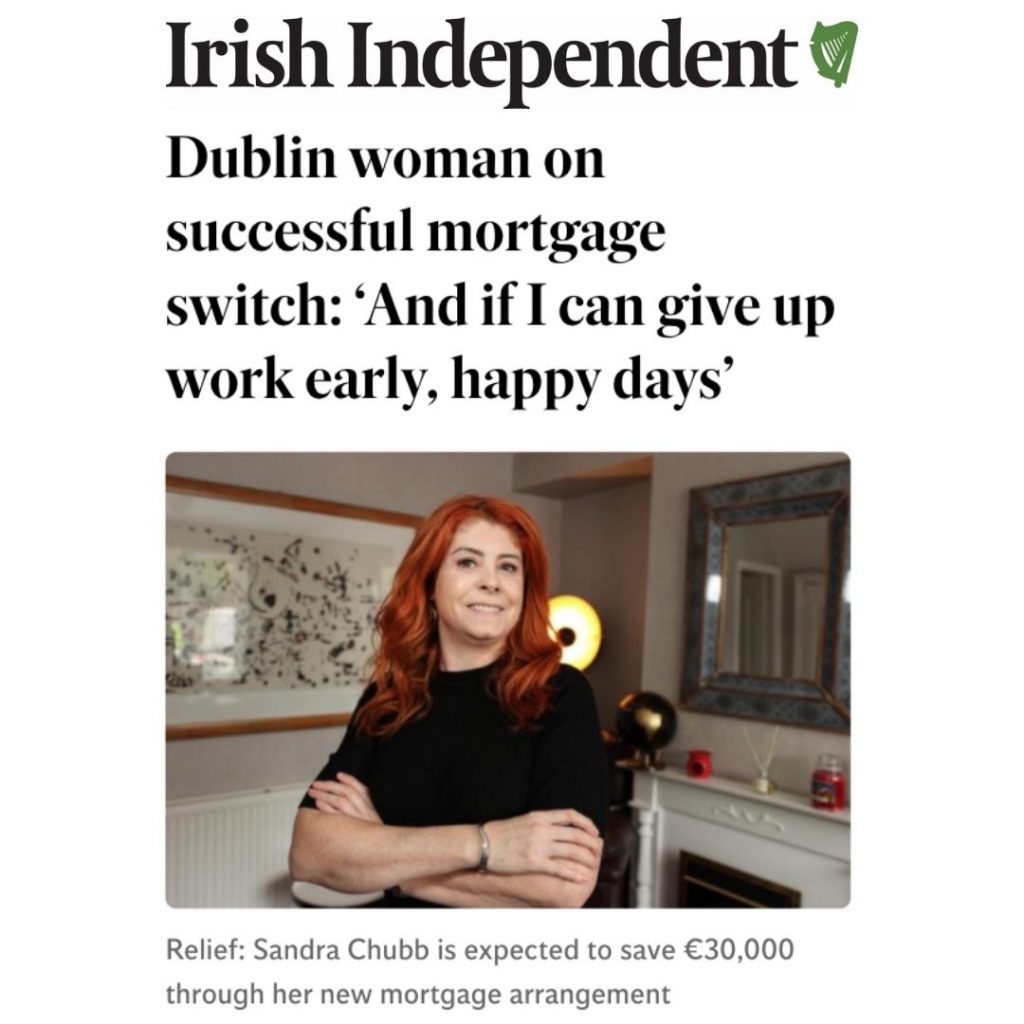
Sandra Chubb from Ballyfermot switched her €110,000 mortgage from PTSB to Avant Money in January.
She saved over €10,000 by lowering her interest rate from 3.4% to 2.01% APRC with Avant Money’s 7 year fixed product.
By reducing her interest rate by over 40% she was able to afford to reduce her mortgage term from 21 years to just 12 saving thousands in interest payments.
“They were really friendly, gave me independent advice and helped me pull together the paperwork. Most people don’t realise they are in a position to save so much by switching”
That’s why we would recommend using a broker to help you switch to a fixed rate product with a low on-going rate from either Avant Money or ICS.
The lenders with the lowest rates can usually only be accessed by brokers, many brokers are free to use and they can take the pain out of the paperwork.
It makes more sense than ever to compare mortgage rates with massive savings available. There probably isn’t another financial decision that has as big an impact on your wallet.
A big thanks to Noel, Naeiri, Murray, Jennifer and Sandra for letting us share their stories.
The non bank lenders ICS, Avant Money and Finance Ireland have really leapt ahead of the pack this year with a 0.5% discount across all mortgage types. This has left the banks, who are weighed down with legacy costs, trailing in their dust.
Annual Percentage Rate Charge (APRC) calculated on a €100,000 loan over 20 years. APRC represents the average rate across the lifetime of a typical mortgage and is recommended as the best rate to use for comparisons by the CCPC. [1]
Ulster KBC switching. Avant Money are offering €1,500 upfront for anyone switching their mortgage from Ulster Bank or KBC. The offer is available until the 31st of March and targets customers thinking of switching from Ulster & KBC as both exit the Irish market this year.
Ulster Bank have sold their existing mortgages to PTSB and KBC to Bank of Ireland. This means if you have a mortgage with either you and your mortgage will transfer.
Higher Rates on the Way for Ulster and KBC customers? – Ulster KBC Switching
PTSB and Bank of Ireland have the highest mortgage rates in the market so many Ulster and KBC customers are considering switching to a different lender. If you are in your fixed rate period then PTSB and Bank of Ireland will have to honour those rates, but after that they could choose to hike rates increasing your monthly repayments.
You can see how much higher PTSB and Bank of Ireland rates are in the table below.
[mortgage_rates_var_followon_ltv_compare]
Free Switching Costs – Ulster KBC Switching
Switching costs are usually around €1,500 for solicitor and valuation fees combined, so this offer will make switching from Ulster and KBC effectively free.
At moneysherpa for example we offer an all in legal package including all outlays for €1,200 including VAT, while estate agent valuation fees are typically around €200. So €1,400 all in.
Example Switching Saving – Ulster KBC Switching
So a typical KBC mortgage customer on their 4.25% variable rate, with €172,000 remaining over 16 years would save €187 a month and €35,983 over their remaining term. The repayment calculation is based on switching to Avant Money’s 5 Year fixed rate and using the switching offer to cover their upfront costs.
[mortgage_rates_3yr_ltv_compare]
If you are with KBC or Ulster and not on a tracker, the new Avant Money €1,500 switching offer means you will probably save over €20,000 without having to pay any upfront fees.
Ulster and KBC have been bought out by the banks with the highest mortgage rates in the State, PTSB and Bank of Ireland, so now is a good time to switch to avoid higher rates down the line.
You can book a free appointment to check out if you would save here.
Remortgage Ireland 2024. When I headed up mortgage products at PTSB, the low numbers of people remortgaging in Ireland was a shock. Despite huge savings we still have one of the lowest rates of remortgaging on the planet.
Remortgaging is simply taking out a new mortgage to pay down your old mortgage, either to get a lower rate (known as switching) or to release cash tied up in your home (know as top up or equity release).
Anybody who took out a mortgage after 2008 and is no longer on an introductory rate is likely to save around €25,000 by remortgaging. Over half of all mortgage holders, that’s over 450,000 households, will save at least €5K.
Why is the remortgaging rate so low? Well, most people don’t know how much they can save or how to remortgage. By the end of this article you will be one of thew few lucky ones able to take advantage of the record low interest rates for those remortgaging right now!
Would I save by remortgaging? Remortgage Ireland 2024
If you are one of the 66%+ people who took out a mortgage after 2008 you should definitely look into remortgaging. This is because you’re probably on what lenders call a standard variable rate.
Irish Standard Variable Rates are some of the highest in Europe, at 4.2% [1]. Remortgaging to a new business rate will reduce your interest rate and remove the risk of further increases.
If you are on a tracker mortgage, remortgaging might also make sense as ECB rates are at record highs and it may help you cap your repayments.
Even if you are on a fixed rate, if it’s less than 3 years you should probably consider remortgaging to get on a longer fixed term deal of 5 or more years to protect against upcoming variable and fixed rate increases.
How much would I save by remortgaging? Remortgage Ireland 2024
If you are in the majority of Irish mortgage holders (66%+) who would save big by remortgaging, working out exactly how much you would save isn’t complicated.
Our handy mortgage repayment calculator automatically calculates the rates available at your LTV and estimates out how much you would save if you remortgaged to the best rate in the market.
If you want to see all the providers mortgage rates and your repayments for your LTV you can click the more information button.
The loan and term outstanding is easy to get as it is sent to you each year by your lender and doesn’t change that much each year. For people remortgaging last year the loan was €170,000 and the term 15 years on average. [2]
The more your home value rises the lower the rate you can get when you remortgage. This is what lenders call the Loan to Value ratio or LTV. If you’re not sure about your home value it’s easy to estimate.
If you bought before the crash in 2008 your house is probably now worth about what you originally paid for it as the market has pretty much bounced back since then.
If you bought after 2008 it should be worth roughly what you bought at, plus give or take an additional 4% for every year since you bought. So if you bought ten years ago you can add on 40%, nice!
How much hassle and cost is it remortgaging? Remortgage Ireland 2024
Fortunately to remortgage in Ireland 2024 isn’t like applying for a mortgage the first time around. You can now do it totally online and for free.
There are still some upfront costs you have to watch out for, you still need to get a solicitor to handle your house deeds and help you with the new mortgage agreement. You will also need to get your house valued by an estate agent to help set your mortgage rate.
The higher the value of the house the lower the loan to value rate, which means less risk for the bank, which means a lower rate for you.
All in switching costs usually come in at around €1,200 including the VAT, way lower than the potential savings.
Even better lenders, who are keen for new business, often pay for your solicitors fees and to get your home valued and for you to use an online switching platform like moneysherpa’s. AIB and Haven offer over €1,500 towards the cost of switching. BoI, PTSB and EBS all offer 2%+ cash back which often works out at even more.
Plus, they will handle all the paperwork for you.
How do I remortgage Ireland 2024?
If you use a service like moneysherpa’s it is pretty straight forward. The main thing you need to worry about is what to do with the money saved. Seriously, do you?
1. Pocket the savings
If you bought after 2008, have around €170,000 and 15 years left on your mortgage you should be looking to save over €180 a month in saved interest payments.
That would be €32,400 saved over the 15 years, without including cash back payments if you keep switching. This can make a really positive difference to the household budget and give you some welcome financial wriggle room.
2. Pay off the mortgage earlier
This is personal favourite as you effectively double down with your savings.
If you use the €180 a month you save to pay off your mortgage quicker, you can reduce your term by over 10% without paying anymore than you do today. Saving you another €4,307.
That’s €32,400 + €4,307 = €36,707 saved.
3. Release more cash
If the lower monthly repayments from remortgaging mean you can borrow more, known as topping up your mortgage you could free up the cash tied up in your home. Because it’s secured on your home, a mortgage is one of the cheapest ways of securing credit. This can be a great way to fund big once off investments, but be careful if you might struggle to repay the higher amount.
In a nutshell – Remortgage Ireland 2024
Remortgaging is a great way to save. 1 in 5 people will save over €25,000 and over half will save over €5,000 by remortgaging in Ireland 2021.
Rates are better than ever and many mortgage brokers will handle the paperwork for you for free as they are paid by the lenders. Talking to a broker can help you work out the best option for your own circumstances, whether you are looking to simply save, fix your rate or free up cash.
Remortgaging is simply taking out a new mortgage on your existing property. When this is done with a lender who isn’t your current lender this is also known as switching. Typically people remortgage to get a lower rate, a shorter term or to borrow additional funds, also known as a mortgage top up.
What the difference between a remortgage, a switch and a mortgage top up?
A remortgage can either be with your current lender or a new lender, while a switch is a remortgage with a new lender. A top up is a remortgage that takes out more funds usually for home improvements.
Why remortgage?
There are two main reasons why people remortgage or switch mortgage. 1) New customer rates in Ireland are almost half existing customer rates, so remortgaging can save mortgage holders significant amounts in interest payments 2) To release equity tied up in your home. To allow investment or major purchases at mortgage interest rates which are lower than other types of loans.
How to remortgage your house?
The first step is usually to talk to a mortgage broker with access to all the lenders. They will look at who is most likely to lend to you and at what rate. Depending on what you want to do, different lenders will be suitable for different things.
How does a remortgage work?
If your switching lenders the new lender will pay down your current mortgage with the current loan. If you are still in your fixed period there may be what’s known as a breakage or early redemption fee, check with your current lender if there is, usually there is no or a very low fee and it still makes sense to switch. Once your new loan is in place with the new lender you will move on to the new terms you have agreed.
What is a remortgage?
A remortgage is a new mortgage on a property already with a mortgage. Usually that new mortgage is used to pay off the previous mortgage. Often the new mortgage is at a lower rate reducing the repayments and saving money for the mortgage holder. In Ireland this is often known as switching mortgage.
How early can I remortgage?
If you are on a variable or tracker rate you can remortgage straight away, if you are on a fixed rate you may be charged a ‘breakage fee’. However, these fees are regulated by EU law and can be zero or quite low, so you may be able to still remortgage within your fixed term. Check with your current lender what your break fee would be and then talk to a broker.
How do you remortgage a house?
To remortgage you take out a new mortgage with a new lender and use that to pay off your current lender. Usually to improve the rate or increase the mortgage amount. This known as mortgage switching in Ireland and remortgaging in the UK, but it is the same process.
Don’t let mortgage switching costs put you off switching. Switching mortgage improves your financial shape more than anything else bar winning the Lotto. In fact, if you bought after 2008 you will probably save over €20,000 by switching to lower rates.
That said, there are some upfront costs you need to know factor in, read on to find out what they are, how you can cover them with cash back and why switching still makes loads of sense.
What are mortgages switching costs and switching mortgage legal fees?
The good news is that switching your mortgage is much less stressful, easier and nowhere near as costly than buying a new home. That said there are still some solicitor and estate agent upfront mortgage switching costs.
Don’t panic though these costs are usually much less than the savings from switching and with some lenders switching mortgage legal fees and estate agent costs are fully covered with upfront payments.
There are no land registry or search fees involved with switching, but you will need a solicitor to do a bit of paperwork for you. Switching mortgage legal fees cover the solicitor costs to:
Request your house deeds on behalf of the new bank from your current bank
Review and advise you on the terms of the loan the new bank is offering you
Witness and process the loan agreement for the new bank
These steps give everyone involved in the switch peace of mind, the bank knows your ownership of the property is kosher and you understand the deal being offered to you by the bank.
As well as switching mortgage legal fees, the other mortgage switching cost is a valuation fee. An estate agent selected by the bank will also value your home, this allows the lender to make sure you are on the right mortgage rate.
How much are mortgage switching costs, switching mortgage legal fees and how much is it to switch?
So how much are the mortgage switching costs all in?
Switching mortgage legal fees range from about €1,500 to €2,000 including VAT at 23%. Typically solicitors in Dublin will be at the higher end of the range.
moneysherpa have agreed an all in switching price of €1,500 including VAT for customers switching with one of their mortgage sherpas [1]. As well as the VAT this all in fee includes
Legal Fees
Bank Fees
Search/Land Fees
Declaration Fees
The other mortgage switching cost is the valuation fee which is much less at around €150.
So if you shop around, your all in costs should come in well below the €2,000 mark inc VAT.
Which banks cover mortgage switching costs, switching mortgage legal fees and what options are there?
Many of the lenders don’t want these costs to put off potential switchers so pay an upfront cashback incentive. These incentives usually cover mortgage switching costs including mortgage legal fees with cash to spare.
Haven offer €1,500, €2,000 depending on the value of the mortgage to cover mortgage switching costs.
PTSB, EBS and BoI offer 2% and 3% of the mortgage loan as cashback. So on a typical loan size of €200,000 that’s €4,000 to €6,000 into your hand, covering your legal fee costs and then some.
These deals are really useful if you can’t afford to cover the mortgage switching costs, but would save by switching. They also are a great option if you are looking to switch multiple times, as under EU law lenders can’t stop you taking more than one cash back.
That said, if you can afford to pay the mortgage switching costs upfront and are looking to get on the best long term deal, you should us the APRC rate rather than the cash back deal to choose your mortgage provider.
In our latest mortgage market reviewthe Avant Money 7 year fixed rate product came out on top, despite having no cash back at all. The 7 year fixed rate is €6,775 cheaper than the best cash back product available on a typical loan size of €200,000.
That’s why you are often better to ignore cash back if you can and cover the mortgage switching costs yourself if you can afford it.
Does it still make sense to switch after mortgage switching costs and switching mortgage legal fees?
If you bought your house after 2008 you are probably on rates of 4% plus.
The rates for switchers right now are at an all time low at around 2%.
This big difference in rate means that you would save over €25,000 by switching on a typical mortgage size of €200,000.
This means that even after you factored in the mortgage switching costs including the legal fees, you would save over €23,000 over the lifetime of the mortgage.
The really great news is that comparing rates and switching is easier than ever thanks to services like moneysherpa.
moneysherpa have agreed an all in switching price of €1,350 including VAT for customers switching with Jacob Law.
Our recommended solicitor panel cover the majority of the country and are experts in property conveyancing, they are 100% online and are the fastest in the market. Just click here to book an appointment.
New information available from the property price register shows that Dundalk mortgage holders could save over €68 million euros by switching their mortgages to lower rates.
With the gap between existing and new business rates wider than ever, there are record savings for Dundalk mortgage switchers.
Mortgage switcher rate savings
To compare different mortgage rates you are better off using the Annual Percentage Rate Change (APRC) rather than the headline rates according to the Consumer Protection Commission. The APRC includes hidden fees and the full cost of the mortgage, so gives a much better picture of real savings.
The average APRC for those who bought after 2008 is 4.2%, according to the Central Bank of Ireland [1], but new business APRC rates are now as low as 2.29%, according to the money guide moneysherpa.test.inview.ie , that’s 1.91% lower.
This means Dundalk mortgage holders can almost half their rate by switching.
One thing to watch out for though, before 2008 Dundalk mortgage holders are likely to be on a tracker mortgage. These mortgages have an APRC of around 1%, so it is unlikely you will save if you bought before then.
How many Dundalk mortgage switchers will save?
According to the property price register [2] just under four hundred houses are sold in Dundalk every year. Since 2008 almost 5,500 homes have been sold in and around Dundalk.
Just over of a third of houses sold are in new developments built since 2008, these include:
Rathmount
Earlsfort
Marlmount
Mount Hamiliton
Lis na dara
Saltown
Castleross
On average, according to the Central Bank, half of those sales are funded with a mortgage, this means there are around 2,500 Dundalk mortgage holders stand to save by switching.
How much is the average saving for mortgages in Dundalk?
According to the Banking and Payments Federation Ireland (BPFI) [3], switchers have an average mortgage of €242,000 and 15 years of payments left.
Based on currently available new business rates, Dundalk mortgage holders would save over €25,000 each and €62.5m in total if they switched right away.
How do Dundalk mortgage holders switch?
The good news is switching isn’t complicated and is usually free according to Daire McConnon of moneysherpa.test.inview.ie.
“The banks are very keen for new business at the moment, so most cover any costs involved. The process is also much simpler than getting a new mortgage as you already have a home loan. “
“If you get a local broker or switching service to help you, they will handle all the paperwork for you and they are paid for by the lenders so are free to use .”
In a nutshell – Dundalk mortgage switcher savings
The fall in new business mortgage rates has made it attractive for the people to switch their mortgage.
There are over 2,500 Dundalk mortgage holders who bought after 2008 will make big savings by switching.
Switching isn’t complicated and a local broker can help you switch by handling the paperwork for you.