148,000 mortgage holders with either variable or short term fixed mortgage rates could face rates as high as 6% next year.
While tracker customers have borne the brunt of recent ECB rate increases, variable and fixed rate customers have seen little or no increases to their mortgage repayments to date.
Now though these customers risk sleepwalking into rates as high as 6% as banks look to pass on increased funding costs.
According to recent mortgage statistics released by the Central Bank of Ireland over 50,000 mortgage holders with less than a year to run on their fixed rates and 100,000 already on variable rates are now exposed to mortgage rate hikes.
A fixed rate customer paying the average fixed rate of 2.85% will see their mortgage repayment rise by €224 a month if they roll off onto a rate of 6%. While the average variable rate customer on 4.02% will also see their repayments climb by just over €140 a month.
Why are Variable Rates Likely to Rise?
Irish banks have come under increasing pressure to increase the deposit rates they offer to savers.
International competitors are offering the best savings account returns right now, with Dutch fintech Bunq offering 1.56% interest for on demand savers for example. In an attempt to head this off we have already seen Irish bank overnight deposit rates creeping up.
Correct as of 25/03/25. AER = Annual Equivalent Rate
This good news for savers is likely to mean bad news for borrowers as the banks look to preserve their profits on the difference they charge between both. We have already seen variable mortgage rates rise by 0.54% so far this year and further increases now look inevitable.
If variable rates do start to rise as predicted, they will impact a whole new set of mortgage holders who have been isolated from repayment increases to date. As with the tracker customer repayments there is a real risk that by the time they wake up to the increases it will be too late to do anything about it.
Central Bank retail Interest Rate data updated 20/10/2023
With the ECB rate likely to stay above 4% for the foreseeable and rising deposit rates, banks may now look to put through ‘catch up’ increases to offset their increased funding costs . This has already happened to over 30,000 variable mortgage rate holders with vulture funds where variable rates are now as high as 9% in some cases.
If variable rate increases track those seen across Europe where the Eurozone average mortgage rate has moved from 1.31% to 3.89% in the last 18 months, we would expect to see an increase of 2.58%, which would take Irish variable rates to an average of 6.06%.
What Can I Do To Avoid the Hikes?
If you’re on a variable rate or a fixed rate with less than a year to run you may still be able to avoid these hikes by switching your mortgage and fixing your rates long term on the best mortgage rate.
As rates have been rising it’s unlikely that you will incur a breakage fee if you choose to break your current fixed mortgage deal to avoid higher rates. This is because EU rules limit when banks can charge breakage fees.
It may even be worth breaking your current short term fixed rate now and paying more to secure a long term fixed rate as the current low long term fixed rates deals available now are unlikely to be around this time next year.
Fixed rates of up to 30 years are available at 3.95% from some lenders, such as Avant Money. At 3.95% the €223 a month the average hike in repayments would be cut to just €75 a month, as well as giving you absolute certainty on your future repayments.
Be aware though if interest rates fall you do risk missing out on any potential upside though.
The high street lenders have some of the highest fixed rates on the market for existing customers, so don’t sleepwalk into higher rates, talk to a mortgage broker and get market based advice before choosing your lender.
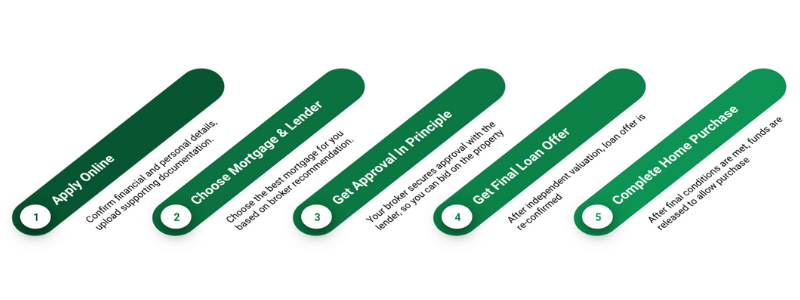
Thinking of buying a house in Ireland, but don’t know where to start? Don’t panic, our 5 key steps to Buying a House will put you on the right path.
If you are buying from Ireland or from abroad the steps are exactly the same, but can look pretty intimidating to the uninitiated, that’s why we created this Buying a House in Ireland guide.
In reality though if you follow these steps, the process is pretty straightforward and could see you securing your dream home in less than 6 months!
5 Key Steps to Buying a House in Ireland
So here’s a quick run down of the key steps to buying a house in Ireland.
Unless you are super lucky, it’s unlikely you will be buying a house in Ireland in cash which means you will need a mortgage. This will set your buying budget and can take a while to put in place, so it’s best to get the ball rolling before you start even looking at properties.
If you are a First Time Buyer you will need to put down at least 10% of the purchase price when you buy, you can do this from your savings or if you are buying a new build home using government grants.
There are two main grant schemes for First Time Buyers, the Help to Buy Scheme and the First Home Scheme. The Help to Buy scheme allows you to claim up to 10% of the purchase price of the house you are buying as a tax refund and the First Home Scheme can add up to an extra 30% by allowing the government to take a stake in the purchase.
These schemes can really boost your deposit and therefore your buying power, but they are only available to First Time Buyers buying newly built homes.
You then need to finance the remaining cost of the property with a mortgage from one of the Irish mortgage lenders. These lenders will look for proof of your ability to repay the loan by analysing your bank account before giving you what’s known as ‘Approval In Principle’.
So it’s really important when buying a house in Ireland that you can show you are saving or paying a rent larger than your mortgage repayment will be for the six months before applying for your mortgage.
How much you will be able to borrow, how much you will have to repay each month and even your chances of approval at all varies widely by lender. That’s why it’s best to get a mortgage broker who works with all the lenders, can recommend the best one for you and help you with the paperwork.
Most of the larger online brokers are free to use, so getting a mortgage broker can really help take the pain out of the financial part of buying and give you a much better idea of your buying budget. You can calculate how much you might be able to borrow here, but remember to leave money aside for costs like your solicitor, surveyor and valuer.
2. Searching for a House to Buy
When you are buying a house in Ireland it’s all about location, location, location. Think about your must haves and nice to haves for where you want to live to narrow down the area of your search.
Once you have your areas picked and your buying budget from your mortgage broker it’s time to hit the property search engines. The big two are DAFT.ie and myhome.ie [1] and if you use these to find out what property is available you will have access to 99% of all the properties listed in Ireland.
It’s worth putting the effort in to set your search engine up right, so register for an account to access email alerts and the full range of filters.
You don’t want to miss that dream home just because you only dip in and out when you are on the daily commute.
3. Viewing Houses to Buy
Before you start viewing you will need to secure your Approval In Principal (AIP) from your mortgage broker. When you are buying a house in Ireland selling agents often ask for the AIP to help them weed out the tyre kickers from the serious house hunters.
Once you have got your viewing here’s a few things you might want to look out for.
Orientation – Is the garden facing North (dark) or South (sunny)
Storage – Are you likely to run out of space?
Area – Once you’ve finished viewing, have a good mooch around the area.
While you have the agent agent, it’s best to make good use of them to dig a little deeper on the original listing. Here’s some smart questions that you might want to ask.
How long has the property been on the market?
Are there any current offers?
Why are the sellers selling?
Is there any planning permission on the home?
Have the sellers made any structural changes?
What year was the property built?
If you are interested in the house the first 3 questions will help you when you are making the offer and the last three will help avoid any nasty surprises when you are closing the purchase.
4. Making an Offer on a House
When your buying a house in Ireland the seller will often favour bids from buyers who already have their AIP in place when deciding which bids to accept, so make sure you have got a full Approval In Principal from your broker before you bid then find out if there are any current offers on the house you want to buy from the estate agent.
Once you have your ducks in a row don’t be shy in placing a bid, things can move very quickly in some house sales if buyers are happy to accept the asking price.
Although you may have your heart set on a house, make sure you don’t go beyond your budget, have a limit and stick to it.
The lenders are unlikely to go beyond their AIP amount and will also get an independent valuation of the house, so don’t be afraid of bowing out of the sale if you can’t make the numbers work.
5. Closing Your House Purchase
Once your bid is accepted and you have sent your booking deposit to the estate agent you will need to engage a solicitor, to help you review the purchase paperwork and draft the final purchase contracts, you should budget around €3,000 for this in total.
You should look for a solicitor who specialises in conveyancing, solicitors who do conveyancing on the side tend to cost more in both time and money. You can find an online conveyancer here.
Your broker will ask you to arrange an independent valuation of the property, mortgage protection and building insurance so the lender can release the remaining funds to you to complete the purchase.
It’s also worth getting a surveyor to give the house a once over at this stage for added piece of mind.
Once the funds are in place, you can exchange contracts with the seller. It’s only at this point that the sale is secure and the sellers can no longer pull out and you can finally look forward to moving into your new home!
In a Nutshell – Buying a House in Ireland
Although intimidating, buying a house in ireland isn’t actually that complicated.
The key steps are,
Getting Your Finance in Place
Searching for a House to Buy
Viewing Houses to Buy
Making an Offer on a House
Closing Your House Purchase
A good mortgage broker will not only help you secure the mortgage, but also deal with the estate agent, solicitors and insurance. Making sure you pick the right mortgage broker for your purchase is key then, you can find out more about what makes a good mortgage broker here or get free mortgage advice from moneysherpa’s brokers here.
Moving into a new home can be a daunting process, leaving many people unsure where to even get started. That’s why we at moneysherpa have created this short and simple “Moving Home checklist”, to help those who are moving home stay organised and make the process of moving home as straightforward as possible.
Moving Home Checklist: What to do before your Moving Day.
We’re all prone to a little procrastination here and there, however when it comes to moving home it’s best to plan ahead and get started as soon as possible. Here’s a short checklist of what you can do ahead of your moving day to help make the moving process as stress free as possible:
Confirm your moving day with your solicitor, conveyancer, and landlord if you are renting.
Research van hire/removal companies. Once you think you’ve found the best one and have confirmed your moving date, get a quote and book as soon as possible to get the best price.
Try to create a daily packing rota, where you allocate a small period of time each day to tick things off your packing list. This way you won’t become overwhelmed by the time your moving date comes around.
Declutter and clear your things out. Moving home is a great opportunity to sort through your belongings and donate, sell, or dispose of items you no longer need.
Start packing. Make sure you have enough boxes, labels, bubble wrap and packing tape ahead of time. If you’re enlisting the help of professional movers, check in with them before your moving date to make sure that everything is in order. Make sure to label your boxes so you won’t be struggling to find things once you’ve moved into your new home.
Make an “Essentials Box.” It might be a good idea to pack up a box with all your essentials, like toiletries, a change of clothes, and basic kitchen items for the first day at your new home.
Notify service providers. It’s important to notify your utility companies and other service providers about your move and what your new address will be. This includes:
Waste Services.
Your gas, electricity, and water provider.
Your broadband, landline, and TV provider.
Your mortgage provider.
Your insurance provider if you have home insurance.
Government offices, for instance the Revenue Commision.
Schools or employers.
Redirect your mail with An Post so that your mail will be posted to your new address. You will need to do this at least five days before your move. We’ve attached a link which will take you to the An Post page where you can redirect your mail here.
Clean and fix any damage to the property. If you rent, carefully check any instructions provided by your landlord for leaving the property.
Moving Home Checklist: What to do on your Moving Day.
With the right preparation beforehand, your moving day shouldn’t be too much hassle. Here’s a quick checklist of what you need to do on the day of your big move:
Take a Meter Reading. It’s important you take readings of all your metered services before you leave the property.
Supervise the Move. If you are hiring movers, be present to oversee the loading and unloading process.
Do a Final Check. Walk through your old home to ensure you haven’t left anything behind.
Moving Home Checklist: What to do once you’re moved in.
Once you’ve moved into your new home, it’s important to:
Ensure utilities are connected at your new home, and set up new services if needed.
Update your Address. Once you’ve moved in, you will need to update your address with the relevant organizations. Here’s a list of who you should inform of your move:
Your mobile phone provider.
Your bank and any other financial services your subscribed to.
Your insurance provider.
Health services, such as your GP.
You will also need to update the address on your drivers licence, passport, and vehicle registration.
In a nutshell: Moving Home Checklist.
Moving house requires careful planning and coordination, so make sure to give yourself enough time to prepare ahead of time. It’s important to make a checklist of what needs to be done before you move, when you move, and after you’ve moved to make the process of moving home as straightforward as possible.
15 bang up to date mortgage statistics and housing statistics that will keep you ahead of the pack. Despite a need for great data about one of the most important policy areas current statistics on the housing and mortgage market are inconsistent and hard to find. We’ve crunched the numbers and scoured the studies for you, so you can get it all in one place.
There is over €77 Billion in outstanding residential mortgages in Ireland currently, with 712,145 mortgages and 569,716 residential mortgage holders in total. With 1.2 mortgages per mortgage holder, based on Central bank data and moneysherpa projections of current mortgage holders.
Size of mortgage market Ireland 2023
Mortgage Market Ireland
Private Household
Buy To Let
Total
Outstanding Mortgages (M)
€79,421
€3,685
€83,106
Mortgage Accounts
712,347
70,057
782,404
Mortgage Holders
569,899
56,046
625,945
Based on Central Bank Credit for House Purchase advanced data and Mortgage Arrears data & moneysherpa analysis 20/10/23
2. What is the average mortgage in Ireland 2023?
The average mortgage for a private household is €135,574, based on Central bank data and moneysherpa projections of current mortgage holders.
Average mortgage in Ireland 2023
Mortgage Market Ireland
Private Household
Buy To Let
Total
Outstanding Mortgages (M)
€79,421
€3,685
€83,106
Mortgage Holders
569,899
56,046
625,945
Average Mortgage Size
€139,360
€65,750
€132,769
Based on Central Bank Credit for House Purchase advanced data & moneysherpa analysis 20/10/23
3. What percentage of people have a mortgage Ireland 2023?
34% of all Irish households currently hold a residential mortgage based on moneysherpa analysis of CSO census data and Central Bank mortgage data.
Percentage of people with a mortgage in Ireland 2023
Housing
Volume
Percentage %
Mortgage Holders [1]
569,899
34%
Home Owners [2]
1,147,552
–
All Households [2]
1,697,665
–
Households by ownership based on[1] Central Bank 2023 & [2] Census (CSO) 2020 data combined as at 20/10/2023
4. What percentage of people are mortgage free Ireland 2023?
53% of home owners and 36% of all households are mortgage free, owning their own home with no mortgage or loan outstanding on it according to the latest CSO data.
Percentage of people with no mortgage in Ireland 2023
Housing
Volume
Percentage %
Owned Outright [1]
611,877
36%
All Households [2]
1,697,665
–
[1] Households by ownership based on Central Bank 2023 & [2] Census (CSO) 2020 data combined as at 20/10/2023
5. What is the most popular mortgage type Ireland 2023?
38% of Irish mortgage holders have a variable mortgage, followed by 36% with a tracker mortgage and 25% with a fixed mortgage based on the latest data available from the Central Bank of Ireland.
Irish Mortgages by type 2023
Mortgage Accounts Ireland
Fixed
Variable
Tracker
Total
Residential Mortgage Accounts
427,287
121,064
170,915
712,347
% of total
60%
17%
24%
–
Residential Mortgage Holders
341,830
96,851
136,732
569,716
Central Bank of Ireland Financial Stability Note ‘The Interest Rate Exposure of Mortgaged Irish Households
6. What is the average outstanding mortgage length and amount Ireland 2023?
38% of Irish mortgage holders have a variable mortgage, followed by 36% with a tracker mortgage and 25% with a fixed mortgage based on the latest data available from the Central Bank of Ireland.
Irish Residential Mortgages Dec 2022 (PDH)
Mortgage Accounts Ireland
Fixed
Variable
Tracker
Total
Outstanding Term (Years)
19
13
11
15
Outstanding Value(M)
€48,383
€10,689
€18,169
€77,241
Outstanding Value per Holder
€141,541
€110,365
€132,880
€135,578
Central Bank of Ireland Financial Stability Note ‘The Interest Rate Exposure of Mortgaged Irish Households, Credit Advanced for Household Purchase as at Dec 2022
7. How many people are in mortgage arrears Ireland 2023?
Number of mortgage in arrears Ireland 2023
Arrears Status
Accounts
Mortgage Holders
Total > 90 days arrears +
17,723
14,178 (19%)
Of which > 5 years arrears +
11,623
9,298
Data from Central Bank Arrears Report adjusted for closed funds using moneysherpa estimates 20/10/2023
8. How many people are with vulture funds Ireland 2023?
Number of mortgages affected by vulture funds Ireland 2023
Closed Fund Status
Mortgage Holders
Total Closed Fund Mortgages
90,104
Performing Tracker
25,625
Performing & Fixed
7,500
Performing Variable
12,500
Restructured
13,638
In Arrears
20,496
moneysherpa estimates 20/10/2023 based on Central Bank Arrears Data
9. What is the current mortgage rate in Ireland 2023?
Current mortgage rate in Ireland 2023
Housing
Tracker (PDH)
Variable Rate
Fixed 1 Yrs+
Private Household
+1.15%
4.02%
2.85%
Buy To Let
+1.08%
4.39%
3.82%
Central Bank retail Interest Rate data updated 20/10/2023
10. How many mortgages are issued every year in Ireland 2023?
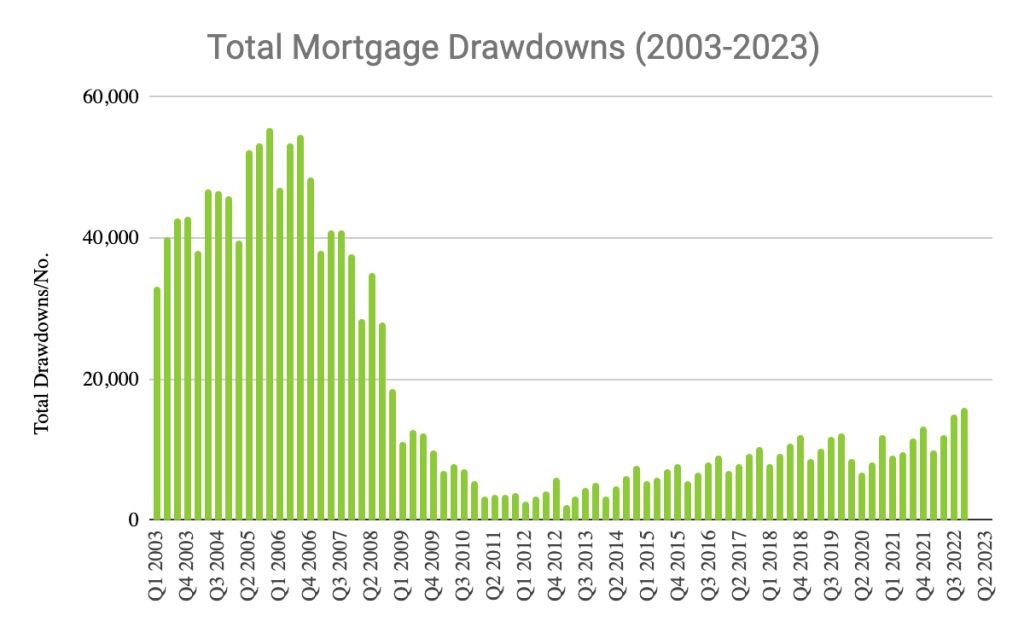
52,634 new mortgages were issued last year in Ireland down from a peak of 204,000 in 2006 according to moneysherpa analysis of BPFI drawdown data.
11. How many people switch mortgage Ireland 2023?
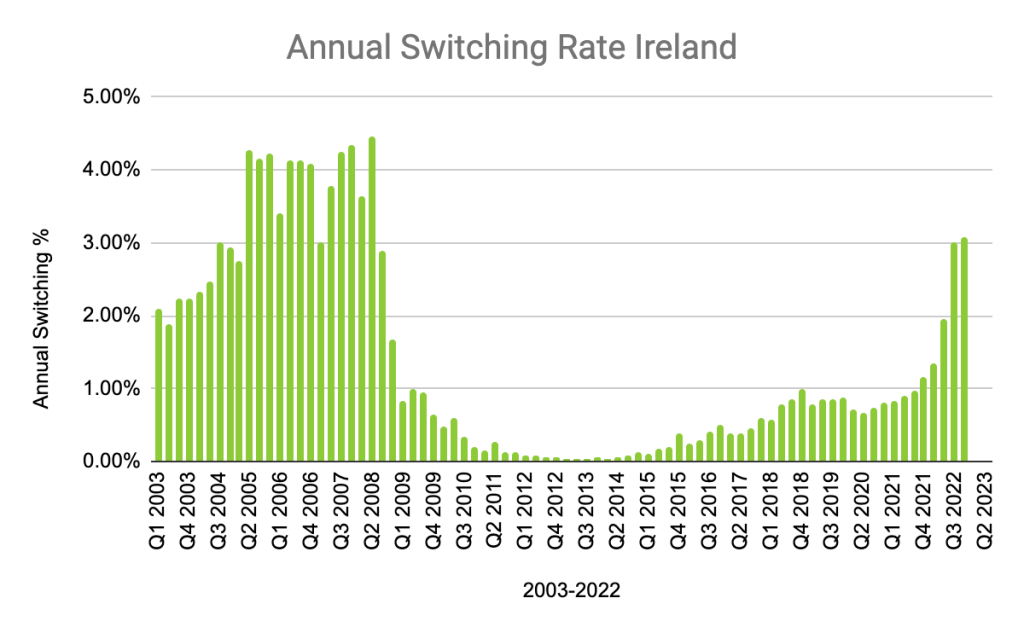
3.08% of existing mortgage holders switch per annum down from a peak of 4.27% in 2005 according to moneysherpa analysis of BPFI drawdown data.
Switching & Top Ups As % of Outstanding PDH Mortgages BPFI Drawdown Report
Key Housing Statistics Ireland 2023
1. What percent of people are homeowners in Ireland 2023?
67% of all Irish households own their own home based on CSO census data.
Percentage of renters and homeowners in Ireland 2023
Housing [1]
Volume
Percentage %
Home Owners
1,147,552
67%
Households Renting
545,006
32%
All Households
1,697,665
–
Households by ownership based on [1]Census (CSO) 2020 data
2. What percent of people rent in Ireland 2023?
32% of households rent based on the latest CSO data.
Percentage of renters and homeowners in Ireland 2023
Housing [1]
Volume
Percentage %
Home Owners
1,147,552
67%
Households Renting
545,006
32%
All Households
1,697,665
–
Households by ownership based on [1]Census (CSO) 2020 data
3. What is the average monthly rent in Ireland 2023?
The average monthly rent is €1,464 compared to the average monthly mortgage repayment with a 50% deposit of €976.
Average rent vs average mortgage Ireland 2023
Housing
Monthly
Household Rent [1]
€1,464
Mortgage repayment[2]
€1,757
Mortgage repayment (inc HTB)[3]
€1,562
Mortgage repayment (inc HTB & FHS)[4]
€976
[1] Average Rent Residential Tenancies Board 2022. Households by ownership based on census data. [2] Scenario: 10% Deposit, Best rate,€370,000, 22 year term including Help to Buy (HTB) scheme. [3] Scenario: 20% Deposit, Best rate,€370,000, 22 year term including Help to Buy (HTB) scheme. [4] Scenario: 50% Deposit, Best rate,€370,000, 22 year term including HTB and First Home Scheme(FHS).
4. What is the average house price in Ireland 2023?
The median house price is €370,000 for a new house and €275,000 for an existing property.
As interest rates rise house prices Ireland 2023 have come under pressure, but the Central Bank raising the mortgage limit from 3.5 to 4 times income from the 1st of January this year may open up significant new demand and prop up prices longer term.
This will cause concern for some but, are house prices Ireland 2023 the real issue or are policy makers and opposition parties missing the point?
A study published by economist Ronan Lyons earlier this year, throws new light on the link between building costs, house prices and supply.
Simply put, the larger the gap between house prices and costs the greater the new housing supply.
If a developer can make a tidy profit, then they will develop more units until eventually supply catches up with demand and prices fall.
Here are the key things you need to know about house prices Ireland 2023 and how they will change in future.
It’s the Economy Stupid – House Prices Ireland 2023
In a free market there are then just two ways to make more houses available.
Reduce building costs
Increase house prices
Lyon’s analysis suggests that for the country to hit anything like the 30,000 completions target in the government’s Housing for All strategy building costs would have to reduce by nearly 40%.
With rising energy costs recently sending material and labour costs spiraling out of control, this seems unlikely.
Sure the government can introduce tax reliefs on development to put a brake on rising costs, but putting them into reverse seems a very tall order.
They could nationalise house building, but the cost problem doesn’t go away and since when did the state being in charge make things more efficient?
So with reducing costs ruled out as an option, let’s turn instead to increasing house prices to get supply back on track.
Housing Affordability does not = Low House Prices – House Prices Ireland 2023
The real issue with the housing market isn’t house prices, it’s housing affordability and that’s not quite the same thing.
What if we could raise prices in the housing market without reducing affordability?
Although this sounds counter intuitive there are many ways to do this, one is to increase the effective income of house buyers through grants or tax reliefs. This is the thinking behind the First Home scheme.
Yet there is one other significant weapon to increase housing affordability.
Credit.
Simply loosening the current Central Bank mortgage lending rules increases house prices, increases developer profits and in turn is likely to increase the supply of new homes.
While also increasing housing affordability for many who previously couldn’t buy a home.
The reason for this is that the Central Bank mortgage rules have locked out thousands of potential homeowners and trapped them in the rental market.
This has driven monthly rents way above monthly mortgage repayments.
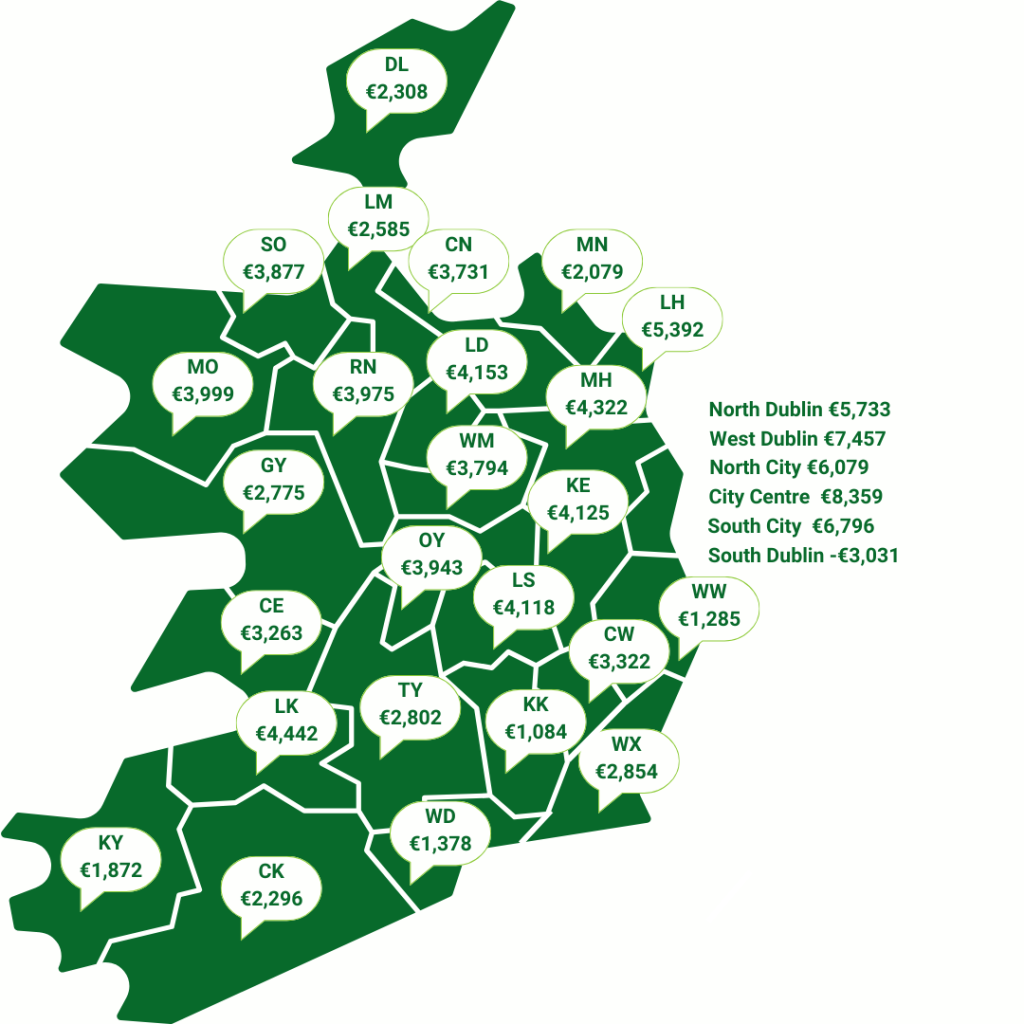
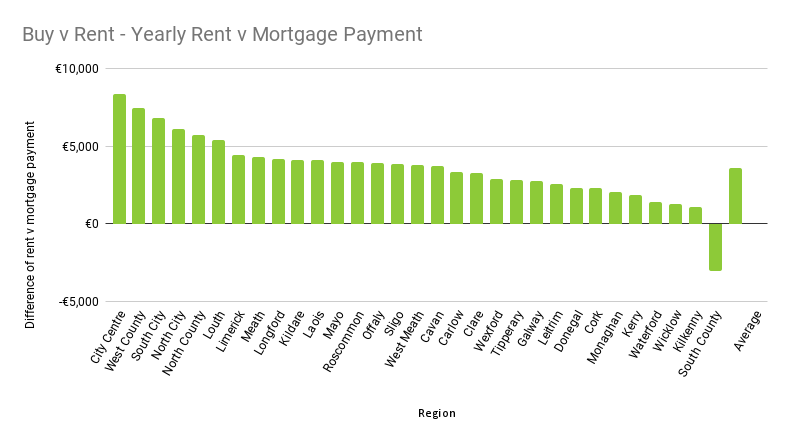
In fact, recent analysis by moneysherpa.test.inview.ie indicates that the average rental household would save over €1,000 a month if the Central Bank rules allowed them to apply for a long term fixed rate mortgage at current rates.
Central Banks Lending Limit – House Prices Ireland 2023
So by lifting the 3.5 times lending cap imposed by the Central Bank, three things are likely to happen.
Housing affordability will rise as currently trapped renters move to a monthly mortgage
House prices will also rise as renters can now compete with investors for property
Housing supply will increase as developers greenlight projects that didn’t make financial sense previously
Hang on a minute though, doesn’t that just create a credit fueled housing bubble with people buying houses they can’t afford just like back in 2008?
That seems unlikely for a couple of reasons.
Firstly, we already know people can afford to pay these mortgages as they are already paying way more every month in rent.
Secondly, even if you removed the Central Bank limits completely the barriers to getting a mortgage are still way higher than back in the day. That’s because the rules imposed on Irish bank’s by the European banking regulators post 2008 already stop Irish bank’s lending willy nilly.
That’s why the Central Bank lifting the lending limits is a move to be welcomed, but should also raise the question. Why on earth was one of the tightest restrictions on mortgage lending across Europe put in the first place?
In a Nutshell – House Prices Ireland 2023
Given the hames the Bank made regulating the Irish banking sector last time around it was only natural for it to take a safety first approach.
The issue with the limit is that it put the kibosh on many lower and middle income families owning their own home. Thereby trapping them into paying spiraling rent, making them poorer and increasing social inequality.
We should be glad to see the back of the 3.5 limit, property investors will welcome the increased purchasing power it creates in a time of rising interest rates and potential house buyers will welcome the inevitable result, more homes being built than there would be otherwise.
moneysherpa believe that the Government and Central Bank are failing customers who have been sold off to ‘vulture funds’.
Although the name ‘Vulture Fund’ is commonly used, these funds, also known as non bank entity funds and closed funds, are usually backed by pension funds who are looking for low risk investments with a steady return and are common in financial markets around the world.
The important difference between mortgages with Vulture Funds and those with other lenders is that they are not open for new retail business. That’s why they are also known as closed funds.
The 85,000 Mortgage holders in Ireland with closed funds (‘vulture funds’) are more vulnerable than customers of ‘open’ funds (funds offering new mortgages) because.
Closed fund customers may be tied to their lender due to not being able to meet open lender affordability tests, making them ‘mortgage prisoners’ leaving them open to predatory pricing.
Closed funds are not actively competing for new business so are not constrained in their approach to their customers as Open funds.
It’s this lack of options that we believe is the key concern, where there is in effect a monopoly. When there is market failure as in this case, bad things can often happen to consumers.
If you have been out of arrears for more than 2 years and paying full capital and interest for more than a year a moneysherpa advisor will be happy to advise you for free here. If you are over sixty then even if you aren’t out of arrears equity release may be an option, if want to find out more check out our Equity Release Ultimate Guide.
We think that the current proposals to address these issues fall short of what is needed, being either unrealistic or even counter productive. The right approach to help vulture fund customers in our view is to focus on addressing the clear market failures.
For this reason moneysherpa believes, the regulator and government have a duty to protect consumers by lowering barriers to accessing the open market.
Within the 85,000 closed fund customers our analysis shows that there are three broad customer groups to consider
Customers who can access the open market now – circa 26,000
Customers who can’t access the market due to affordability tests- circa 38,625
Customer customer who can’t access the market due to arrears – circa 20,375
Our estimates are based on the Central Bank non bank lender data reduced by the projected non bank lender share of open bank lenders and converted to actual mortgage holders using the 1.2 ratio of mortgages per mortgage holder als in Central Bank data as below.
Number of mortgages affected by vulture funds Ireland 2023
Closed Fund Status
Mortgage Holders
Total Closed Fund Mortgages
90,104
Performing Tracker
25,625
Performing & Fixed
7,500
Performing Variable
12,500
Restructured
13,638
In Arrears
20,496
moneysherpa estimates 20/10/2023 based on Central Bank Arrears Data
Within the 85,000 mortgage holders with closed funds we estimate there are around 59,000 ‘mortgage prisoners’ who are unable to move to the open market.
Current interest rates for these groups is estimated below based on Central Bank Jan 2023 data and assuming that the 1% ECB rate increase post Jan has been passed through to mortgage holders.
Closed Fund Type
Mix
Mortgage Accounts
Mortgage Holders
Est Rates March ’23
Closed Fund Type
Mix
Mortgage accounts
Mortgage holders
Estimated Rates March ‘23
Trackers
37%
37,517
31,000
4.14%
Variable
45%
45,475
38,000
5.57%
Fixed
18%
18,000
15,000
2.57% (5.57% after fixed ends)
Total
100,992
85,000
Rates based on Central Bank January 2023 Retail Interest Report + ECB 1% March ’23 – 20/03/2023
Based on these projections the majority of closed fund customers are paying or will be paying significantly above current market rates, which are typically around 3.5% APRC.
It should be recognised that a sizable group of these customers, over 30,000, are simply with closed funds due to the exit of HBOS and Danske bank from the Irish market.
Read on for further analysis of the vulture funds customers and what should be done.
Customers with non restructured mortgages – vulture funds Ireland
53% of closed fund customers (46,294) are not in arrears and are paying the full outstanding capital on their mortgage. They are therefore in theory able to switch to open market lenders subject to meeting lender criteria.
Affordability checks
CCR requirements 2-5 outside of arrears
It’s unclear how many of these customers can switch in practice.
The most significant obstacle in practice is the lender affordability checks which include a mandatory 2% stress test on the prevailing rate required under the Central Bank Consumer Protection Code.
Closed Fund Switching Examples
March ‘23 APRC
New rate APRC
Remaining Loan
Remaining Term
Current Repayment
New Average Repayment
Monthly Saving
Total Saving
Variable customer
5.57%
3.19%
€138,000
15
€1,133
€966
€167
€30,068
Tracker customer
4.14%
3.19%
€173,000
15
€1,292
€1,211
€81
€14,626
Fixed customer
5.57%
3.19%
€206,000
15
€1,691
€1,441
€249
€44,884
Data from Central Bank Retail Interest Rate report Jan 23
Therefore a typical performing closed fund variable rate customer @ 5.57%, €138,000 and 15 years outstanding, paying €1,133 a month may not be able to switch to an open market repayment of €167 less due to a combination of lender and Central Bank affordability rules.
Customers with Restructured Mortgages – vulture funds Ireland
22.5% of closed funds,19,000 in total, are classified as restructured of which 16,000 are meeting the terms of the restructure. This includes mortgage splits, capitalisation, reduced interest and term extension.
The 16,000 restructured mortgages meeting the terms of their restructuring may also be able to switch to the open market, although only to a limited set of products and lenders. The example shown below uses Finance Ireland Progress Plus rates, which are available to restructured customers, not in arrears for 2 years when paying the full capital and interest.
Closed Fund Switching Examples
March ‘23 APRC
New rate APRC
Remaining Loan
Remaining Term
Current Repayment
New Average Repayment
Monthly Saving
Total Saving
Variable customer
5.57%
5.69%
€138,000
15
€1,133
€1,142
-€9
-€1,589
Tracker customer
4.14%
5.69%
€173,000
15
€1,292
€1,431
-€139
-€25,061
Fixed customer
5.57%
5.60%
€206,000
15
€1,691
€1,694
-€3
-€592
Data from Central Bank Retail Interest Rate report Jan 23
For both Variable and Fixed mortgage holders, if ECB rates rise above 3.5% returning to the open market could potentially reduce monthly repayments.
Customers in Arrears – vulture funds Ireland
Almost 24%, a total of 25,469 customers are in arrears of more than 90 days currently.
Number of mortgage in arrears Ireland 2023
Arrears Status
Accounts
Mortgage Holders
Total > 90 days arrears +
17,723
14,178 (19%)
Of which > 5 years arrears +
11,623
9,298
Data from Central Bank Arrears Report adjusted for closed funds using moneysherpa estimates 20/10/2023
These customers may have fallen into arrears due to changes in personal circumstances or other reasons. There are very limited solutions for them in the open market, however equity release may still be an option as explained below.
Options for customers by group – vulture funds Ireland
Depending on individual circumstances there are different options open to these customers. We have broken it down into three main groups.
1 – Customers who can access the open market now – vulture funds Ireland
We estimate that 26,000 of the 85,000 mortgage holders with vultures are able to switch, based on taking the average salary and outgoings 45,625 performing non restructured loans, with the average salary and outgoings applied to current lender calculators.
These customers may not have chosen to move to the open market, by switching their mortgage lender, as they think there may be little benefit or may be unaware that they can.
We believe that there are in fact substantial benefits for the majority of customers of moving to the open market, by being able to fix for example or to be able to exercise market power and that these benefits may not be fully understood by consumers.
We believe that inaccurate or misleading media coverage around Vulture funds and lack of communication by active lenders and brokers may have led to a false perception that these customers are ‘mortgage prisoners’ when they are in fact free to move.
2 – Customers who can’t access the market due to affordability tests – vulture funds Ireland
We estimate that there are 38,625 customers who can’t access the market due to affordability. These customers are either paying the whole value of the loan, but can’t pass affordability checks due to changed credit rules or circumstances, or are only currently paying off part of their loan.
These customers are not in arrears, but are currently ‘mortgage prisoners’ as they can not pass the open market lender affordability tests.
Some of these customers are being stopped moving by the Central Bank CPC stress test requirement of 2%.
Some of these customers would still fall below affordability thresholds if this test was to be removed.
3 – Customers who can’t access the market due to arrears – vulture funds Ireland
These customers 20,375 are in arrears and are currently ‘mortgage prisoners’ as it is unlikely another lender would take them on due to their credit history.
There are some exceptions to this, in particular equity release for those over 60 is not dependent on credit history and is a way to pay off the closed fund in return for giving away a slice of your property when you leave the home.
However for most people, it is unlikely they have any open market options currently and are therefore the group most in need of protection from predatory pricing.
moneysherpa are advocating for a number of changes from both government and the funds themselves to help those customers who are currently trapped or believe themselves to be trapped with closed funds.
1- Customers who can access the open market
The Government and/or the Closed Funds themselves should fund free independent financial advice to all closed fund customers currently able to access the open market.
This advice would include a full comms plan administered by the funds, website and advice services provided by the government and government agencies such as Citizens Information and/or MABS.
2- Customers who can’t access the market due to affordability
The Central Bank to work with lenders to develop more flexible affordability test for customers who are reducing their repayments by returning to the open market and to remove the CPC stress test for any customer moving to a lower average repayment over the mortgage term
The Government should also fund an equity grant scheme modeled on First Home scheme to bridge the affordability gap by reducing the required open market mortgage to a level that can be afforded by the customers and return closed customer to open market.
In the UK the London School of Economics has recently published a set of proposals including free advice and an equity release scheme to address the issue of Mortgage Prisoners there.
Next Steps- vulture funds Ireland
We are keen to understand the circumstances around mortgage prisoners as well as we can, so that we can lobby and develop ways to help.
If you have been out of arrears for more than 2 years a moneysherpa advisor will be happy to advise you for free here. If you are over sixty and want to find out more about equity release as an option, check out our Equity Release Ultimate Guide.
We are keen to understand the circumstances around mortgage prisoners as well as we can, so that we can lobby and develop ways to help. We have also opened a thread on this topic on askaboutmoney.com here.
Congratulations you have your loan offer, but what happens next? Don’t worry we are going to guide you through the mortgage drawdown process with our Mortgage Drawdown Ultimate Guide Ireland 2022
For most people this is a once or twice in a lifetime transaction. It can be stressful but ultimately it will be worthwhile. Your solicitor needs to make sure that they cover all legal and planning issues before mortgage drawdown so that there won’t be any problems when and if you decide to sell in future.
The following guide will give you a better understanding of the mortgage drawdown process and how you draw down your mortgage.
How Long Will The Process Of A Mortgage Drawdown Take? Mortgage Drawdown Ultimate Guide Ireland 2022
First your own solicitor will need a copy of your loan offer, this should be sent directly to your solicitor by your lender, in what’s known as the loan pack.
Your solicitor will need the loan pack for the house you are purchasing before they can proceed, if it’s a switch they still need the loan offer pack. On average the loan offer takes 4/6 weeks to be issued by the lender.
Most solicitors will not look at any other documents until they have received the loan offer as they don’t want to spend time on a purchase that might not go through.
If you want to speed the mortgage drawdown process up though, you can either undertake to pay the costs in the event of the loan not being received or find a solicitor who will waive their fee if the transaction doesn’t go through.
This can speed up the process considerably, as you can be working on sale contracts whilst still waiting for your loan offer.
What Can Delay Mortgage Drawdown ? Mortgage Drawdown Ultimate Guide Ireland 2022
The issuing of contracts can be delayed if the Vendor’s Solicitor is getting deeds from a Bank (this takes between 10 and 14 days normally, but can take over a month) or if they are missing documents such as Certificates of Compliance.
Your solicitor will request these as they need to make sure that the house complies with all Planning and Title matters.
The house deeds are always needed so requesting these as early as possible is essential in getting your mortgage draw down complete as soon as possible.
It’s worth pushing your solicitor to act fast and move things along in parallel.
Most solicitors don’t specialise in property conveyancing so are only part time on your house purchase. You might want to look for a solicitor who is 100% dedicated to conveyancing and allows you to track your completion process on line.
moneysherpa recommend Jacob Law who specialise in conveyancing and have an online tool so you can upload your docs and track progress. If your switching they offer an all in price of €1350 including outlays and VAT.
Solicitors are also a particularly cautious breed and while this can be a good quality in their role, encouraging them to act faster rather than hang on for all the t’s to be crossed and i’s dotted usually pays off.
If your don’t move quickly vendors can pull out, lenders rates can change and your own circumstances may also shift, so it’s your job to push the solicitor as hard as you can to speed up the closing.
What Happens When You Get The Contracts- Mortgage Drawdown Ultimate Guide Ireland 2022
Once your solicitor has contracts and your loan pack, they read them and advise you about the property. They will also raise queries with the Vendor’s solicitor regarding the title.
They should send you a copy of any correspondence with the vendors solicitor.
What Happens After You Get The Advice Letter- Mortgage Drawdown Ultimate Guide Ireland 2022
Once you get the advice letter from your solicitor you should make sure that you are happy with the advice given and your solicitor will chase for replies to the queries/questions they have sent to the vendor’s Solicitor.
Once they reply and if the replies are ok, your solicitor will call you to arrange an appointment to go through the contracts and sign them if appropriate.
On average it takes two weeks to get replies and arrange to get contracts signed.
What Do You Need When You Sign- Mortgage Drawdown Ultimate Guide Ireland 2022
You need to pay the balance of the deposit on signing contracts and the cheque is payable to the Vendor’s solicitor. If you have not given your solicitor a copy of your driving licence or utility bills, as proof of identity and address, you will need to provide these at this point.
Your solicitor will then go through the contracts and loan offer and if you are happy then you sign the contracts. At this point you should get a definite idea as to the closing date from your solicitor.
Are You Committed When You Sign? – Mortgage Drawdown Ultimate Guide Ireland 2022
Once you sign the contracts, they are sent to the Vendor’s solicitor for signing by the vendor. The contract is not binding until they sign and return one copy.
This normally takes a week or two but it may be longer if the Vendor is buying another property or if there is a chain of transactions.
When Do You Close And When Do You Pay? – Mortgage Drawdown Ultimate Guide Ireland 2022
Once your solicitors have a copy of the contract back and know the closing date, your solicitor will email you details of what balance is required to close.
You also need to make sure that all the documents necessary for drawdown of your loan are with your mortgage provider.
Once your solicitor has all the monies they will arrange the mortgage draw down.
The Vendor’s solicitor then sends your solicitor all the Title documents on trust and the purchaser’s solicitor will transfer monies on trust then carry out searches to make sure there are no judgements against the property or the vendors.
If everything is ok and you confirm that the house is vacant and cleared out, your solicitor will authorise the release of the monies and you can collect keys from the Auctioneer.
What Happens After Closing – Mortgage Drawdown Ultimate Guide Ireland 2022
Your solicitor will arrange to stamp the deed and register the property. If you have an existing mortgage, they send your deeds to the Bank after the registration completes. If you do not have a mortgage, they will write to you to collect your deeds when they are registered.
Summary – Mortgage Drawdown 2022, Ultimate Guide
Mortgage draw down is a complex process so to summarise the steps that you need
Review your loan offer conditions with your solicitor
Request the house deeds from your current lender (if you are also selling or switching)
Review the property contracts with your solicitor and sign
Pay the outstanding deposit balance (if a new house purchase)
Supply lender with any outstanding documents (mortgage protection etc..)
Drawdown Mortgage
The key tip is chase, chase, chase. Don’t let your solicitor drive the process, make sure you are pushing and getting all your docs in on time.
The longer things take, the more that can go wrong.
That’s why getting partners that know the process inside out makes a lot of sense. moneysherpa advisors work with the best completions and solicitors in the country to make sure you get the best and fastest route to mortgage drawdown.
Next Steps – Mortgage Drawdown Ultimate Guide Ireland 2022
The Central Bank announced as series of changes to the mortgage rules ireland this week, starting on the 1st of January next year, aimed at helping with the housing crisis:
The Loan to Income ratio for First Time Buyers is to be increased from 3.5 X Income to 4 X Income
The definition of First Time Buyers is to be extended to include those who have been divorced, separated or bankrupt to give them a ‘fresh start’.
The Loan to Value ratio for 2nd Time Buyers is to be reduced from 20% to 10%. Meaning you will only need a 10% deposit although the lending limit remains at 3.5 X income.
Is this a good thing? Mortgage Rules Ireland 2022
This mortgage rule change is a welcome move, this summer moneysherpa analysed rents and repayments nationwide and found the average renter would save over €1,000 a month by buying instead of renting.
The 3.5 X Cap froze our renters, who are typically lower income, from buying. This led to the less wealthy becoming even less wealthy, trapped paying rents instead of building up family wealth.
Increased social inequality and was therefore an unintended consequence of the limit.
The 3.5 limit made sense for the Central Bank after making a hames of the housing market back in 2008, they wanted to cover themselves from ever happening again.
But, and it’s a big but, the social cost of baking in intergenerational inequalities was massive. It’s great to see the 3.5 X mortgage rule go, but it’s one of many short sighted and ill judged housing measures currently in place that need reforming.
Will This Increase House Prices? Mortgage Rules Ireland 2022
There is some concern that this move may lead to increased house prices by letting renters into the market. It may well do, but that’s because it makes houses more affordable by giving more people access to credit, it’s a little perverse to say this is not a good thing.
To the worry that this is a return to the bad old days of the 2008 credit bubble, there are a number of significant differences between now and 2008 in play.
The LTI limit has not gone, it’s just gone up to 4 times income which just brings us in line with others in Europe
Lender rules are much tighter, with proper due diligence on affordability. Back in 2008 it was the wild west and we all have stories of brokers and banks making up the numbers as they went along.
The banks cost of credit is much higher due to increased capital requirements, which makes them a lot pickier about who they lend to.
Are Higher House Prices A Bad Thing? Mortgage Rules Ireland 2022
My last point on this, which may seem counterintuitive is that higher house prices may not in fact be a bad thing.
If more support through looser credit and grants being available, prices can be higher without affordability actually being lower.
Because our building costs are so high, developers aren’t actually making that much on building houses right now, with margins often below 10%.
As a result they ‘cherry pick’ which areas they want to build in and what type of customer they want to buy for.
That’s why we have a supply shortage particularly in rural or lower income areas. If prices rise, profits for developers will rise, which means supply will also rise.
This is a point many seem to miss entirely. I know it requires using a bit more using the grey matter to understand this, but people who are making housing policy or who will potentially be making policy really need to avoid saying daft things like lowering house prices is the objective.
Making more houses affordable is the objective and that’s a completely different thing.
The process of applying for a mortgage can often be very daunting and filled with uncertainty, but not if you get the right mortgage adviser. Find out what to look for with our mortgage adviser ultimate guide Ireland 2022.
In this article, we aim to outline what a mortgage adviser is, why you should consider going to one, and how to find the best one for you.
What is a Mortgage Adviser? Ultimate Guide Ireland 2022
A mortgage advisor is a qualified professional who aims to find the best mortgage deal for you given your personal circumstances.
With over 250 mortgage products offered by 9 different lenders in Ireland, it’s no wonder so many struggle to find the best mortgage for them, and end up going with a mortgage that could lose them thousands in the long run.
A mortgage adviser will help you work out how much you can afford to borrow and use their knowledge of the market to find the best deal available.
When looking for the best deal out there, a good mortgage adviser will;
Talk with you to figure out what you can afford to borrow given your financial situation
Search the market for the best deals available
Compare deals offered by lenders
Tell you about different deals to help you find one that best suits you
Why should I go to a Mortgage Adviser? Ultimate Guide Ireland 2022
There are many benefits to seeing a mortgage adviser, as a good mortgage adviser will;
Look at your financial circumstances to find a deal that best suits you
Use their knowledge of lenders to find ones that are right for you
Access exclusive deals not available directly
Help you with the paperwork that comes with applying for a mortgage
Help you find a deal that you are likely to get
A mortgage advisor can help lift the burden that comes with applying for a mortgage.
By using their connections and knowledge of the market, mortgage advisers can help find a deal that is affordable and right for you.
Finding a deal yourself can be a long and difficult process. Mortgage advisers are there to save you time and effort, and may even be able to find you a deal you can’t on your own.
How do I find the right Mortgage Adviser for me? Ultimate Guide Ireland 2022
There are many factors you should take into consideration when looking for a mortgage adviser, such as;
Type of mortgage adviser
Mortgage advisers can either act independent or work on behalf of a lender. It’s important to know if you’re mortgage advisers is working for a financial institution, as this can impact their advice.
It’s also important to see how many lenders your mortgage adviser works with, as mortgage advisers who only work with a certain amount of lenders can only offer you a limited amount of deals.
An independent mortgage adviser will show you deals from many different lenders as they are not tied to only one, meaning you can choose from a wider range of lenders and deals.
Fees
Some mortgage advisers will not charge their clients, as they’re paid a commission based on the value of their clients mortgage once it has gone through.
Yet some mortgage advisers may charge their clients a flat fee of €100-€150. Other advisers may charge their clients a commission based on a percentage of their mortgage. This can be a problem if you are looking to take out a large mortgage.
Always ask mortgage advisers about their fees before deciding who to go with.
Qualifications
It’s important to find out what qualifications your potential mortgage adviser has. Before going with a certain advisor, check that they;
Are a Qualified Financial Adviser (QFA)
Are an Accredited Product Adviser (APA)
Are registered with the Central Bank of Ireland
It’s vital that the advisor you go to has the right qualifications to give you accurate financial advice when it comes to your mortgage.
Find out more on how the Central Bank regulates mortgage advisers here.
In short, mortgage advisors are professional financial advisers who are there to act in your best interests and find the best mortgage for you.
Mortgage advisers help ease the stress of applying for a mortgage by figuring out what you can afford to lend, getting and comparing deals from lenders and finding the best one for you.
Next Steps – Mortgage Adviser Ireland 2022, Ultimate Guide
We at moneysherpa have qualified financial advisors on hand to help you find the best mortgage deal for you. If choose moneysherpa as your mortgage adviser, you will;
Get our expert opinion free of charge
Have a wide range of options from a wide range of lenders, as we act independent from financial institutions
Have your paperwork dealt with digitally in one of our free online calls
Get comprehensive advice on all your options to find the best deal to suit your personal circumstances
Get our lifetime best rate guarantee, meaning our sherpas will always check the market to switch if we find a better deal for you
Have all your questions or queries answered by our team of professional mortgage advisers
The European Central Bank (ECB) base rate drives lender mortgage interest rates, when it goes up or down then ultimately so do the mortgage rates in Ireland.
The latest ECB survey of professional forecasters expect the ECB interest rate to stay at 4.5% in the first half of 2024 and then fall back to just over 4% by the end of 2024.
That means the average ECB interest rate across the year in 2024 will actually be 0.5% higher than the rate was in 2023. In worse news they expect rates to stay above 3.5% in 2025 as underlying inflation is proving hard to tackle.
So does this mean mortgage interest rates in Ireland will go up and what does it mean for you?
In a nutshell, mortgage rates Ireland will stay higher for longer and the impact on your monthly repayments is likely to be significant. If you are on a tracker, variable or are one of the 70,000 households on a fixed rate of less than one year you could be looking at rates staying around 5%-6% into 2025.
Don’t panic though, by switching to the best fixed rate you can probably still reduce your monthly repayments as there are still fixed rates available below 4%. If you need advice on your options talk to a mortgage broker who has access to all the rates on the market, you can book a free advice call with a broker now using the button below or read on to get our in depth analysis of the market for each mortgage type.
Check out moneysherpa’s analysis for RTE news below or read on to understand what the mortgage rate increases mean for you (including our new simple tool for calculating the impact of rate changes for you) and to get the inside track on what to do about it.
ECB Interest Rate Increases – Mortgage Interest Rates Go Up Ireland 2024
The latest ECB Survey of Professional Forecasters came out this Autumn.
The survey uses forecasting data from finance experts across Europe to predict the likely direction of interest rates.
The average prediction is that ECB interest rates will stay at 4.5% until the second half of 2024 and drop slightly to 4.25%, before falling back to 3.25% in 2025. This sounds pretty realistic with UK interest rates are already over 6% with US rates over 5%.
Some of the European experts surveyed though see interest rates climbing toward 5% as the ECB struggles to tamp down inflation.
It’s worth remembering that back in the nineties interest rates hit over 10%, so although many believe rates will come down from the current peak, no one really knows how high they might get this time around or how long rates will stay high.
If you are one of the 300,000 tracker mortgage holders in Ireland, these mortgage rate increases will be passed directly onto you. A tracker mortgage ‘tracks’ the ECB interest rate and range between 0.5% above the base rate to 2.25%, with the average tracker in Ireland having a rate of 1.15%.
If ECB interest rates stay at 4.5% then,
1.15% tracker = 1.15% + 4.5% = 5.65%
Every 0.25% increase adds around €18 a month on average and mounts up because mortgages are usually taken out over a long period. Each 0.25% is actually an increase of €2,000 across the average mortgage term remaining of 11 years.
Variable Mortgage Rate Holders
The 175,000 variable rate mortgage holders have gotten a temporary stay of execution as the main Irish lenders have held off passing on ECB interest rate increases to customers. It is still possible though that these rates will be passed on over the next six months as the banks seek to catch up.
In a recent report the Irish Central bank assumed that 60% of the ECB interest rate increases will ultimately be passed on to variable rate customers. At a 4.5% ECB interest rate that would make the rate passed on around 2.7%.
0.7% of the ECB increase has already been passed through by lenders making the average mortgage variable rate in Ireland 4.0% according to the latest data available from the Central Bank of Ireland [1].
At an ECB interest rate of 4.5%,
4.0% variable mortgage rate = 4.0% + 2% = 6.0%
Average Monthly Increase = c€120
Fixed Rate Mortgage Holders
The remaining 235,000 mortgage holders are on fixed mortgage interest rates, this means that lenders can’t pass on the ECB rate increases to these customers. Yet these customers can’t rest easy either.
The average duration of fixed mortgage rate interest deals in Ireland is less than 3 years. This means that many of these customers will emerge out of their fixed rate periods onto the highest rates in a decade.
The average fixed mortgage interest rate is currently around 2.5%,
2.5% Fixed will go to 6% variable
Average Monthly Increase = €400+
Many of these customers believe that they will be able to re-fix at around 2.5% when they come off their current fixed mortgage interest rate deals, but average available fixed rates are already at 4.0% and set to rise further.
The good news is though that all 710,000 mortgage holders are able to act now to protect themselves from these increases. Read on to use our calculator and get the inside track on how to dodge the impending lender mortgage interest rates hike.
All of the above mortgage repayment calculations are based on an average outstanding mortgage of €200,000, but what does the hike in mortgage interest rates mean for your own mortgage?
Your actual increase will vary slightly from the calculator depending on your current mortgage interest rates.
What Can You Do To Dodge The Mortgage Rate Hikes? – Mortgage Interest Rates Ireland 2024
Without taking action over 710,000 mortgage holders face an average monthly increase ranging from around €180 to over €300 depending on where ECB rates actually land.
If you take action now by fixing your mortgage rate for 5 years or more, you can avoid the hikes completely.
There are two options open to you.
Fix with your current lender
Switch to a new lender and fix
If you are still in your fixed period, you may think that you will have to pay a ‘break fee’ for breaking out of your existing deal. Actually, due to recent EU legislation that’s unlikely to be the case, so call you bank to double check straight away.
Almost everyone, can fix or switch without penalty.
The best rates are with the ‘non bank lenders’ Avant Money and Haven, who are over 1% cheaper than Bank of Ireland or Permanent TSB, so if you want to get the lowest repayments possible that’s the way to go.
That means switching your lender for the vast majority of people.
See the comparison of the average mortgage interest rates across the term below.
[mortgage_rates]
you can add text here…
In fact the Avant Money 5 year fixed rate above, is €17,387 cheaper over the full mortgage term than Bank of Ireland’s 5 year rate for the average mortgage.
It should take you about 8-10 weeks to complete a switch to Avant.
Bear in mind though that if you are switching lender, you will need to invest about €1,500 to cover your valuer and solicitor costs, unless you switch to Haven who will give you €2,000 to cover these.
In A Nutshell – Mortgage Interest Rates Ireland 2024
So if you have a mortgage and you don’t act now, you may be looking at a €180-€300 hole in your monthly finances this time next year.
That said, you still have options to dodge these mortgage interest rate hikes completely.
You should look to fix in the next few months.
Call your current lender and confirm there are no break fees, then get in touch with a broker and see if you should switch to a new lender or fix with your current one.
Make sure the broker has all the lenders on board though, so you get the best deal.
A self-build mortgage Ireland is a mortgage for people building their own home.
Building your own home can be a long and difficult process, but can be very rewarding in the long-run. Many chose to build their own home as it can turn out to be cheaper than already built homes on the market.
What you need to know before applying for a Self Build Mortgage Ireland
One of the key differences between a self build mortgage and your standard mortgage is that the funds for a self build mortgage are given out in stages of your home being built.
As your funds are in stages, you only have to pay interest on the funds you have already drawn down, not the whole amount of the mortgage.
How much can I borrow for my Self Build Mortgage Ireland?
Generally, lenders will allow you to borrow 3.5 times your gross income for your self-build.
You need 10% of the total build and site cost for a deposit.
It’s also important you have around 10% of the value of your build saved on top of your deposit to cover any unforeseen costs. The lenders will look for proof of this contingency fund.
What do I need before applying for a Self Build Mortgage Ireland?
Before applying for a self build mortgage Ireland, you will need to;
Find a site to build your property
Get planning permission for both;
The property itself
Construction of the property
Note that lenders will not give you the funds until you’ve obtained planning permission. They will also not help fund the cost of getting planning permission.
How much of a deposit do I need for my Self Build Mortgage Ireland?
First time buyers need a 10% deposit, with a maximum Loan to Value (LTV) of 90%.
Loan to Value: Value of your mortgage compared to the value of your build.
This LTV is based on the cost of the site along with the cost of construction, or 90% of the site value once it has been completed, whichever is lower.
Second time buyers need a 20% deposit, with a maximum LTV of 80%.
However, many lenders allow you to use the site as a deposit if you already own it.
If you are gifted the site, this can count toward your deposit, so for example if your site is worth over 10% of the combined build and site cost, then you can borrow a 100% for your build.
How do I get started on my Self Build Mortgage Ireland Application?
Once you have a site and planning permission, you can get started on your self build mortgage application.
Only certain lenders offer self build mortgages, Haven, Permanent TSB and Bank of Ireland.
Rates are the same as for first time buyers or movers, check out the comparison below for all the lenders who currently offer self builds.
[mortgage_rates_self_build]
You should talk to a mortgage broker to help you choose which lender is best for your particular build.
You will need the following documents to get started;
Evidence of contribution
Full Planning permission
Map of site
Estimates of building plans and costs
Fixed Price Contract
Once you have these documents in order, you will get an initial offer from a lender.
After your self build mortgage Ireland is approved, you will begin to receive funds that correspond with the stages of your property being built.
There are generally 4-6 stages depending on your build, which can include;
Buying the site
Substructure
Completion of roof
Completion of floor
First and Second fix
Certified completion
Depending the length of your building period, these stage payments are generally spread out over 18 months.
Advantages and Disadvantages of a Self Build Mortgage Ireland
Advantages
Government Incentives
Self Builds are included in the Help to Buy scheme offered by the Irish Government. If you are a first time buyer and plan on building your home by December 2022, you may be eligible to benefit from this scheme.
Unfortunately the new First Home Equity scheme is not currently available for self builds.
Lower costs
Usually building your own home will turn out to be cheaper in the long run, as it can cost less than many already built homes on the market.
Disadvantages
Time and effort required
Building your home takes much more time and effort than finding an already built home.
It requires a serious amount of planning and can be a very long process.
You have to plan out all aspects of the build such as finding an architect, getting planning permission, finding a site, finding a mortgage that best suits you, etc.
Risks attached
There are many risks that come with building your own home, such as construction taking longer than expected or going over budget.
In a Nutshell, Self Build Mortgage Ireland
In short, the process of building your own home can be exciting and very rewarding in the long run, with self build mortgages there to help you get started on your self build journey.
However it’s important to consider the risks attached with building your own home, and make sure you carefully plan your expenses to avoid going over budget.
We recommend speaking to a mortgage advisor before starting your self build journey, so you can plan ahead and make this process as stress-free as possible.
With runaway inflation across the continent the European Central Bank looks set to hike interest rates with the cost of Irish mortgages set to continue to rise as a result.
So the question your probably asking is should i fix my mortgage in Ireland 2023?
ECB rates have risen by a staggering 4.0% in the last year and are due to rise again when the ECB rate gurus next meet.
The financial markets are expecting rates to have risen by at least 0.5% in the next 12 months, which would add a further €100 a month to the average Irish mortgage.
The good news is that by fixing your mortgage rate now you can dodge the coming rate hike and probably cut your current repayments at the same time.
The Irish mortgage market is almost unique in having fixed mortgage rates priced well below variable rates and over 140,000 variable, 240,000 tracker and around 200,000 fixed rate mortgage holders could save big by switching now and fixing on a lower rate, read on or check out our video explainer to see how much you could save and how.
How much you could save by fixing? – Should I Fix My Mortgage Ireland 2023
According to the latest Irish Central Bank figures available, the average variable rate in Ireland is around 3.8%, this is probably what you are on if you are with Bank of Ireland, AIB, Ulster, KBC and PTSB and not on a tracker which now average at 4.65%.
If you are with any of these banks then you should look into switching to a fixed rate. If you’re not sure about what rate you’re on dig out your annual mortgage statement, or take a gander at the table below.
[mortgage_rates_var_followon_ltv_compare]
So let’s run the numbers on an average outstanding loan of €200,000 and average outstanding term of 15 years. This is the case for Joe Average based on data from the Irish banking and payments federation.
Total monthly at variable rate of 3.8% = €1,459
Total monthly at a fixed rate of 2.96% = €1,372
That’s a saving of €87 a month or €15,660 over the full term and that’s not even an extreme case, that’s just Mr Joe Average.
However, that’s not even the biggest reason for you to switch.
The no 1 reason to switch is that you will cap your repayments, protecting yourself from further rises.
The Pro’s and Con’s of Fixed v Variable – Should I Fix My Mortgage Ireland 2023
The bizarre thing is that fixed rates are usually a better choice for mortgage holders, even before you compare fixed versus variable rates savings, because they are less risk.
For most people the certainty of knowing the payment at the end of the month won’t rise for 5, 10 or even 20 years far outweighs the risk that they might end up paying more than the going rate at some point.
In fact that’s why fixed rates in other countries are usually more expensive than variable, they are effectively ‘insurance’ that your repayments can’t rise.
Let’s take Mr Joe Average again who is on a variable rate of 3.8% paying €1,459 a month.
Remember that expected ECB rate increase of 2%? The banks will pass that straight through to Joe increasing his variable rate to 5.8%.
Total monthly at variable rate of 3.8% = €1,459
Total monthly at variable rate of 5.8% = €1,666 Total monthly at a fixed rate of 2.96% = €1,372
If the ECB hike rates by 2% as expected, Joe’s monthly repayments on his variable rate will go up by €207 a month. Making his monthly repayments €294 more a month than if he had fixed for 15 years with Avant Money.
There are still a couple of things to watch out for though with fixed rates. As well as the chance you could end up paying more if rates fall, you can also be penalised if you want to payback early.
That said on rates falling, most experts expect interest rates to stay high for years to come and never to fall back to the super low rates seen between 2008-2022.
Plus you might not have to pay a ‘breakout’ fee to get our of your fixed period. Under EU legislation the banks can only charge you the difference between the rate when you originally fixed and the rate when you look to repay.
Who Should I Fix With? – Should I Fix My Mortgage Ireland 2023
For most people we advise switching to the non bank lenders. As new entrants these lenders offer attractive long term rates, but also the best variable rates once you come off your fixed rate period.
This gives these mortgages a much lower average rate across the whole mortgage term, known as the APRC [1].
We would also encourage you to fix for as long as you’re comfortable with. Although this may cost you more in the short term, the benefit of capping your repayments will out weight the extra cost for most people.
The best fixed deals in the market across all 7 lenders and 290 mortgage products are shown below.
How to fix your mortgage rate – Should I Fix My Mortgage Ireland 2023
The simplest way to fix is to get in touch with your existing lender and get them to move you to their fixed rate.
This option, although hassle free, is unlikely to deliver big savings as many of the fixed rates are reserved for new customers only and the best fixed rates in the market are with the non bank lenders like Avant Money.
So the best way to fix your mortgage and save big is to switch your mortgage to one of these ‘non bank’ lenders. With regulation and new online platforms emerging in the last few years switching is now quite straightforward, most brokers will handle it for free as they are paid a commission by the lenders.
In a Nutshell – Should I Fix My Mortgage Ireland 2023
So should I fix my mortgage?
Probably.
With such uncertainty about interest rates right now almost everyone should look into fixing. Being able to cap your repayments against future potential interest rate rises, makes sense for almost anyone with a mortgage.
Even those with trackers or on shorter term fixed rates need to think about if they can afford not to.
If your on a variable though it really is a no brainer, you will save thousands and remove the worry around rising repayments.
Next Steps – Should I Fix My Mortgage Ireland 2023
The Buy to Let market and property investment has huge potential in Ireland. That’s why there’s lots of interest in getting a Buy to Let Mortgage Ireland 2023 for those looking to invest. But, what’s needed and how do you get the best deal? Check out our Buy to Let Mortgage Ireland Ultimate Guide 2023.
In this article, we discuss what a Buy to Let Mortgage also known as a Buy to Rent Mortgage is, how it works, how to apply, and some more investment property points you should know before deciding to apply for one.
What is a Buy to Let Mortgage? Ireland Ultimate Guide 2023
A Buy to Let Mortgage is a mortgage for people who are looking to purchase a property to rent out to others. Usually as an investment property to give a steady income. Ireland’s approach to other asset classes makes property one of the few options offering steady returns that are relatively tax efficient.
How does a Buy to Let Mortgage Work? Ireland Ultimate Guide 2023
Unlike your standard mortgage, with a Buy to Let Mortgage you can opt for your monthly repayments to pay off just your interest instead of your capital.
Capital: The money you borrowed from a lender
Interest: What you pay a lender for borrowing money
With this kind of Buy to Let Mortgage, your monthly repayments pay for the interest on your loan. This means you will have more money in the short-term, as you’re only paying off your interest instead of your capital on the investment property.
However once your mortgage has reached the end of its term, you must pay off the mortgage capital in full. This is why many choose to remortgage or sell their investment property once the mortgage has reached the end of its agreed term. The hope is that the capital will have appreciated during the term so it can be used to pay off the mortgage leaving a profit left over.
Alternatively you can decide to use your repayments to pay both the interest and the capital so you are reducing the risk of you not being able to recoup the capital due to a fall in the property market.
The value of your Buy to Let Mortgage depends on how much you plan on charging the residents living in your investment property. If you’re planning on renting out a decent sized property in a good location and are able to charge a higher rent, you can apply for a larger Buy to Let Mortgage.
How much will my deposit be on a Buy to Let Mortgage Ireland? Ireland Ultimate Guide 2023
The deposit on a Buy to Let Mortgage Ireland is around 25%-30% of your investment properties value. Deposits on Buy to Let Mortgages Ireland are high, as lenders consider them more high risk.
Whilst 25%-30% is a large sum of money, the bigger your deposit is the more likely you are to be approved for a Buy to Let Mortgage and get a better rate.
It’s important to take the cost of your deposit into account when applying for a Buy to Let Mortgage Ireland.
How do I apply for a Buy to Let Mortgage Ireland? Ireland Ultimate Guide 2023
After putting down your deposit, your lender may ask you to provide;
Evidence of income
Credit history
There are a few extra details needed for a Buy to Let Mortgage Ireland. Your bank may ask how much you’re planning on making from rent, as well as the details of the investment property you’re planning on purchasing.
Ultimately, lenders are looking to see if you are able to repay the Buy to Let Mortgage by taking all these factors into consideration.
Only certain lenders provide Buy to Let or Investment property mortgages and rates are higher than for standard mortgages. This is because the banks see investment property mortgages as a higher risk than a standard residential mortgage.
You can get both variable and fixed Buy to Let mortgages, to make things simpler though we have shown a comparison of just variable rates below. Even if you are fixing for a few years the variable rate is still important as it is the rate you will go onto at the end of your fixed period.
[mortgage_rates_btl_5yr]
Will I be charged Stamp Duty on my Buy to Let Mortgage Ireland? Ireland Ultimate Guide 2023
According to the Revenue Commission, the current Stamp Duty rates as of 2022 are;
1% up to €1,000,000
2% on anything after €1,000,000
However if you buy more than 10 Buy to Let investment properties, you will be charged 10% Stamp Duty on the total amount of your investment properties. This rate was introduced to put off the so called ‘cuckoo funds’ buying up large amounts of properties to rent.
You can read more about the Revenue Commission Stamp Duty rates here.
Advantages and Disadvantages of a Buy to Let Mortgage Ireland – Ultimate Guide 2023
If you are considering getting a Buy to Let or Buy to Rent Mortgage, it’s important to consider some of the advantages and disadvantages.
Advantages
Investing in the right property can lead to a high return on investment if the property increases in value, making a Buy to Let Mortgage very worthwhile in the long run.
Disadvantages
There is an increased Stamp Duty rate for people looking to buy investment properties to rent.
There are many potential issues that come with renting out an investment property, such as;
Periods of rental lost between tenants
Damage to the property
Tenants failing to pay rent
If you have to sell the investment property and the sale price doesn’t cover the mortgage capital, you will have to cover the rest yourself. This is why it’s important that you don’t rely on selling the property to pay off the mortgage capital.
Summary: Buy to Let Mortgage Ireland Ultimate Guide 2023
In short, purchasing a Buy to Let investment property to rent out can be a great way to make money, and can lead to a major return on investment.
However, it’s important to consider the risks attached with becoming a landlord and renting out your investment property to others.
It’s important to take all the expenses and ongoing costs of a Buy to Let Mortgage into consideration. Always be as financially prepared as possible, as rent is not always guaranteed and neither is your investment property going up in value.
This is why we recommend you seek advice from a professional before applying for a Buy to Let Mortgage Ireland.
Next Steps Ireland Ultimate Guide 2023
If you’re thinking about becoming a landlord and looking to get started on your Buy to Let Mortgage application, you can contact one of our QFA money sherpas and get an online consultation free of charge.
The process of applying for a mortgage can often be very daunting and filled with uncertainty, but not if you get the right mortgage advisor. Find out what to look for with our mortgage advisor ultimate guide Ireland 2022.
In this article, we aim to outline what a mortgage advisor is, why you should consider going to one, and how to find the best one for you.
What is a Mortgage Advisor? Ultimate Guide Ireland 2022
A mortgage advisor is a qualified professional who aims to find the best mortgage deal for you given your personal circumstances.
With over 250 mortgage products offered by 9 different lenders in Ireland, it’s no wonder so many struggle to find the best mortgage for them, and end up going with a mortgage that could lose them thousands in the long run.
A mortgage advisor will help you work out how much you can afford to borrow and use their knowledge of the market to find the best deal available.
When looking for the best deal out there, a good mortgage advisor will;
Talk with you to figure out what you can afford to borrow given your financial situation
Search the market for the best deals available
Compare deals offered by lenders
Tell you about different deals to help you find one that best suits you
Why should I go to a Mortgage Advisor? Ultimate Guide Ireland 2022
There are many benefits to seeing a mortgage advisor, as a good mortgage advisor will;
Look at your financial circumstances to find a deal that best suits you
Use their knowledge of lenders to find ones that are right for you
Access exclusive deals not available directly
Help you with the paperwork that comes with applying for a mortgage
Help you find a deal that you are likely to get
A mortgage advisor can help lift the burden that comes with applying for a mortgage.
By using their connections and knowledge of the market, mortgage advisors can help find a deal that is affordable and right for you.
Finding a deal yourself can be a long and difficult process. Mortgage advisors are there to save you time and effort, and may even be able to find you a deal you can’t on your own.
How do I find the right Mortgage Advisor for me? Ultimate Guide Ireland 2022
There are many factors you should take into consideration when looking for a mortgage advisor, such as;
Type of mortgage advisor
Mortgage advisors can either act independent or work on behalf of a lender. It’s important to know if you’re mortgage advisors is working for a financial institution, as this can impact their advice.
It’s also important to see how many lenders your mortgage advisor works with, as mortgage advisors who only work with a certain amount of lenders can only offer you a limited amount of deals.
An independent mortgage advisor will show you deals from many different lenders as they are not tied to only one, meaning you can choose from a wider range of lenders and deals.
Fees
Some mortgage advisors will not charge their clients, as they’re paid a commission based on the value of their clients mortgage once it has gone through.
Yet some mortgage advisors may charge their clients a flat fee of €100-€150. Other advisors may charge their clients a commission based on a percentage of their mortgage. This can be a problem if you are looking to take out a large mortgage.
Always ask mortgage advisors about their fees before deciding who to go with.
Qualifications
It’s important to find out what qualifications your potential mortgage advisor has. Before going with a certain advisor, check that they;
Are a Qualified Financial Advisor (QFA)
Are an Accredited Product Adviser (APA)
Are registered with the Central Bank of Ireland
It’s vital that the advisor you go to has the right qualifications to give you accurate financial advice when it comes to your mortgage.
Find out more on how the Central Bank regulates mortgage advisors here.
In short, mortgage advisors are professional financial advisors who are there to act in your best interests and find the best mortgage for you.
Mortgage advisors help ease the stress of applying for a mortgage by figuring out what you can afford to lend, getting and comparing deals from lenders and finding the best one for you.
Next Steps – Mortgage Advisor Ultimate Guide Ireland 2022
We at moneysherpa have qualified financial advisors on hand to help you find the best mortgage deal for you. If choose moneysherpa as your mortgage advisor, you will;
Get our expert opinion free of charge
Have a wide range of options from a wide range of lenders, as we act independent from financial institutions
Have your paperwork dealt with digitally in one of our free online calls
Get comprehensive advice on all your options to find the best deal to suit your personal circumstances
Get our lifetime best rate guarantee, meaning our sherpas will always check the market to switch if we find a better deal for you
Have all your questions or queries answered by our team of professional mortgage advisors
Our Approval In Principle tool uses the sherpa’s own algorithm to assess if you are likely to be approved by the lenders.
The first hurdle to clear to get Approval In Principle is the central bank guidelines, all lenders have to conform to these [1]. If the central bank computer says no, then you probably need to do some more work getting mortgage ready.
First is the deposit to loan ratio, only 80% of the purchase price can be funded through loans. If you are a first time buyer the good news is this is increased to 90% to help get you on the property ladder.
Second is the loan to income ratio, your loan can be no more than 3.5 times your joint income per year. So if your household earns €100,000 a year, your maximum mortgage would be €350,000.
Don’t despair though, if these limits put your dream home out of reach. The Central Bank also allows lenders a quota of exceptions outside the rules above, read on to find out more.
Exceptions – Approval In Principle
As the lenders only have a limited amount of exceptions, they want to parcel them out to the ‘best’ customers. If you are a lender this means customers with higher disposable income, as that generally means a larger mortgages that have very high odds of being paid back.
To get an exception then the secret is to maximise the gap between your income after tax and your financial commitments. We give you the inside track as to how the banks measure this below.
Watch out though, exceptions are a double edged sword. As well as stretching your finances to the limit. They often run out early in the year and can be withdrawn leaving your home purchase stranded.
Our algorithm factors exceptions as an extra risk to your approval in principle, but if you income is high enough this doesn’t need always to be a barrier to approval.
Credit policy – Approval In Principle
Above and beyond the central bank limits, each lender has their own credit policy, which they use to approve both exceptions and loan applications.
These policies though boil down to the same thing. How likely are you to pay back the mortgage?
The way the lenders assess this is to look at how much cash you have over after you have made your repayment. This gives them an idea of how much wriggle room you have if interest rates rise or your financial circumstances change.
In general only regular income after tax is counted, although some lenders factor in bonuses and overtime etc.. at a discount.
The secret though is cutting back your committed outgoings. These are loans, childcare or if you are divorced or separated your monthly maintenance.
Also the more family members you have the higher the level of disposable income you will need.
To pass the lender limits after taking into account your outgoings our mortgage approval calculator will have to see a healthy amount left over at the end of the month.
This is to take into account what might happen if mortgage interest rates rise in the future.
Mortgage calculators – Approval In Principle
You can also use our other mortgage tools to help you get approval in principle and mortgage ready. Check out our
With interest rates peaking, you’re probably wondering should I fix my tracker mortgage? The answer used to be a flat out no, but now the answer depends on two things.
What type of tracker mortgage are you on?
How much can you afford your repayments to rise by?
Check out our Tracker Mortgage Ultimate Guide Ireland 2024 to find out more.
Tracker mortgages come in different flavours based on how much extra interest they charge over the European Central Banks (ECB) base interest rate.
The average tracker in Ireland charges 1.15% above the ECB base rate based on the latest data from the Irish Central Bank. If you are on a tracker mortgage that charges over 1% above the ECB rate you should think about fixing your tracker as you are already paying more than you could on a fixed rate.
If you are on a tracker mortgage that charges less than 1% above the ECB rate, it still might make sense for you to fix your tracker mortgage.
Why? With experts predicting ECB rates will stay around 4.5% well into 2024 and rates to only come down slowly, most trackers could remain more expensive than current fixed rates.
Based on the average outstanding tracker value of €81,322 and a term of 15 years we have calculated the average savings by fixing at the best rate on the market against the forecast ECB rate for 2025 of 3%-3.5%.
Tracker to Fixed Rate Example Savings Average
Current APRC
Current Repayment
Monthly Saving
Total Saving
ECB 3.0% +1.15% Tracker (Best Case)
4.15%
€608
€39
€7,091
ECB 3.5% +1.15% Tracker (Mid case)
4.65%
€628
€60
€10,817
Savings for Average €81,322 15 year tracker switching to 3.17% APRC
The numbers above assumes the ECB rate does not come down below these rates for the remaining term. The latest ECB survey of expert forecasters indicated that most experts expect ECB rates to stay high until 2024 and then level off between 3-4% from 2025. It is very unlikely that rates will ever return to the levels seen after the 2008 financial crisis.
Unfortunately waiting to see which way things pan out isn’t really an option as lenders are likely to withdraw the ultra low fixed rate deals currently available at any moment.
So, should you fix your tracker mortgage?
Fixing your tracker is a big decision, once you fix there is no going back to your tracker rate. If you don’t fix however you are at risk of significant increases in your monthly repayments. Every case is different, so getting advice from a qualified mortgage advisor before making the final decision is crucial.
Check out us sharing our advice for tracker mortgage holders on Ireland AM or read on to find out more.
A tracker mortgage is a mortgage that follows or ‘tracks’ the ECB base rate. These mortgages were introduced by banks in the Celtic Tiger years in an attempt to cash in on the Irish housing boom.
Depending on the lender and when you signed up, rates ranged from 2.5% above the ECB base rate down to as low as 0.5% above the rate. The average tracker rate is 1.15% over the ECB base rate.
After the financial crash of 2008 ECB interest rates plummeted to 0%, this made tracker mortgages very attractive for consumers and loss making for the banks.
As a result Irish banks withdrew all tracker mortgages from the market and attempt to move a number of customers off tracker mortgages to try to reduce their losses. This is known as the ‘tracker mortgage scandal’ [1] resulting in customers losing homes and millions of euros in both costs and fines levied on the Irish banks.
How Does Fixing Compare to Sticking with My Tracker Mortgage?
In 2022 the European Central Bank raised the ECB base rate that tracker mortgage rates follow from 0% to 0.5% in July, added a further 0.75% in September and 0.75% in November, then 0.5% in December.
Most recently in February this year the ECB added a further 0.5% and announced it will hike rates by 0.5% again in March and 0.25% in June. All this takes the ECB rate to a record 3.75%.
That means the average tracker rate has gone from 1.15% to 4.95% in just 8 months, adding over €24,000 in total to the cost of the average tracker mortgage of a 15 year term. Depending on which tracker rate you are on then, tracker mortgage rates will rise to around 4.0%-6.0%.
They are doing this to try to reduce inflation by making credit more expensive to consumers.
But, markets indicate the ECB may put through even more increases before the summer’s out.
Most now expect to see a further 0.25% hike before July.
The average outstanding tracker mortgage in Ireland is €81,322 and the average term people have left is 15 years. By fixing onto the best rate on the market the average tracker customer will save €10,817 at an ECB rate of 3.5%.
You can calculate your own potential savings with our handy tracker calculator here.
[formidable id=”78″]
The average savings based on switching to the best rate in the market are below.
Tracker to Fixed Rate Example Savings Average
Current APRC
Current Repayment
Monthly Saving
Total Saving
ECB 3.0% +1.15% Tracker (Best)
4.15%
€608
€39
€7,091
ECB 3.5% +1.15% Tracker (Medium)
4.65%
€628
€60
€10,817
Savings for Average €81,322 15 year tracker switching to 3.17% APRC
Here’s the savings range from the highest tracker to the lowest as well, just in case you need it.
Tracker to Fixed Rate Example Savings High & Low
Current APRC
Current Repayment
Monthly Saving
Total Saving
ECB 3.0% +2.25% Tracker (Best)
5.25%
€654
€85
€15,383
ECB 3.5% +2.25% Tracker (Medium)
5.75%
€675
€107
€19,267
ECB 3.0% +0.75% Tracker (Best)
3.75%
€591
€23
€4,162
ECB 3.5% +0.75% Tracker (Medium)
4.25%
€612
€44
€7,830
Savings for Average €81,322 15 year tracker switching to 3.17% APRC
You can check out our explainer video here or read on to use our handy tracker calculator and get the full lowdown on the pro’s and con’s of fixing.
But, there is no reason that rates won’t go higher.
In the early 2000’s for example Central Bank interest rates were around 4.5%, that’s 1% higher than now, so would add €100 to the average monthly repayment.
If increases of that order may potentially cause issues with making your mortgage repayments, then you should think about fixing.
Should I Fix My Tracker Mortgage Ireland 2024?
So should I fix my tracker mortgage? A tracker mortgage is a variable rate mortgage so is exposed to interest rate hikes. The average tracker rate is now 4.65%, increasing the average repayment by 28% or €24,000 over a 15 year term.
With inflation across Europe still on the rise it’s not clear how high rates might go or when they might come back down again.
In fact, the near zero interest rates we have had since 2008 have been historically unprecedented and may believe that rates may never return to the levels we have seen for the last decade. Most analysts now predict that if ECB rates fall in future a level of around 2.5%-3.0% would be the most likely scenario.
Most experts agree that ECB rates are unlikely to return to previous rates for many years if at all.
The good news is that fixed rates are still available from as low as 3.5%, for most tracker mortgage customers this would keep their mortgage repayments at similar levels to today while capping any potential rises in future.
[mortgage_rates]
you can add text here…
The catch is that these low fixed rates are only available for 5 years or less and so when you come off them you still could be vulnerable to higher ECB base rates.
If you really want certainty then you can fix for up to 30 years right now with some lenders.
[mortgage_rates_longterm]
This would cap your repayments for the rest of your mortgage.
If you go to a broker 15-30 year fixed mortgages are still available for around 4.2%.
Obviously if tracker mortgage rates go down below the rate you fix at you will miss out on any savings, but you have to trade this off against the certainty you will get by fixing.
For most people we think these long term fixed rates offer great value as you are paying a low premium for the certainty they provide by capping future repayments.
How Do I Fix My Tracker Mortgage? Tracker Mortgage Ireland 2024
There are two ways to fix
Fix with your current lender
Switch and fix with a new lender
The best fixed rates are those with the newest lenders in the market Avant Money and Haven. So the chances are if you fix with your current bank you will end up paying more than you should. The table below shows how the different lenders stack up.
[mortgage_rates]
you can add text here…
Every 0.1% = €1,800 on the cost of the average mortgage over the full term, so not fixing onto the best rate could end up costing you tens of thousands in the long term.
So fixing with Bank of Ireland would cost you almost €25,000 more than if you were to fix with Avant Money.
That’s why we strongly advise that you talk to a broker to see what options you have.
Make sure the broker has access to all the lenders, will switch you for free and has experience of switching tracker mortgages. You can book a call with a broker now below.
We wouldn’t hang around having that first conversation with your broker for two reasons.
It’s not certain how long these low long term fixed rates will be available.
There is a rush to fix nationwide which is causing backlogs right now.
The good news is that you may be able to fix with your current lender while you are in the process of switching to a better fixed rate without being charged any breakage fees. This is because under EU law lenders can’t charge breakage fees when rates are on the rise.
This means you can ensure your rates don’t rise while you are waiting to complete your switch to a new lower cost lender.
In A Nutshell – Tracker Mortgage Ireland 2024
Although tracker mortgages have been fantastic value since 2008 as a variable mortgage they are exposed to rate rises. With ECB rate rises the average tracker rate is now 4.95%, much higher than current fixed rates.
These rates may go even higher and most analysts believe that tracker rates are unlikely to ever return to the rates seen since the 2008 crash.
That’s why fixing your rate to cap your repayments is the right option for most people and they should talk to a broker as soon as possible to get the best fixed rate, before fixed rates rise.
A tracker ‘tracks’ the European Central Bank (ECB) base rate, this means that if the ECB rate goes up your mortgage repayments will also rise. You should fix your tracker if you want to be certain what your monthly repayment will be.
Is now a good time to fix your mortgage in Ireland?
As rates are currently on the rise, fixing makes a lot of sense right now. The ECB base rate will be 3.5% by March 2023, this is 3.5% higher than it was in June 2022. Increasing the average cost of a tracker mortgage by €24,000 over a 15 year term, that’s 28% more. Fixing will cap the impact of these rises on your mortgage repayments.
What are the disadvantages of fixed rate mortgages?
Obviously if rates fall in the future, you may be locked into your fixed rate and be payment more. However, the certainty of capping repayments outweighs this disadvantage for most mortgage holders. Break fees may also apply if you want to move house, switch or pay your mortgage off early. Some lenders are more flexible than others, so you should talk to a mortgage broker about which lender will suit you best.
Is it better to go with a fixed or variable mortgage?
For most people a fixed mortgage is a much better option as it will cap your repayments. With a variable mortgage may be at risk if you are unable to make repayments due to rising interest rates. Fixed rates are also generally lower than variable rates in Ireland due to the amount of competition for new business making them doubly attractive. Fixed rates may not be the best option however, if you are looking to change your mortgage within the fixed term.
Will interest rates go up in 2023 Ireland?
ECB Interest rates have already increased by 0.5% so far this year, with tracker mortgages rising by the same amount. The ECB has already announced a further 0.5% in March with another increase possible before the summer. This would bring the ECB lending rate to 4% and the average tracker to 5.15%. New fixed rate deals have also been on the rise and variable rate mortgages are likely to rise, by the end of the year also. Further ECB rate increases, which drive all other rates in the market, are expected. However, fixed rates are currently available at 3.19% APRC almost 2% lower than the predicted average Tracker rate.
Will interest rates come back down?
Most experts agree that interest rates are unlikely to fall to previous levels for many years and possibly never. The near zero interest rates seen post the 2008 banking crisis were unprecedented and are unlikely to return. As Central Banks continue to battle stubbornly high inflation into 2023 most expect interest rates to continue to rise.
The First Home Scheme Ireland 2024 is a first time buyers support that allows first time buyers to borrow up to 30% of the value of their property directly from the government created scheme.
The FHS scheme can help you boost your buying budget and what you are able to borrow from the lenders making it easier to get a foot on the property ladder.
In this article, I will be going into detail about how the First Home Scheme Ireland 2024 works, what you have to do to qualify, how much can be available to you and finally how to apply. If you are thinking of buying and need more information about the First Home Scheme you can book a free advice call using the button below.
How does the First Home Scheme Ireland 2024 Work as a First Time Buyers Grant?
The First Home Scheme Ireland 2024 is a First Buyers Grant that works as an equity scheme, while the Help to Buy Scheme is a tax refund scheme.
It allows first time buyers purchasing newly built homes or those self building to receive from 2.5% up to 30% of their property value as a deposit to help reduce the mortgage amount needed.
In return the Irish Banks and Government retains a share of ownership of your home through a private company they have created to administer the scheme.
When you sell your home the FHS company will get a share of the sale price depending on how much share they took.
For example,
Home purchased @ €300,000
First Home Scheme Deposit @ 30% = €90,000
Home sold @ €400,000
Government owed 30% = €120,000
The government also has the right to interest payments on the amount advanced after 5 years, first at 1.75% then rising to 2.15% after 15 years and 2.85% after 29 years.
So for a typical mortgage of 20 years
10 years €90,000 @ 1.75%
10 years €90,000 @ 2.15%
Total additional interest of €18,760
So in the example above the government would ultimately receive €138,760 for the €90,000 you receive under the First Home Scheme.
How do I know if I qualify for the First Home Scheme Ireland 2024?
The First Home Scheme Ireland 2024 is targeted at First Time Buyers who can’t get a large enough mortgage to afford to buy a new home. One recent tweak to the scheme allows also anyone who has been served notice of eviction and self builds to also apply for the FHS scheme.
It aims to bridge the gap between how much money you need and how much money the lender will give you.
For that reason the First Home Scheme requires you to have a mortgage of at least 70% of the properties value to qualify. If you can afford to buy without maximising your loan, then by definition you don’t need the scheme.
The First Home Scheme Ireland 2024 is available to all First Time Buyers purchasing a newly built property or self building a home under €500,000 in Dublin or Cork and down to €250,000 in some parts of the country.
Local Authority Area
House Price Ceilings*
Self BuildCeilings
Apartment Price Ceilings
Cork City, Dublin City, Dún Laoghaire-Rathdown, Fingal, South Dublin
€475,000
€475,000
€500,000
Galway City
€450,000
€450,000
€450,000
Limerick City and County
€400,000
€400,000
€450,000
Waterford City and County
€375,000
€375,000
€450,000
updated 6/01/2024
*For the purposes of the First Home Scheme, duplexes fall within house price ceilings.
A First Time Buyer is anyone who hasn’t previously taken purchased a property in or outside of Ireland.
Due to the governments ‘fresh start’ policy the scheme is also available to anyone who has been made bankrupt or is divorced and no longer has a share of a property.
In order to qualify, you must-
Be a first time buyer both in Ireland and outside of Ireland
Be moving in with an applicant who is also a first time buyer if more than one person will be purchasing the home
Be moving into a newly built home in a private development
Be using the property as your principal private residence for 5 years
The government has indicated that the FHS scheme will be extended to also include self build properties.
How much is available to me from the First Home Scheme Ireland 2024?
Under the First Home Scheme Ireland 2024, first time buyers can claim,
Up to 30% of the purchase price of their new home, for example a home worth €200,000 can claim €60,000
If you avail of the Help to Buy Scheme however the First Home Scheme is capped at 20%
As the Help to Buy Scheme is a grant it is not subject to being reclaimed or to future interest payments.
This means that a combination of funding the purchase through a 10% Help to Buy Scheme grant and a 20% First Home Scheme equity option is the best approach for most cases.
The FHS scheme is not means tested so is available for all income levels.
How can I apply to the First Home Scheme Ireland 2024?
If you think you qualify for the First Home Scheme Ireland 2024, then you should talk to a mortgage broker who can advise you on the best approach and which lenders work with the scheme.
There is also a web site dedicated to the scheme. [1]
In a Nutshell – First Home Scheme Ireland 2024
With monthly rents now often costing more than monthly mortgage repayments on the exact same property, buying a home can be an essential step in creating better financial and life outcomes.
The First Home Scheme Ireland 2024 used in conjunction with the current Help to Buy scheme may help renters trapped by these rules escape, by reducing the size of mortgages required to buy a home by a further 20%.
There are some catches to the FHS scheme bear in mind though, the only lenders in the scheme currently are PTSB, Bank of Ireland and AIB Group (which includes EBS and Haven). These lenders have the most expensive mortgages on the market.
If you wanted to switch mortgage to a cheaper lender, you would have to buy out your 20% equity stake to do so. This could severely limit your options and leave you paying through the nose on your interest repayments.
Also if you are looking to trade up a few years down the line, your equity for the trade will be worth less as you will have to take the scheme’s stake in your property into account. This could make getting the 20% deposit required for a second time buyer an impossible hurdle in some cases.
There is no doubt also that this will put further upward pressure on house prices, a similar scheme in the UK is said to have added 6% to property prices, but for those wasting thousands every month in rent, it at least offers some hope at last.
Next Steps – First Home Scheme Ireland 2024
You can find out more about the other major government support scheme, the help to buy scheme here.
Wanting to find a mortgage for your new property? Contact one of our mortgage sherpas today free of charge or you get provisional approval in 5 minutes with our instant approval calculator, so you can get going and view some properties!
With house building ramping up and new homes starting to come on stream, many are starting to dream of owning their first home once again.
By using a combination of the grants available to you, equity release from the family home and the right mortgage lender, that new home might be closer than you think.
Times are still tough for First Time Buyers due to rising prices and some of the tightest lending rules in Europe.
Don’t despair though, with the right approach First Time Buyers may still be able to get a foot on the property ladder.
By using the Help to Buy grant, the First Home Scheme, plus a gift from your parents funded through equity release you can increase the size of your deposit and steal a march on other would be buyers.
In our First Time Buyer Ultimate Guide Ireland 2024, we’ll give you the full run down on everything you need to know if you are a first time buyer, plus some insider tips to help you get your dream home.
Who qualifies as a First Time Buyer? First Time Buyers Ireland 2024
To qualify as a First Time Buyer you can’t have had a mortgage before.
If you have taken out a mortgage under your name either in Ireland or overseas, you are no longer a First Time Buyer.
The good news though is you still count as a First Time Buyer if you previously inherited a house or bought outright or if you have been separated/divorced or bankrupted since you previously bought a property.
Importantly if there are two people going on the mortgage, both must never had a mortgage before to qualify as a First Time Buyer.
How much can I borrow? First Time Buyers Ireland 2024?
The amount you can borrow is set by two things. First the Central Bank lending limits and secondly your mortgage lender’s credit policy.
Central Bank Lending Limits
The Irish Central Bank’s lending limits are some of the tightest in the world, so these are usually the biggest hurdle that needs to be overcome. [1]
The absolute maximum you can borrow under Central bank limits is 4.5 times your annual gross household income, however lenders are only allowed to go this high on 20% of mortgages. These are known as exceptions, 80% of mortgages must be under 4.0 times annual gross household income.
Typically lenders want any loans over 4.0 to go to what they see as the lowest risk customers. So these ‘exceptions’ go to people later in life who are the very highest earners and have lower living expenses than most First Time Buyers.
For the vast majority of First Time Buyers then, the maximum you can lend will be 4.0 times your annual gross household income. This is how it usually works.
Kate earns €34,000 gross per annum, €24,000 basic and €10,000 last year in bonuses
Liam earns €30,000 gross per annum, €20,000 basic and €10,000 in commission last year
So their joint gross annual income is €64,000 per annum.
The Central Bank limit of 4.0 will allow them to borrow up to a maximum of €256,000.
Lender Credit Policy
On top of the Central Bank limits lenders apply a second set of rules to assess if you will be able to repay the mortgage.
These differ significantly from lender to lender. For example some lenders discount bonus and commission payments completely and others bump up salary contributions if you are in the public sector.
More generally the lender looks at your earning and spending history in the last 6 months to work out how much income will you have left over after you have covered your commitments.
The more money they think you will have left over the more they are likely to lend you.
This makes picking the lender who maximises your potential mortgage and maximising how much you put by in the 6 months before applying for a mortgage really important.
It can even help you get hold of one of those precious mortgage exceptions.
Look for a mortgage broker who has access to all the lenders in the market as some lenders are only available via a broker.
What Deposit do I need for a First Time Buyer mortgage? Ireland 2024
The minimum amount of deposit you need to buy is also set by the Central Bank of Ireland.
The good news is that as a First Time Buyer you only need to put down 10% of the properties purchase price upfront. Second time buyers also have to stump up 10% for the deposit, but can only borrow 3.5 times their gross income.
That said it still makes sense to maximise your deposit if you can.
Ramping up the deposit reduces the mortgage size, which can knock thousands off the interest you will pay or may even help you afford a property that the Central Bank rules may have put out of reach.
With spiralling rents eating into your savings additional support schemes are often essential to make the numbers add up correctly.
What are the latest help schemes for First Time Buyers? First Time Buyers Ireland 2024
The Help to Buy scheme allows first time buyers to claim 10% of their property value to help them pay a deposit on newly built homes.
It’s a Government tax refund scheme and in order to claim, you must have paid the equivalent amount of 10% of your property value in tax in the previous 4 years before moving into your new home.
In order to claim from this scheme, your home must be valued at €500,000 or less.
The most you can claim is €30,000, so if your home is valued at more than €300,000, you still can only receive €30,000 max.
There is also the First Home scheme, which provides up to 30% of the properties value in return for the scheme taking a share of your home. You can find out more about the First Home Scheme here.
You may be able to bump up your deposit further with a gift from friends or relatives. The usual route for first time buyers is through their parents, commonly known as the ‘bank of mum and dad’.
It’s unlikely that your parents have fifty grand lying about the house, but they may have equity tied up in the family home that they can access to provide cash for a deposit via a process known as equity release. Equity release allows homeowners who have paid down part of their mortgage to get a tax free cash lump some to fund a deposit for their family members or others.
By releasing equity on the family home parents can gifts their kids up to €330,000 tax free, this may be an attractive option for them if the kids are still taking up room on the family couch or wasting thousand of euro’s in rent.
Insider Tips for First Time Buyers Ireland 2024
Work with a mortgage broker who will match you with a lender that maximises your mortgage
Reduce your outgoings in the 6 months before applying for a mortgage to maximise your loan
Consider equity release as an option to further increase your deposit and purchasing power
By maximising your deposit and working with a broker with access to all potential lenders, first time buyers will make the most of their chances of securing their dream home.
Next Steps – First Time Buyers Ireland 2024
Are you a first time buyer wanting to find a mortgage for your new property? Contact one of our mortgage sherpas today free of charge!
Trying to save money as a first time buyer? Check out our top ten saving tips in Ireland here!
Looking to free up the equity locked up in your home? Equity release can free up cash tied up in your home for holidays, gifting to the kids, home improvements, a new car and more. Releasing equity from your home can also be a good way to solve financial issues like paying off other debts, freeing up cash for a divorce settlement or to help your kids get on the property ladder.
Equity Release is only open to people over 60 in Ireland, in this article we will give you the lowdown on whether Equity Release is right for you and what options are available. If you are under 60 you can still free up cash from your home with a mortgage top up.
If you’re are over 60 you can get a lifetime loan which is a tax free loan which you pay off plus interest when you move out (or die) and sell your property.
Interested in releasing equity from your home? You can get in touch with an expert equity release advisor here, who will step you through each stage of the journey.
The option that’s best for you depends on your particular circumstances so read on to find our if equity release is right for you and which type would be the right option.
What Is It and How does It Work? – Equity Release Ireland 2024
Equity is the cash you would get if you were to sell your home right now. This is the difference between the value of your house and what you still owe on it.
Equity release products are a way of getting at the value locked away in your home without having to sell up and move out. In return for letting you get your hands on the cash right now though, you will have to give more of your homes value away to the financial providers when you eventually move out.
Equity Release is becoming increasingly popular, in the UK over half a million people have released equity from their home. As well as paying off their debts many have used the cash freed up to help their kids get a foothold on the property ladder, giving over £5 Billion to their children through equity release.
According to a recent study in the UK these are the main things that people did with the cash they freed up from Equity Release.
Repay other debts (51%)
Take a holiday (20%)
Improve lifestyle overall (19%)
Give to kids (including as a deposit on a new home) (16%)
Make home and garden improvements (15%)
The only Equity Release provider currently in Ireland is Spry Finance who have been operating in Ireland since the early 2000’s and are regulated by the Central Bank of Ireland.
Lifetime Loan
Spry Finance offer what is know as a Lifetime Loan. This is the most popular form of equity release where you borrow some of your home’s value at a fixed interest rate.
You can choose to either leave the repayments to when you move out and sell your home or pay off some of the interest monthly. If you don’t make any monthly payments the interest that builds up will eat into what is left over from the sale of your property for you or your family when you do move out though.
The Spry Equity Release product guarantees however that the money you will have to repay at the point of sale will never be bigger than the value of your home, so you won’t pass on any debt to your family.
Before we go any further into releasing equity from your home, the question you need to ask yourself is
Is Equity Release Right for Me?
There is a cost to Equity Release either in the interest rate you pay with a lifetime loan, typically around 6.5%, or in the discounted price that is offered for a share of your property with a home reversion.
That’s why you should consider your alternatives carefully before making any commitments to release equity from your home.
Down Sizing
Although current mortgage interest payments are at record lows, interest payments really mount up over longer periods. An option that doesn’t involve paying more in interest or discounting your home value is to sell up and move to a smaller property.
You will probably incur around €1,500 in solicitor and valuer fees in the process, but this is much less than you would pay in interest or discount, so financially speaking is a much better option than equity release.
If you’re settled in an area emotionally this can be a big wrench, so you will have to balance the cost to your quality of life with the financial cost of equity release to come to a final decision on what’s best.
Equity Release Pros and Cons – Equity Release Ireland 2024
So here’s some of the key things to consider when thinking about releasing equity from your home.
Pros
You can access cash now and continue to live in your home
You can’t lose your home while you live there, it’s insured and in good condition
You won’t leave any debt to your kids due to the “No Negative Equity” guarantee
You are free to do whatever you like with the cash you free up
Cons
Cost through interest (lifetime loan) or discounted sale price (home reversion)
Costs to arrange a solicitor and valuer for your home, around €2,000 in total
Potential impact on means tested social security benefits
Lack of flexibility (you may not be able to downsize later or pay off as early as you’d like)
You can get in touch with a qualified equity release advisor here.
Equity Release Top Tips – Equity Release Ireland 2024
1) Release equity from your home in phases
If you are thinking about releasing equity from your home you don’t need to take it all out at once. By taking it out over time you can reduce the overall amount of interest that you will pay.
There is no point in having cash from your lifetime loan or home reversion sat in the bank not being used and earning no interest. So only take out what you need to reduce the interest you pay on the lifetime loan overall.
While we are on the subject never release equity to fund speculative investments, focus on taking out the minimum you need for your own use.
2) Talk to those who might be affected
If your thinking of Equity Release it may make sense for you to talk to members of your family who may be effected.
If you are going to take cash out of the value of your home now, that means there will be less cash from the sale of your home if you die or have to move into long term care.
This can cause issues with family members who may see the family home as part of their ‘inheritance’.
There is obviously no legal reason you have to discuss your decision with them, but it can save some heartache when your decision to take equity release comes to light later on down the track.
3) Get advice
Equity Release is a big decision and you should get advice and guidance through the process from a qualified financial advisor and a solicitor.
You will have to pay for a solicitor, with fees ranging from €1,350 to €2,500 depending on who you use. We recommend Jacob Lawwho operate nationwide as they specialise in equity release arrangements and operate nationwide. Please quote moneysherpa if you want to secure the best rate.
In a Nutshell – Equity Release Ireland 2024
Equity release is growing in popularity if you’re over 60 as a way to free up much needed cash from your home and still continue to live there. If you’re under 60 the equivalent is a top up mortgage.
You can use it for yourself or to free up cash for your kids, often to help them get on the housing ladder. It is relatively costly compared to downsizing so you need to weigh the pros and cons of both.
If you do want to go ahead with equity release you should get qualified financial advice.
The most common way to release equity is through a lifetime loan, the only provider of these in Ireland right now is Spry Finance who are regulated by the Central Bank of Ireland.
What’s next – Equity Release Ireland 2024
You can get in touch with a qualified financial advisor who can talk you through how to get a lifetime loan or home reversion here or you can check out moneysherpa’s review of the only equity release player in the Irish market Spry Finance lifetime loan review.
Our founder Mark Coan chatted to Aidan Horgan COO of Spry Finance on the moneysherpa insider pod recently which you can listen to here. They cover releasing equity to help get your kids on the property ladder, to help with divorce, with a home retrofit and lots more.
How to release equity from your home in Ireland?
If you’re under 60 you can use a ‘mortgage top up’ to release cash for home improvements. Over 60’s can access their equity using either a lifetime loan or a home reversion for a wider range of uses. A qualified mortgage broker can advise on which option would suit you best.
What is equity release?
Equity release is a financial service typically accessed through a mortgage broker that allows you to turn value locked up in your home into cash you can use day to day.
What banks do equity release?
All lenders offer what are known as ‘top up’ mortgages these are only available for a limited number of purposes such as home improvement, only Spry Finance offer full equity release in Ireland for those over 60. These products can be used to fund pretty much anything including holidays, gifts to children, purchases or donations. A qualified mortgage broker can advise on the best product for you.
RTE also spoke to Mark about the benefits of equity release and lifetime loans for an article which is available here [1].
Top Up Mortgage Ireland 2024. Looking to free up the cash locked up in your home? A top up mortgage or home improvement loan may be what you are looking for, allowing you to release some of the equity tied up in your home.
No matter what you want the money for, our tips will give you the inside track on whether a mortgage top up is right for you and the best way to go about it.
By switching mortgage to a better rate you can often borrow more and still pay less in repayments per month. That’s why the the number of people taking out a mortgage top up, also sometimes known as releasing equity or as a home improvement loan, is on the rise.
A mortgage top up is simply re-mortgaging your home for more than your current outstanding mortgage to allow you to access the amount you have ‘topped up’ by to spend now.
Use our mortgage top up calculator to see what your new monthly repayment will be. Select ‘new mortgage’ to see if your repayments on the topped up amount are less than you are paying today.
If you’re over 60 there are also some other equity release options know as a home reversion equity release or a lifetime loan equity release, which will also allow you to stay put and release some cash.
For most of us though the mortgage top up is the way to go. To find out more about how you can get a mortgage top up and whether it would suit you read on.
Should I Get A Mortgage Top Up? – Mortgage top up Pro’s & Con’s Ireland 2024
Before we go any further the first question you need to ask is
Should I Borrow More At All?
Even though relatively low mortgage rates mean you may be able to borrow more than you have today and still pay less in monthly repayments, it doesn’t mean you should.
If you can wait and save up instead, you could simply switch your current mortgage loan to the new lower rates reducing your mortgage repayments and giving you the option to reduce the term of your mortgage.
If that’s not an option for you, read on.
Why Are You Borrowing More?
Remember by topping up your mortgage you are securing the loan against your home and probably borrowing across a long period which means making higher interest payments overall.
So if you are thinking of borrowing more with a mortgage top up, long term investments for the future like home improvements, make more financial sense. A home improvement loan will let you get major or minor work done on your home potentially increasing the value of the home, that what makes these types of top ups easier to get than other types.
If you are borrowing to fund current spending or consolidating short term debts tread carefully. Interest payments really mount up over longer periods, so debt consolidation might seem smart, but you could end up paying more longer term.
Only a limited number of lenders will take these type of top ups for this reason, however most lenders will provide a home improvement loan without proof of what it is used for up to a limit, usually around €25,000, but if you plan to use for debt consolidation or any other reason you could get yourself into trouble with the lender as you are making an inaccurate application.
Use our mortgage top up calculator to see what your new monthly repayment will be if you top up your mortgage. Select new mortgage and if your repayments on the topped up amount are still less than you are paying today then you at least have some good options to work with.
3 Top Up Tips – Mortgage Top Up Ireland 2024
There are 3 things you need to consider when you are getting a top up mortgage.
Principal – the total amount you need to borrow
Purpose – what is the top up part of the loan going to be spent on
Process – how do you maximise your approval odds
These 3 p’s are your passport to releasing the maximum amount of cash from your home with a top up mortgage.
1) Mortgage Top Up Tips – Principle
The principle is the total amount you need to borrow.
Principle = outstanding mortgage + top up mortgage amount
In most cases under Central Bank limits the principle can not be bigger than 20% of the value of your home or 3.5 times your annual gross salary.
2) Mortgage Top Up Tips – Purpose
Different lenders have very different policies about what the mortgage top up part of your principle can be used for.
That’s why you should use a mortgage broker to match you with the right lender. Some lenders only allow mortgage top ups for home improvement, whilst others pretty much allow anything depending on the size of the top up you are looking for.
Assuming you engage a broker that works with all the lenders on the market here’s how the options break down by top up mortgage amount.
Top Up Mortgage Below €20,000, Includes debt consolidation, gifting to children, education, medical expenses depending on the lender. No proof required of use however.
Top Up Mortgage €20,000 – €70,000 , things are still pretty flexible. Includes debt consolidation, gifting to children, education, medical expenses depending on the lender. The only real change is you will need to produce the receipts/quotes.
Top Up Mortgage €70,000 up, at this point it’s home improvement loans only. All lenders offer home improvement top ups, but only some will let you lend up to 80% of the future rather than current value of your home.
Note from €70,000 up it’s likely you are conducting major structural works so you will need quotes in advance and planning permission.
3) Mortgage Top Up Tips – Process
The top up mortgage process works in pretty much the same way as any other mortgage.
Get a mortgage broker. They can help you navigate the process and match you with the right lender.
Get mortgage ready. As part of the application process the lenders will also run the rule over your ability to repay the loan. The 6 months before the application is critical as lenders will look at your bank statements in this period to assess your ability to repay the loan as part of the application.
Get a solicitor and valuer. Again a good broker can help you with this and some lenders will cover the costs.
Get your mortgage protection increased. If your increasing your mortgage you will need to increase your protection, this should be less than €5 more per month and you might even save by switching provider.
Once you receive your loan offer and meet any remaining conditions you will be able to drawdown the top up amount into your bank account and get spending.
In a Nutshell – Mortgage top up Ireland 2024
Mortgage top ups are on the rise with historically low rates giving the option for some of releasing cash now without having to increase their repayments.
That said, you should think about if you really need to borrow and why before you take the plunge.
For example for those looking to get their kids on the housing ladder or improve their home, a mortgage top up or home improvement loan can make a lot of sense.
Due to the wide range of lender policies though you should arrange your top up through a broker who has access to all the lenders in the market.
What’s next – Mortgage top up Ireland 2024
If you are thinking of getting a mortgage top up in Ireland in 2024 make sure all your documentation lines up and if needed clean house on your finances for the 6 months before you apply.
You should then engage with a broker who can guide you to the best lender and help take the pain out of the paperwork. You can check out moneysherpa’s own in house broker teams the mortgage sherpas here.
moneysherpa.test.inview.ie analysed how rents now compare to the equivalent monthly mortgage payments on the same properties region by region. The average renter will now pay €3,588 a year more than a buyer taking out a 90% loan to value mortgage on the same property.
Significant Differences In Savings Across Ireland
The analysis found that in Dublin, Louth, Limerick, Kildare, Meath, Longford and Mayo renters were paying an average of €4,000 more a year than buyers. With City Centre Dublin showing the highest difference at €8,359 more in rent paid each year and all areas of Dublin paying over €5,700 more versus the repayments on a 90% mortgage on the same property.
The only region in the country where rents are actually lower than mortgage repayments is South County Dublin, where renting is over €3,000 cheaper a year than buying.
South County Dublin was very much the exception though, in all other regions buying saves at least €1,000 a year compared to renting.
The moneysherpa analysis indicates that renters are those being worse hit by the housing crisis. With a shortage of new rental supply driving a 8.0% increase in rents year on year combined with strict mortgage lending limits locking out renters from buying.
The Irish Central Bank imposed lending limit of 4.0 times salary is one of the strictest lending caps in Europe, with would-be buyers being forced to continue renting as they are unable to get a mortgage due to the bank’s rules.
Even if a would be buyer hurdles the Central Bank limits they then face lenders with some of the highest rates and strictest credit policies in the world.
Creative Solutions Needed
This analysis raises some significant questions about the current mortgage lending rules, which are creating a chasm between those who can get a mortgage and those that can’t.
Those that can, pay over €100,000 less to live in their home over 30 years and then own a home that they can pass onto to their family if they wish. Those that can’t, pay over €100,000 more over 30 years and have nothing to show for it.
The government, regulators and lenders need to develop more creative solutions to help trapped lenders get on the property ladder.
The idea that expanding grants or relaxing credit rules will inflate housing costs or result in unsustainable repayments is misguided, housing cost inflation and unsustainable repayments are already here in the form of sky high rents.
Relaxing mortgage rules or increasing the scope of grants will simply allow more people to own their own homes and become financially secure.
Average regional rents, house prices and monthly mortgage repayments.